
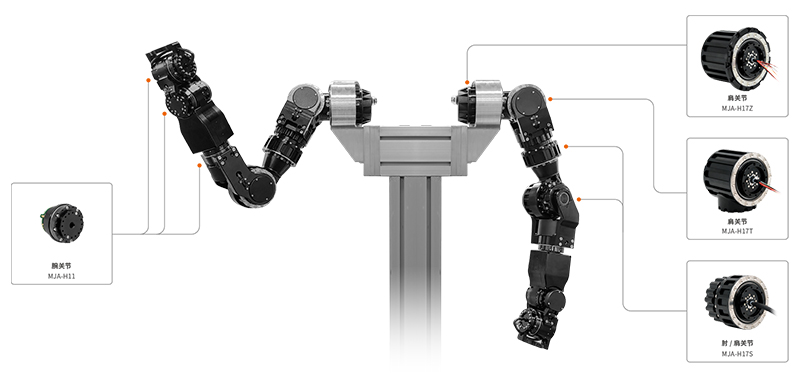
Humanoid robots place demanding requirements on joint lubrication. During dynamic motion, a shoulder joint can experience repeated impact, high-frequency oscillation, and rising internal temperature. These conditions are more severe than the steady loads used in many laboratory lubrication tests.
For a shoulder joint planetary reducer, the objective is not simply to reduce friction. The grease must maintain protective lubrication when load changes rapidly, preserve its structure under repeated shear, and retain enough base oil as temperature increases.
Impact Load: Rapid Protection at the Tooth Flank
When a robot takes a step or changes direction, load at the reducer teeth can rise quickly. The lubricant film may be challenged before a conventional chemical extreme-pressure reaction has fully developed. Repeated impact can therefore increase the risk of surface distress, micro-pitting, and metal-to-metal contact.
A grease formulation for this application should be evaluated for rapid load response and wear protection. Solid lubricants such as molybdenum disulfide or PTFE may provide an additional physical protection mechanism, but their suitability depends on the reducer design, materials, clearances, speed, and compatibility requirements. They should be validated through application-specific testing rather than selected by ingredient name alone.
High-Frequency Oscillation: Thickener Structure Matters
Shoulder movement subjects the grease to repeated shear. Over time, the thickener network can weaken, consistency can change, and the lubricant may become more vulnerable to displacement from the tooth flank.
A suitable grease should therefore be assessed through worked penetration, shear stability, and long-duration endurance testing. Complex lithium thickener systems may offer better structural retention than conventional systems in some applications, but the final selection must be based on measured performance under the customer’s actual speed, load, temperature, and operating cycle.
Temperature Accumulation: Retaining Base Oil During Operation
Continuous dynamic motion can raise the temperature inside a compact joint housing. As temperature increases, base-oil viscosity decreases and oil separation or evaporation may accelerate. If too much base oil is lost, the grease can harden and the reducer may move toward inadequate boundary lubrication.
Important evaluation items include high-temperature oil separation, evaporation loss, oxidation resistance, torque behavior, and compatibility with seals and reducer materials. These tests should be conducted using the same or equivalent operating conditions as the target joint instead of relying only on general product data.
Why Track Conditions Differ from Bench Tests
A steady-state bench test may not reproduce the combined stress of a dynamic humanoid robot joint. Field conditions can involve transient impact, repeated oscillation, temperature accumulation, and changing load direction at the same time. A grease that performs well under one condition may still fail when all of these factors interact.
For this reason, selection should follow a complete validation process:
- Define the reducer type, materials, speed, load, duty cycle, temperature range, and sealing conditions.
- Screen candidate greases for wear protection, shear stability, oil retention, evaporation, and compatibility.
- Run endurance testing with representative motion profiles and load changes.
- Inspect torque, noise, temperature, wear debris, and tooth surfaces after testing.
- Confirm the final lubrication specification before production release.
A Practical Selection Direction
Humanoid robot shoulder joint grease should be selected as part of the complete reducer system. A formulation may combine rapid load protection, a stable thickener structure, and strong high-temperature oil retention, but these properties must be balanced against torque, noise, material compatibility, and service-life targets.
Vnovo supports application-based grease customization for specialty lubrication requirements. Share the reducer type, materials, speed, load, operating temperature, motion profile, and target service life for a technical review and sample-testing recommendation.