

By VNOVO Technical Support Team
Rubber and elastomeric components – O-rings, seals, gaskets, bushings, diaphragms – rely on precise dimensions and material properties. When a lubricant is incompatible with the rubber, the result is swelling, shrinkage, hardening, or cracking, and the component fails. Selecting rubber-compatible grease is about ensuring the grease does not degrade the very component it is meant to protect.
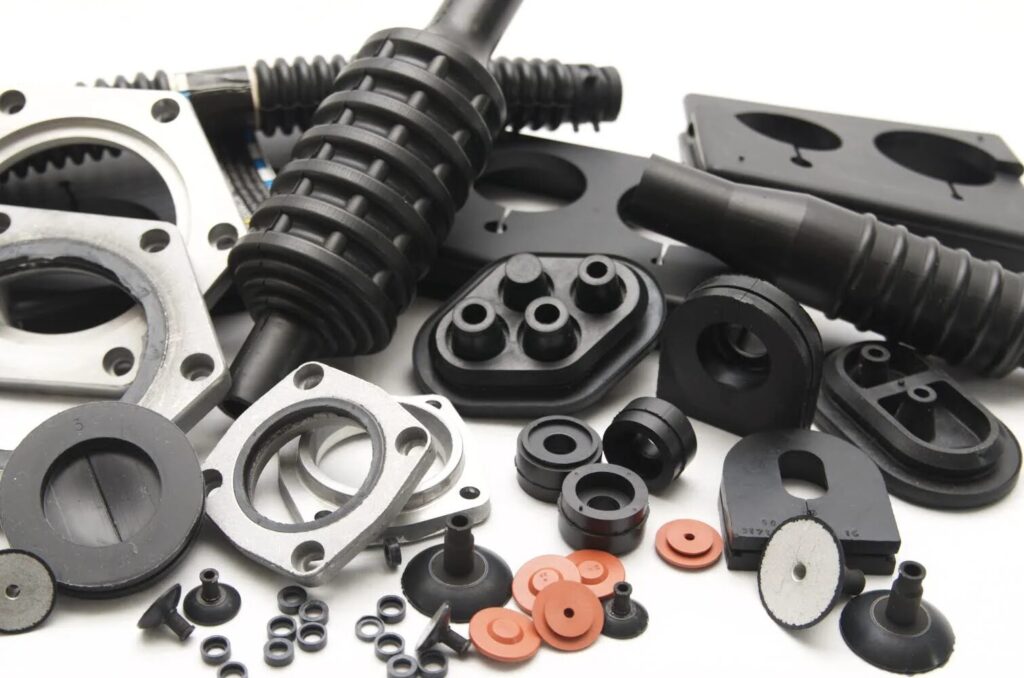
What Makes Rubber Component Applications Demanding for Rubber-Compatible Grease?
Rubber components present specific challenges:
– Diverse elastomer types. Equipment uses many elastomers – NBR, EPDM, FKM (Viton), silicone (VMQ), CR, HNBR, Aflas. Each has different chemical resistance. A grease compatible with NBR may swell EPDM; one safe for FKM may harden VMQ. There is no universal rubber-compatible grease.
– Dimensional sensitivity. O-rings depend on precise compression dimensions. Even 2-5% swelling from lubricant absorption causes over-compression, friction increase, and premature wear. Shrinkage creates leak paths.
– Dynamic and static sealing. Dynamic seals need consistent lubrication during sliding. Static seals need protection without long-term property changes.
– Wide temperature range. Rubber components face -40 °C to 150+ °C. The grease must be compatible across this range.
– Long-term exposure. Seals are installed once and operate for years. The grease remains in continuous rubber contact, so even slow incompatibility accumulates.
– Assembly lubrication. During installation, O-rings must slide into position without damage. The grease prevents rolling, nicking, or twisting, then transitions to long-term protection.
– Mixed-material contact. Rubber contacts metal and sometimes plastic. The grease must lubricate these interfaces while maintaining rubber compatibility.
Why Do Rubber Component Problems Persist Even When Grease Is Applied?
Six failure modes continue to cause issues:
1. Elastomer swelling from incompatible base oil. Mineral oils swell EPDM and VMQ excessively. Ester-based greases can swell or soften certain rubbers, causing over-compression and seal failure.
2. Elastomer shrinkage and hardening. Some formulations extract plasticizers, causing shrinkage, hardening, and loss of sealing force – particularly with aggressive synthetic oils on certain grades.
3. Additive-induced degradation. EP additives and anti-oxidants in general-purpose greases can chemically attack rubber, causing cracking or surface degradation.
4. Incompatibility varying by compound grade. Even within the same family (e.g., NBR), different compound formulations respond differently. Compatibility data for one NBR compound does not guarantee the same for another.
5. Grease drying or migrating from the seal. Some greases dry out or leave the contact zone, removing protection and increasing friction and wear.
6. Assuming silicone grease works with all rubber. Silicone is compatible with many elastomers but not universal – some FKM and specialty compounds may not be compatible.
What Properties Determine Whether a Grease Is Truly Rubber-Compatible?
Key properties:
– Base oil chemistry. Silicone greases are broadly compatible with EPDM, NBR, VMQ, CR but not universally with FKM. PAO greases suit NBR/HNBR but may swell EPDM. PFPE greases offer the broadest compatibility across virtually all elastomers but at higher cost.
– Controlled swelling behavior. Some rubber-compatible greases cause slight swelling (e.g., MOLYKOTE 55 O-Ring Grease), enhancing seal tightness. Others are designed for zero swell. The application determines which is appropriate.
– Additive formulation. Rubber-compatible greases minimize additives that could attack elastomers – particularly EP additives, sulfur compounds, and aggressive anti-oxidants.
– Temperature range. Must cover the full range without changing compatibility. Phenyl silicone oils (e.g., MOLYKOTE 822M) extend silicone capability to 200 °C while maintaining EPDM compatibility.
– Long-term stability. Must not dry, separate, or change composition over years of continuous rubber contact.
– Assembly lubrication performance. Must provide lubricity for O-ring installation without causing seal rolling.
How to Select the Right Rubber-Compatible Grease for Your Application
Step 1 – Identify the elastomer type:
| Elastomer | Common Uses | Known Sensitivities |
| NBR / HNBR | O-rings, shaft seals, fuel seals | Swells in ester oils; compatible with PAO and mineral |
| EPDM | Weather seals, brake seals, steam seals | Swells in mineral oil and hydrocarbons; use silicone, PAG, or PFPE |
| FKM (Viton) | High-temp seals, chemical-resistant seals | Resistant to most oils; verify silicone compatibility |
| VMQ (silicone rubber) | High-temp static seals, medical | Swells in hydrocarbon oils; use silicone or PFPE |
| CR (neoprene) | General seals, vibration dampers | Moderate resistance; verify with specific formulation |
Step 2 – Select base oil chemistry: EPDM → silicone, PAG, or PFPE. NBR → PAO, silicone, or mineral. FKM → PAO, PFPE, or fluorosilicone. VMQ → silicone or PFPE. Multiple elastomers → PFPE for broadest compatibility.
Step 3 – Verify with the specific compound: Confirm compatibility with the actual compound, not just the generic elastomer family.
Quick Reference: Selection Guide
| Elastomer / Condition | Key Properties | Direction |
| NBR / HNBR seals | PAO or mineral compatible, low swell | PAO-based rubber-compatible grease |
| EPDM seals | Non-hydrocarbon, low swell | Silicone or PAG-based; not mineral oil |
| FKM (Viton) seals | High-temp, broad resistance | PAO or PFPE; verify silicone compatibility |
| VMQ (silicone rubber) | Non-hydrocarbon, high-temp | Silicone grease or PFPE; not hydrocarbon |
| Multiple elastomers | Broadest compatibility | PFPE-based (broadest elastomer compatibility) |
| O-ring assembly aid | Slight swell acceptable, installation lubricity | Silicone-based O-ring grease (slight-swell type) |
How VNOVO Provides Technical Support
VNOVO does not supply off-the-shelf “rubber-compatible grease” with universal claims:
Application-Oriented Selection Guidance – VNOVO reviews your elastomer type(s), operating conditions, and functional requirements (sealing, assembly, long-term protection), mapping them against formulation categories to recommend base oil chemistry, thickener type, controlled-swell behavior, and verification approach.
Material Compatibility Verification – VNOVO helps assess candidates against the specific elastomer compound(s) – not just generic families – with emphasis on swelling behavior, hardness change, and long-term property retention.
Scenario-Based Communication Support – VNOVO provides rationales explaining *why* a direction is suggested, what trade-offs exist (silicone = broad EPDM/VMQ compatibility but may not suit FKM vs. PAO = good NBR compatibility but swells EPDM vs. PFPE = broadest compatibility but highest cost; slight swell = tighter seal but higher friction vs. zero swell = lower friction but potentially less positive seal), and what validation steps to prioritize.
Conclusion
When to use specialized rubber-compatible grease
When the application involves elastomeric seals where swelling, shrinkage, or hardening would compromise function, when multiple elastomer types require a single compatible formulation, or when long-term seal life depends on consistent grease-rubber interaction.
When a general-purpose approach may suffice
When the elastomer is highly resistant (FKM with PAO, NBR with mineral oil) with known compatibility, conditions are moderate with short service intervals, or the component is not dimensionally sensitive (non-sealing bushings, dampers).
What VNOVO can support
1. Selection guidance – translating elastomer type, conditions, and requirements into base oil chemistry, thickener type, and swell behavior
2. Material matching – assessing compatibility between candidates and the specific elastomer compounds in your application
3. Scenario communication – providing the technical rationale and decision framework to specify, validate, and apply the right rubber-compatible grease for your components
*This article is provided for informational purposes based on publicly available industry references and established lubrication engineering principles. Specific product selection should always be verified against the component manufacturer’s guidelines, OEM recommendations, lubricant supplier compatibility data, and application-specific testing.*