
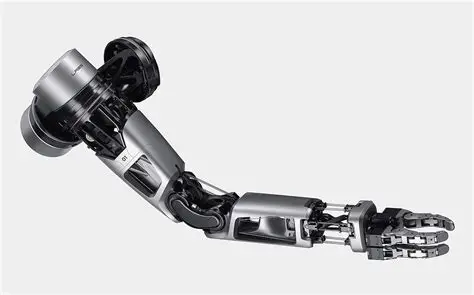
In humanoid robot shoulder joints, planetary reducers bear multiple tasks: high load, high frequency, high precision. Most shoulder joint reducers are designed sealed, maintenance-free, filled once and used for life.
When engineers select grease, they usually focus on hard indicators: EP anti-wear, oil separation rate, low-temperature torque, consistency grade. All correct. But one indicator is often overlooked — even absent from many specification sheets: evaporation loss.
Evaporation loss is simply the mass percentage of base oil that slowly volatilizes under high-temperature environments. Testing method is typically GB/T 7325: heated at 99°C for 22 hours, measuring mass loss rate. The smaller the number, the less base oil escapes.
How Hot Does the Shoulder Joint Actually Get?
During lifting actions in humanoid robot shoulder joints, peak torque often exceeds 100 N·m, and planetary reducer internal gear mesh friction generates significant heat. Combined with sealed joint cavity and poor heat dissipation, internal temperature easily reaches 60–80°C during continuous operation, and can hit 120°C under instantaneous impact conditions.
Base oil evaporation rate has exponential relationship with temperature — roughly every 10°C increase doubles the volatilization rate. Evaporation rate at 80°C is several times that at 50°C.
This means: an evaporation loss value that looks fine in a lab at room temperature becomes very “sensitive” under actual shoulder joint conditions.
What Does 1.0% Evaporation Loss Actually Mean?
Assuming a grease has evaporation loss of 1.0% (99°C/22h). Sounds small, right? But note: this value is the result of a specific high-temperature short-time test, not the total loss during actual use.
Rough engineering estimate: base oil typically comprises 70–90% of grease by mass, take 80% as example. At 80°C inside the shoulder joint cavity, if volatilization rate follows Arrhenius-type temperature dependence, cumulative evaporation loss after 8,000 hours of continuous operation (approximately one year of industrial use) can reach 8–12% of original oil quantity.
This is not a negligible number.
What Happens When Base Oil Escapes?
Base oil is the component in grease that actually provides lubrication. Thickeners (PTFE, lithium soap, polyurea) are just “sponges” responsible for adsorbing and holding base oil in place. When base oil volatilizes in large quantities:
- **Grease hardens.** Thickener proportion relatively increases, grease cone penetration drops, becoming like dried mud. This causes torque surge at low temperature or start-up, motor requires greater current to rotate, affecting energy consumption and response speed.
- **Oil film thins.** Effective lubricating oil film on tooth surfaces decreases, transitioning from mixed lubrication toward boundary lubrication or even partial dry friction. Tooth surface micro-pitting risk greatly increases.
- **Contaminant generation.** Evaporated oil vapor may condense on cooler inner housing surfaces, forming oil films or droplets that contaminate encoders, Hall sensors, or motor windings, causing signal interference or insulation problems.
The process is slow and gradual — not sudden failure one day, but performance declining bit by bit.
Oil Separation vs. Evaporation: Two Different Oil-Loss Channels
Many engineers know to focus on oil separation rate. Oil separation is base oil separating from thickener under mechanical shear and gravity, then seeping out through seals or contact surfaces. Good seals largely control oil separation.
But evaporation is different. Evaporation is base oil molecules directly vaporizing from the grease surface — no external channels needed. Seals cannot block gas molecules. High-evaporation-loss grease, even with perfect sealing, silently “loses weight” under long-term high temperature.
For sealed maintenance-free shoulder joint planetary reducers, evaporation loss is equally important as oil separation rate — and because it is more concealed, it deserves extra attention.
Selection Recommendation: Control Evaporation Loss Within 0.5–1.0%
Industry reference threshold for robot joint reducer long-life grease: evaporation loss (99°C/22h) should be controlled within 0.5–1.0%. The more you pursue continuous operation exceeding one year without maintenance, the closer you should lean toward 0.5%.
VNOVO SYN150 shoulder bearing dedicated grease has evaporation loss <1.0% (99°C/22h), oil separation rate ≤5%, operating temperature -30~180°C, wear scar diameter 0.46 mm — effectively slowing base oil volatilization under long-term thermal conditions.
If you are conducting bench life tests on shoulder joint planetary reducers, or already have some field operation data, try disassembling to check: Is the grease harder and darker than initial state? Any condensed oil stains inside the housing? Has cone penetration noticeably decreased before and after operation? These phenomena likely indicate evaporation loss at work.