

33 hours, 45,000 parcels, averaging 1,364 items per hour, with a complete pick-and-place cycle of approximately 2.6 seconds per item.
This was the continuous operation test completed by Figure 03 at a logistics sorting center. From an engineering perspective, the significance of this number lies not in ‘the robot can do the work,’ but in the fact that it pushes the operating conditions of dexterous hand planetary reducers into a domain that has never been systematically discussed before—the lubricating grease adaptability issue under non-uniform velocity fields.
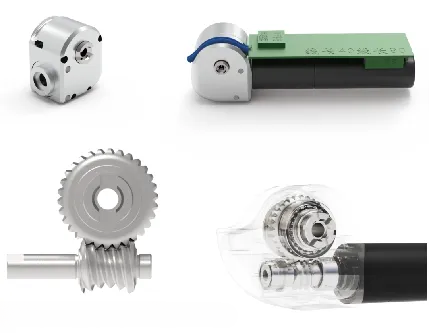
The velocity field of a planetary reducer is not uniform
In a typical single-stage planetary reducer, the sun gear rotates actively, driving three planet gears in simultaneous motion: revolution around the sun gear’s axis and rotation around their own axes. The ring gear remains fixed, so there is always relative motion between the planet gear tooth surfaces and the ring gear tooth surfaces.
The key point is that this relative sliding velocity along the tooth profile direction is not constant. Because the planet gear’s orbital velocity is constant while the tangential speed of its rotation combines vectorially with the orbital velocity differently at the tooth root and tooth tip, the relative sliding velocity gradually increases from tooth root to tooth tip, with extreme ratios typically ranging from 2:1 to 3:1, and even higher under extreme operating conditions.
This creates a problem that has rarely been discussed before: after the same grease enters the mesh zone, it experiences vastly different shear rates at different positions. The high-speed zone requires the grease to rapidly decrease viscosity under high shear to form a hydrodynamic oil film; the low-speed heavy-load zone requires viscosity to remain relatively high to maintain oil film load-bearing capacity. Traditional grease selection typically focuses only on EP performance and oil-bleeding rate, overlooking the matching requirements that velocity field differences impose on the grease.
The rheological characteristics of the grease become critical here
Grease is a non-Newtonian fluid whose viscosity varies with shear rate, a behavior typically described by the power-law equation τ = K·γ̇ⁿ. When the shear-thinning index n < 1, the grease’s viscosity decreases at high shear rates, which theoretically benefits oil film formation in high-speed zones.
But the n value is only one aspect of the problem. Thixotropy—the rate at which grease recovers its viscosity after shearing—is equally crucial.
In planetary reducers with high-frequency start-stop cycles, the grease is repeatedly sheared: it is in a high-shear state when entering the mesh zone, and the shear rate drops sharply when exiting. If the thixotropic recovery time is too long, the oil film in the low-speed heavy-load zone will be deficient before viscosity is fully restored; if recovery is too fast, viscosity remains high when entering the high-speed zone, making it impossible to establish hydrodynamic lubrication.
This means the grease’s rheological curve must simultaneously satisfy two opposing requirements: sufficiently low dynamic viscosity in the high-speed zone, and sufficiently high static viscosity in the low-speed zone. The balance between the two depends on the synergistic interaction between the shear-thinning index and thixotropic recovery time.
Figure 03’s 45,000 cycles amplify this contradiction
Returning to Figure 03’s specific operating conditions: 1,364 items per hour, 2.6 seconds per item. Using conservative estimates, the planetary reducer completes approximately 6,000 mesh cycles per hour, totaling approximately 200,000 cycles over 33 hours.
Each cycle subjects the grease to a complete shear-recovery process. If the grease’s shear stability is insufficient and viscosity cannot fully recover after each cycle, the base viscosity will continuously decay, and the overall oil film will gradually thin.
More insidiously, after the high-speed tooth-tip zone fails first, the load it was carrying transfers to the tooth-root area, creating local overload—this is a typical manifestation of mismatched grease rheology and velocity field at high cycle counts. This also explains why the same grease exhibits drastically different service life on planetary reducers with different velocity field characteristics.
Add one more dimension during selection
In traditional selection workflows, engineers typically focus on core parameters such as EP performance, oil-bleeding rate, cone penetration, and evaporation loss. These indicators measure the grease’s ‘absolute performance,’ but they do not directly reflect the degree of matching between the grease and a specific velocity field.
For transmission components like dexterous hand planetary reducers, which feature high direction-reversal frequency, small module sizes, and enclosed spaces, it is recommended to add an additional evaluation dimension beyond conventional indicators: grease viscosity stability across a wide shear rate range and its thixotropic recovery characteristics.
Some fluorinated oil PTFE greases (such as VNOVO X500) optimized for complex velocity fields were designed with consideration for viscosity stability and thixotropy balance across a wide shear rate range. Evaluating this dimension typically requires communication with the supplier or monitoring the grease’s cone penetration change curve during bench testing—focusing on viscosity decay trends across different cycle counts rather than a single static value at a given point in time.
When selecting dexterous hand or small planetary reducer configurations, have you paid attention to the matching between grease rheological characteristics and tooth surface velocity fields? Have you encountered cases where high-speed zone wear morphology differs from low-speed zone wear morphology? Feel free to share and exchange experiences.