

Fishing reels operate in conditions that few other precision mechanisms face. Freshwater and saltwater exposure, sand contamination, wide temperature swings, and long periods without maintenance all place heavy demands on internal lubrication. Inside every spinning reel, baitcaster, or conventional reel, gears, bearings, shafts, and drag components must work together smoothly. The lubricant used in these areas plays a major role in reel performance, corrosion resistance, and service life.
Why Fishing Reels Need Specialized Lubricants
Fishing reel lubricants must do more than reduce friction.
They must resist water washout, protect against corrosion, remain compatible with mixed materials, and preserve the smooth mechanical feel that anglers expect. This is especially important in reels that combine stainless bearings, brass or bronze gears, aluminum housings, and plastic bushings in one compact assembly. In many cases, the original grease and oil are expected to last for an entire season or longer without replenishment.
What Makes Fishing Reel Lubrication So Demanding
A fishing reel may be exposed to freshwater, saltwater, sand, silt, fish residue, and repeated start-stop motion in a single trip.
Saltwater is especially aggressive because chloride ions accelerate corrosion on steel bearings, brass gears, and aluminum bodies. Sand and fine debris can mix with degraded lubricant and become an abrasive paste. Temperature also matters. Reels may be used in sub-zero ice fishing conditions or in tropical heat, and the lubricant must remain workable across that range.
At the same time, anglers judge reel quality by smoothness. Handle feel, startup resistance, gear noise, and drag consistency are all influenced by lubrication choice.
Why Reel Lubrication Problems Still Happen
Even when grease is applied, lubrication failures are still common.
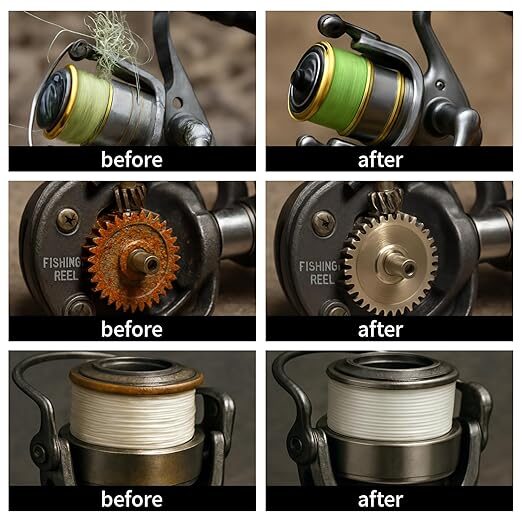
One reason is saltwater corrosion. Standard greases may not provide enough corrosion protection for marine conditions. Another is washout. In surf casting, wading, or repeated splashing, grease with poor adhesion can be displaced from critical parts.
A third problem is abrasive wear. When sand mixes with softened grease, the lubricant becomes a grinding medium. In addition, many users apply grease where oil is needed, or oil where grease is needed. Grease belongs on main gear and pinion meshes, and sometimes in loaded bearings. Oil is more suitable for high-speed spool bearings and light pivots where grease would create drag.
Material compatibility is another issue. Sulfur-containing EP additives may stain or damage yellow metals such as brass and bronze if not properly controlled. Over-greasing can also increase resistance and attract debris, especially in exposed reel designs.
What Properties Matter Most in Fishing Reel Grease and Oil
For fishing reel grease, the most important properties are:
- water washout resistance
- corrosion inhibition
- salt spray resistance for marine use
- load-carrying capacity for gears under load
- NLGI consistency, usually around Grade 2
- tack and adhesion to stay in place under water exposure and rotation
For reel oils, the key factors are:
- viscosity at 40 °C
- low-temperature fluidity
- water displacement ability
Material compatibility must also be checked carefully. Brass and bronze gears require sulfur-free or yellow-metal-safe formulations. Stainless bearings are generally less sensitive, but additive packages still matter. Aluminum bodies should avoid corrosive chemistries, while POM, nylon, and PTFE bushings require plastic compatibility. Drag washers also need special attention, since many are designed to run dry or with minimal lubrication depending on OEM guidance.
How to Choose the Right Lubricant for Each Reel Part
The first step is to identify the lubrication point.
Main gear and pinion gear: use grease with load-carrying ability, corrosion resistance, and yellow-metal compatibility.
Spool bearings: use low-viscosity oil only. Grease should not be used here because it increases drag.
Handle-side bearings and pivots: use light grease or oil depending on speed and load.
Drag systems: follow OEM guidance carefully. In many reels, too much lubricant causes drag inconsistency rather than improvement.
Environment also matters.
For freshwater reels, a water-resistant grease and corrosion-inhibited oil are often sufficient.
For light saltwater use, washout resistance and corrosion protection become more important.
For heavy saltwater or offshore use, marine-grade grease with strong salt-spray protection is usually necessary.
For ice fishing, synthetic oils and greases with verified low-temperature performance are preferred.
For sandy environments, tack and adhesion matter more, but cleaning frequency must also increase.
Fishing Reel Lubricant Selection by Reel Type
Spinning reel — freshwater: prioritize water resistance and yellow-metal-safe grease, plus light oil for bearings.
Spinning reel — saltwater: prioritize washout resistance, marine corrosion control, and tack.
Baitcasting reel — freshwater: use gear grease for the gear train and light oil for the spool system.
Conventional trolling reel — offshore: choose heavy marine grease with strong corrosion protection.
Ice fishing reel: use synthetic lubricants that remain fluid at very low temperatures.
Fly reel: focus on corrosion resistance and drag-system compatibility, noting that many disc drags follow OEM dry-running specifications.
How VNOVO Supports Fishing Reel Lubricant Selection
VNOVO supports fishing reel lubricant selection in three practical ways.
First, it provides selection guidance based on reel type, environment, service expectations, and OEM requirements. Second, it helps with material matching, especially for brass gears, stainless bearings, aluminum frames, polymer bushings, and drag materials. Third, it offers scenario-based communication, helping users understand why a lubricant direction suits a given fishing style, what trade-offs exist, and how maintenance frequency should change between freshwater and saltwater use.
When Specialized Reel Lubricants Are Necessary
Specialized fishing reel lubricants are the better choice when reels face regular saltwater exposure, contain yellow-metal gears, operate in very cold conditions, or represent high-value equipment where performance and durability matter.
Standard lubricants may be acceptable for freshwater-only use, lower-cost reels, light recreational use, or cases where OEM guidance already specifies a conventional product and re-service intervals are short.