
By VNOVO Technical Support Team
Inside its compact aluminum housing, a thin-walled flexible steel ring — the flexspline — continuously flexes as an elliptical wave generator rotates, engaging a rigid circular spline across a controlled arc of tooth contact. The result is zero backlash, high torque density, and precision positioning — making harmonic drives the dominant transmission in collaborative robots, articulated arms, and aerospace actuation systems.
That same flexspline cycling behavior makes harmonic reducer lubrication fundamentally different from standard industrial gearbox lubrication.
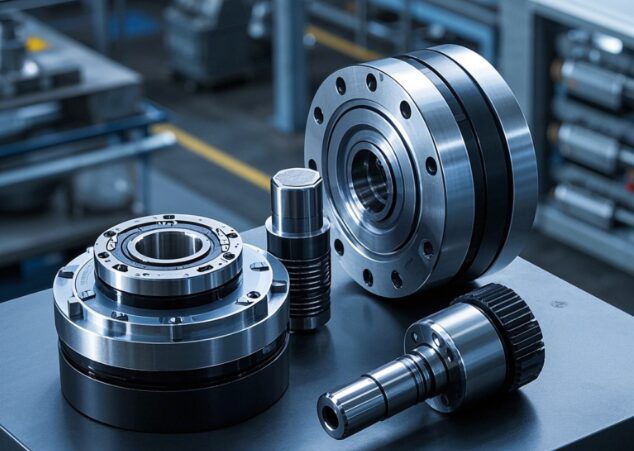
What Makes Harmonic Reducer Lubrication Distinct from Standard Industrial Gearbox Lubrication?
Three characteristics set harmonic reducer lubrication apart. The flexspline deforms with every rotation — the grease must maintain a stable film under this cyclic loading without structural breakdown. Harmonic reducers are factory-filled and sealed for their operational lifetime — the grease must remain functional for the unit’s entire service without hardening, softening, or migrating. The housing is typically aluminum while the flexspline and bearings are steel — mineral oils and certain ester-based greases can cause aluminum swelling or degrade seals in extended sealed service.
Why Do Harmonic Reducers Still Experience Torque Variation, Noise, and Premature Bearing Failure?
Field complaints cluster around four failure modes. Reduced torque capacity: grease degradation reduces film thickness at tooth contacts, degrading transmissible torque. Wave generator bearing failure: grease that softens, hardens, or bleeds at operating temperature fails to protect the bearings. Noise and positional error: inadequate film allows metal-to-metal contact, producing measurable noise and positional error. Aluminum and seal incompatibility: greases not formulated for aluminum housings can cause swelling or seal degradation over extended sealed service.
What Properties Distinguish a Grease Formulated for Harmonic Reducer Applications?
Base oil viscosity and viscosity index (VI). A base oil in the range of 100 to 200 cSt at 40 degrees C provides adequate film thickness for harmonic reducer gear teeth without excessive drag. A VI above 130 ensures the oil does not thin excessively at operating temperature or thicken unacceptably at cold start — both directly affecting torque consistency.
Thickener mechanical stability under flexing conditions. The thickener structure must resist cracking or displacement under repeated deformation. Polyurea-thickened greases and select lithium-complex-thickened greases have demonstrated mechanical stability suited to this cyclic loading environment.
Anti-wear additives without corrosive components. AW additives — typically ZDDP or equivalent — form protective tribochemical films on steel surfaces under boundary lubrication. EP packages should be evaluated for copper alloy compatibility and should not contain active sulfur chemistry that could attack aluminum over extended sealed service.
Aluminum and seal material compatibility. All candidate greases should be verified for compatibility with aluminum housing and the seal compounds used in the specific reducer design.
How to Select the Right Gear Grease for a Harmonic Reducer Application
Step 1 — Follow the OEM specification. Confirm the OEM viscosity grade, base oil type, thickener, and NLGI consistency. Any deviation should be validated through testing.
Step 2 — Define the operating temperature range. Determine minimum and maximum operating temperatures, including transient peaks, to govern base oil chemistry and required viscosity index.
Step 3 — Verify material compatibility. Confirm the candidate grease is compatible with the aluminum housing, steel flexspline and bearings, and seal compounds in the assembly.
Step 4 — Match thickener system to flexing demands. For higher flexspline stress or continuous duty cycles, prioritize thickener systems with demonstrated mechanical stability under cyclic loading — polyurea-thickened or lithium-complex-thickened greases are common directions for precision applications.
Step 5 — Validate torque performance. Where the application involves precise torque transmission, prototype testing with the selected lubricant is recommended to confirm starting torque, running torque, and torque variation fall within acceptable ranges.
Quick Reference: Gear Grease Selection for Harmonic Reducer Applications
| Application Scenario | Base Oil Direction | Thickener Direction | Key Properties |
| Collaborative robot joint (standard duty, -10 to 60 degC) | PAO, VI above 130 | Polyurea or Li-complex | Long-life, aluminum compatible, low torque variation |
| Industrial articulated arm servo (moderate duty, -15 to 80 degC) | PAO or PAO-ester blend | Li-complex | Oxidation stability, AW additives, torque consistency |
| High-precision positioning stage | Low-viscosity PAO, VI above 140 | Polyurea | Minimal torque variation, excellent film stability |
| High-temperature or near-motor installation (up to 100 degC) | PAO with high VI | Polyurea or synthetic-compatible thickener | Thermal stability, high VI, extended seal life |
How VNOVO Provides Technical Support for Harmonic Reducer Gear Grease Selection
VNOVO does not supply a single product marketed as a universal harmonic reducer grease. The appropriate grease depends on the reducer design, OEM specification, operating temperature range, and torque requirements of the application.
Application-Oriented Selection Guidance: VNOVO reviews harmonic reducer type, operating conditions, temperature range, and torque requirements, mapping them against established grease formulation categories. The output is a directional recommendation covering base oil chemistry, viscosity grade, thickener system, NLGI consistency, and additive priorities.
Material Compatibility Assessment: VNOVO assists in verifying compatibility between candidate greases and the aluminum housing, steel flexspline and bearings, and seal compounds used in the specific design, including evaluation of ester base oil compatibility with aluminum and specific elastomer compounds.
Formulation Trade-off Analysis: VNOVO provides technical rationale for formulation direction — explaining, for example, why polyurea thickeners are preferred for their mechanical stability under cyclic flexing, and what validation steps are appropriate before committing to a lubricant for sealed lifetime service.
Conclusion: When to Specify Gear Grease for Harmonic Reducers, When Not to, and What VNOVO Can Help With
When gear grease for harmonic reducers is the right specification: when the application operates within the rated temperature range of a PAO- or synthetic-ester-based grease with appropriate thickener; when the OEM specification permits an equivalent alternative; when all contacting materials have been verified; and when prototype torque testing confirms acceptable starting torque, running torque, and torque variation.
When an alternative approach may be more appropriate: when operating temperature exceeds the practical range of available grease options; when the OEM explicitly prohibits lubricant substitution; or when the application involves thermal transients that a grease film cannot adequately manage.
What VNOVO can support: directional formulation guidance — matching base oil chemistry, viscosity grade, thickener system, and additive package to the specific harmonic reducer design and operating conditions; material compatibility assessment — verifying grease candidates against aluminum housing, steel components, and seal compounds; and validation planning — identifying verification steps, including torque testing and aging protocols, to confirm that a selected grease meets sealed-lifetime application requirements.
This article is provided for informational purposes based on publicly available industry references and established lubrication engineering principles. Specific product selection for harmonic reducer applications should always be verified against the manufacturer’s guidelines, OEM specifications, lubricant supplier technical data sheets, and application testing.