
Gear grease for electric motor gearboxes is a thickened lubricant formulated to reduce friction, resist tooth wear, and stay in the gear mesh under churning and centrifugal throw-off.
Use it in sealed planetary, spur, or worm gearboxes where oil leakage is a concern or where the unit is sealed for life.
Do not use grease in high-speed industrial gearboxes designed for oil bath lubrication, in open gear drives requiring a tacky coating, or in food-processing equipment unless the grease holds NSF H1 registration.
How do planetary gearboxes in power tool motors operate, and what lubrication do they need?
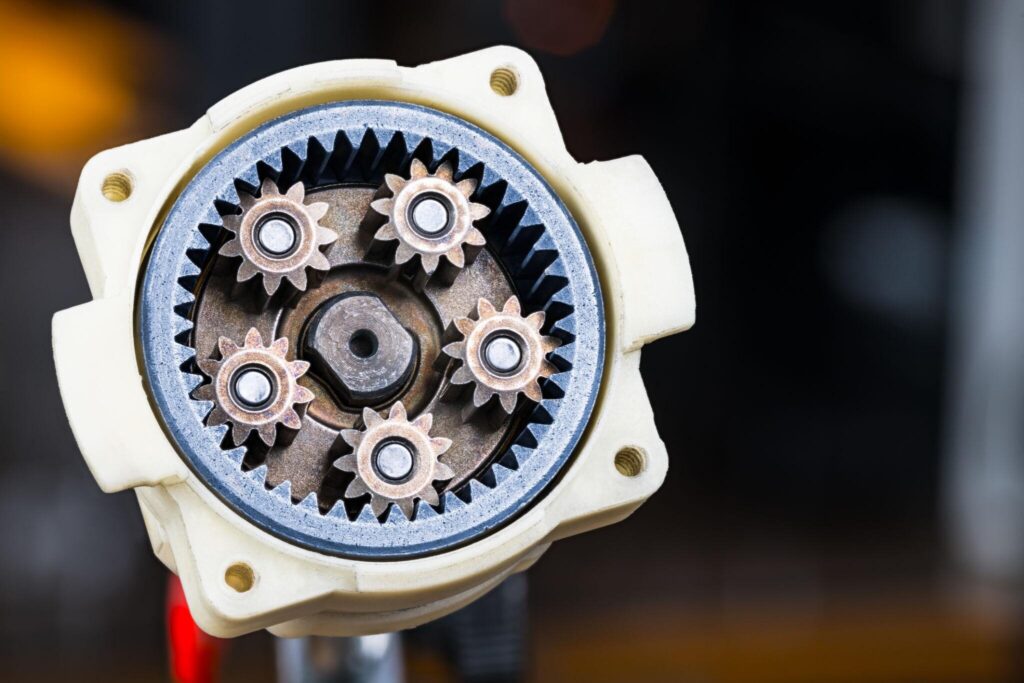
Power tools transmit motor output through a planetary reduction gearbox before reaching the chuck or spindle.
The train typically consists of a sun gear driven by the motor, three to five planet gears on a carrier, and a ring gear fixed to the housing, achieving gear ratios from 5:1 to 60:1 in a small-diameter casing.
The gearbox is sealed at assembly and not intended to be opened. Grease is the standard lubricant because it stays in place under churning and centrifugal force without a sump, pump, or shaft seals.
Why do power tool gearboxes fail even though they are sealed at the factory?
Three mechanisms shorten sealed gearbox life.
Thermal breakdown: motor and gear friction generate heat; if the grease oxidises above its upper service temperature, it hardens and cannot flow back to the mesh.
Oil separation: prolonged high-speed operation causes the thickener to release base oil, which pools at the housing bottom while the mesh runs dry, accelerating tooth wear and noise.
Mechanical stability loss: continuous shearing by the planet gears softens the grease structure. A product that was NLGI Grade 2 at assembly may thin to near-fluid, reducing mesh retention and increasing leakage risk through the output shaft bearing.
What properties should a gear grease deliver to keep a sealed planetary gearbox running over its design life?
A gear grease for this application must satisfy four requirements.
- Thermal stability: the grease must resist oxidation and evaporation at housing temperatures during sustained load. Synthetic base oils and lithium complex thickeners outperform mineral oil and simple lithium soap in this regard.
- Mechanical stability: the grease must retain its NLGI consistency under continuous shear.
- Oil separation resistance: the thickener must hold base oil within its matrix, measured by oil separation loss per ASTM D6184.
- Wear protection: the grease must provide adequate film strength at tooth contact to prevent scuffing and scoring. EP additives such as organic molybdenum improve load-carrying capacity.
NLGI Grade 0.5 to 2 is the typical consistency range for sealed-for-life gearboxes, as noted in industry gear grease application guides.
Gear Grease Selection Table for Sealed Motor Planetary Gearboxes
| Operating condition | Recommended grease type | Technical basis |
| Cordless drill / impact driver, intermittent duty, motor temp up to 80-100 deg C | Synthetic EP gear grease, NLGI 2, Li complex | Thermal and shear stability; EP additive for tooth wear; consistent backflow under churning |
| Angle grinder / high-speed tool, continuous duty, elevated temp, vibration | Synthetic EP gear grease, NLGI 0.5-1, Li complex, high dropping point | Lower NLGI grade improves backflow at speed; dropping point above 250 deg C (ISO 6299) prevents softening |
| Low-noise application, plastic or metal gears, low-temperature use | Low-noise gear grease, NLGI 1-2, PTFE or MoS2 | Low friction coefficient reduces mesh vibration; verify plastic compatibility before use |
| General-purpose motor gearbox, light load, infrequent use | White lithium grease, NLGI 2, standard lithium | Adequate film for light-load gears; cost-effective for consumer-grade motor gearboxes |
What technical support does VNOVO provide for gear grease selection in motor gearbox applications?
VNOVO supports power tool OEMs and motor gearbox manufacturers through three channels.
1. Formulation matching
VNOVO evaluates gearbox type, gear material, temperature range, and duty cycle, then recommends a grease from its product range.
VNOVO SYN220 is a synthetic EP gear grease with lithium complex thickener and organic molybdenum additive, rated minus 40 to 150 degrees C with a dropping point of 322 degrees C per ISO 6299, NLGI Grade 2 per ASTM D217, and oil separation loss below 0.57 percent per ASTM D6184, suited to sealed planetary gearboxes in cordless drills, electric hoists, and reduction mechanisms.
VNOVO SYN177 is a softer NLGI Grade 0.5 power tool grease rated minus 30 to 200 degrees C with a 260-degree-C dropping point, for higher-speed gearboxes where improved grease backflow is required.
2. Material compatibility review
VNOVO engineers review grease compatibility with gear and housing materials, including POM, PA, and PEEK plastic gears and aluminium or zinc housings, to confirm the grease will not cause stress cracking, swelling, or degradation of gear or seal components.
3. Application guidance
VNOVO provides written guidance on fill quantity and method for sealed-for-life gearbox assembly to avoid overfilling and excessive churning heat.
When should you use gear grease for motor gearboxes, and when should you choose a different lubricant?
Use gear grease:
- the gearbox is a sealed planetary, spur, or worm gearbox in power tools, small motors, and reduction mechanisms
- the unit is closed at assembly and not intended for relubrication
- the housing cannot retain oil
- the duty cycle is intermittent start-stop
- gear mesh noise reduction is a design priority
Do not use grease:
- the gearbox is designed for oil bath lubrication
- the application is an open gear drive requiring a heavy-tack coating
- the motor gearbox is used in food-processing equipment unless the grease carries NSF H1 registration
VNOVO supports gear grease decisions through formulation matching to gearbox type and duty cycle, material compatibility review for plastic and metal substrates, and direct technical communication for assembly guidance.
Contact the VNOVO technical team through your local distributor or at www.vnovo.com.