
By VNOVO Technical Support Team
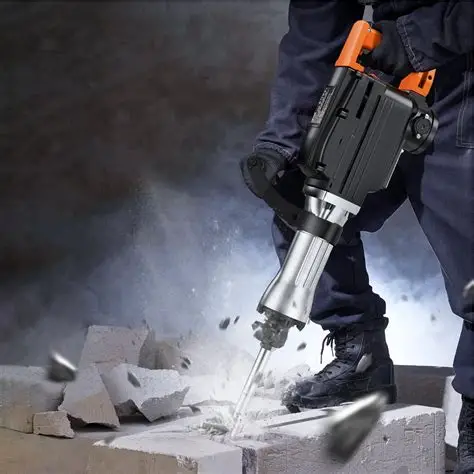
Rotary hammers and demolition hammers are among the most demanding power tool applications for gear lubrication. Inside, a motor drives a gear train that converts rotary motion into high-frequency percussion – delivering thousands of impacts per minute into concrete and masonry. The gears face simultaneous high load, high speed, shock impact, and continuous vibration. The right gear grease determines whether the tool survives its service environment.
What Makes Rotary Hammer and Demolition Hammer Gear Lubrication So Demanding?
– Simultaneous high load and high speed. The gear train transmits motor torque to both the rotary output and the percussion mechanism, under continuous heavy load at speeds generating significant frictional heat.
– Shock and impact loading. The percussion mechanism creates cyclic impulsive loads transmitted back through the gear train.
– Continuous vibration. The entire tool vibrates at high frequency. Vibration can cause grease to migrate from the gear mesh or separate under mechanical agitation.
– High operating temperature. Motor heat and gear friction raise internal temperatures. Greases unable to withstand these temperatures oxidize, forming acids that attack metal surfaces.
– Frequent start-stop cycling. Each start creates a boundary-lubrication condition before the gear train reaches operating speed. The grease must protect during these transitions.
Why Do Rotary Hammer Gear Problems Persist Even When Grease Is Applied?
1. Grease displaced by vibration. Low-tack greases are progressively shaken from the gear mesh, leaving gears to run dry.
2. Oxidation at operating temperature. Conventional lithium greases oxidize, forming acids that attack gear surfaces.
3. Film collapse under shock load. Greases without extreme pressure (EP) additives fail under impulsive loads, allowing metal-to-metal contact.
4. Excessive churning. Greases too stiff create high churning resistance, reducing efficiency and generating additional heat.
5. Oil separation under vibration. Constant vibration accelerates oil separation, leaving dry thickener in the mesh.
6. Incompatibility with seals or bushings. Some EP additives attack copper alloy bushings or swell elastomer seals.
What Properties Make a Gear Grease Suitable for Rotary Hammers and Demolition Hammers?
– EP protection under shock load. Nye specifies that “lubricants fortified with extreme pressure additives can help support heavy loads by creating a barrier between connecting surfaces.” Synthetic ester greases are particularly suited for heavily loaded metal-on-metal wear.
– Shear stability under vibration. Must resist mechanical degradation from vibration without thinning or separating. Nye’s Rheolube 380 is recommended for metal gearing “exposed to high loads, speeds, and temperatures.”
– Appropriate NLGI grade. NLGI 2 balances mesh retention with acceptable churning. NLGI 1 (e.g., Rheolube 380-G1) may be used where better flow is needed.
– Thermal and oxidative stability. Synthetic base oils (synthetic esters, PAO) resist oxidation far better than mineral oils, avoiding acid formation at sustained operating temperatures.
– Tackiness, water resistance, and copper-safe EP. High adhesion keeps grease on gear teeth despite vibration. Construction-site exposure demands water resistance. EP additives must be sulfur-free where copper alloy bushings are present.
How to Select the Right Gear Grease for Rotary Hammers and Demolition Hammers
Step 1 – Identify tool conditions:
| Tool Type | Typical Conditions | Key Requirement |
| SDS-Plus rotary hammer | Medium impact, high speed | EP, shear stability, NLGI 2 |
| SDS-Max rotary hammer | Heavy impact, moderate speed | High EP, shock load resistance |
| Demolition hammer | Maximum impact, low speed | Max EP, adhesion, NLGI 1-2 |
| Cordless rotary hammer | Compact, weight-sensitive | Low churning, efficiency, NLGI 1-2 |
| Combination hammer | Variable mode (drill/hammer/both) | Versatile EP, wide temperature |
Step 2 – Match formulation: SDS-Plus → synthetic ester EP, NLGI 2. SDS-Max → high-EP, NLGI 2. Demolition → max EP, tacky, NLGI 1-2. Cordless → low-churning NLGI 1-2. Combination → versatile EP, -40 to 130 °C.
Step 3 – Verify: Confirm EP under shock loading. Confirm shear stability after vibration. Confirm copper alloy and seal compatibility. Confirm low-temperature startup.
Quick Reference: Gear Grease for Rotary/Demolition Hammers
| Tool Type | Grease Priority | Direction |
| SDS-Plus rotary hammer | EP + shear stability | Synthetic ester EP, NLGI 2 |
| SDS-Max rotary hammer | High EP + shock load | High-EP ester, NLGI 2 |
| Demolition hammer | Max EP + adhesion | Tacky high-EP, NLGI 1-2 |
| Cordless rotary hammer | Low churning + EP | Soft NLGI 1-2, efficiency grade |
| Combination hammer | Versatile EP + wide temp | Multi-mode EP, -40 to 130 °C |
How VNOVO Provides Technical Support
VNOVO does not supply off-the-shelf “gear grease” with universal claims:
Application-Oriented Selection Guidance – VNOVO reviews your tool type, impact class, operating temperature, and service life target, recommending EP level, base oil type, NLGI grade, and temperature range.
Material Compatibility Verification – VNOVO helps assess candidates against steel gears, copper alloy bushings, and elastomer seals – confirming no copper corrosion and no seal swelling.
Scenario-Based Communication Support – VNOVO provides rationales explaining *why* a direction is suggested, what trade-offs exist (higher EP = better shock protection but risk to copper if sulfur-based vs. sulfur-free EP = copper-safe; NLGI 2 = stays in mesh but higher churning vs. NLGI 1 = better flow but higher oil separation), and what validation to prioritize.
Conclusion
When to use specialized gear grease in rotary hammers and demolition hammers
When the gear train operates under simultaneous high load, high speed, and shock impact, when vibration would displace conventional grease, or when the sealed-for-life gearbox demands a single fill for the tool’s entire service life.
When a general-purpose grease may be acceptable
When the tool operates at light duty with low impact energy, when the gearbox runs cool, and when shock loading is absent.
What VNOVO can support
1. Selection guidance – translating tool type and operating conditions into EP level, NLGI grade, and base oil type
2. Material matching – assessing compatibility between gear grease candidates and steel, copper, and elastomer components
3. Scenario communication – providing the rationale to specify, test, and validate the right gear grease for your rotary hammers and demolition hammers*This article is provided for informational purposes based on industry references and power tool gear lubrication principles. Specific product selection should always be verified through shock-load EP testing, vibration shear stability testing, and material compatibility confirmation