
By VNOVO Technical Support Team
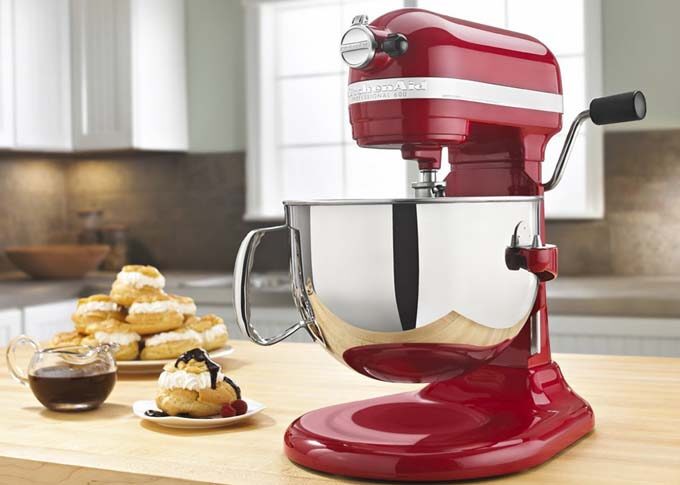
A stand mixer kneads dough, whips cream, and mixes batter for hours at a time. Inside the mixer head, a planetary gear system, transmission shafts, and seals work under continuous load – millimeters from the food being prepared. If the lubricant migrates past the seal, it becomes a direct food contaminant. Food-grade silicone grease – formulated with NSF H1-registered ingredients and inherently compatible with rubber and plastic components – addresses this risk while providing the thermal stability, water resistance, and low-temperature performance that stand mixer internals demand.
What Makes Stand Mixer Lubrication a Food-Safety and Engineering Challenge?
– Direct food-contact proximity. The transmission shaft seal sits above the mixing bowl. Any lubricant migrating past the seal can drip into food. NSF H1 registration confirms ingredients comply with FDA 21 CFR 178.3570 and are safe for incidental contact.
– Continuous high-load operation. Kneading bread dough places sustained torque on planetary gears. The grease must maintain film without being squeezed from the mesh.
– Elevated temperature. Motor heat and friction raise internal temperatures to 60-80 °C. Grease must not soften excessively or separate.
– Water and steam exposure. Washing the mixer head, steam from hot mixtures, and humid environments expose the seal and grease to moisture.
– EPDM seal compatibility. Shaft seals are typically EPDM or NBR. PAO-based greases can swell EPDM; silicone formulations are inherently compatible. Per Klüber’s beverage reference, EPDM-compatible H1 lubricants are specifically required where this elastomer is present.
– Low-temperature startup. Mixers stored in cold kitchens must start smoothly. Grease must not stiffen excessively at low temperatures.
– Years without service. Grease must resist separation, oxidation, and degradation over thousands of hours.
Why Do Stand Mixer Lubrication Problems Persist Even When Grease Is Applied?
1. Non-food-grade grease. Conventional lithium grease lacks NSF H1 registration. Migration past the seal creates a food safety non-compliance.
2. EPDM swelling from incompatible base oil. PAO and mineral oil-based greases swell EPDM, compromising the seal and accelerating leakage toward the food zone.
3. Grease softening at operating temperature. Conventional lithium grease may soften significantly at 60-80 °C, reducing ability to stay in place.
4. Water emulsification. Non-silicone greases may emulsify with water, losing consistency and allowing migration.
5. Oil separation. Low-quality greases separate; base oil migrates along the shaft toward the food zone.
6. Stiff cold startup. Lithium and calcium complex greases can become stiff below 10 °C, causing rough startup.
What Properties Make Food-Grade Silicone Grease Suitable for Stand Mixers?
– NSF H1 registration. Ingredients comply with FDA 21 CFR 178.3570 – the regulatory foundation for stand mixer lubrication.
– Inherent EPDM compatibility. Silicone oil does not swell or degrade EPDM, NBR, or most mixer seal elastomers – the key differentiator from PAO and mineral oil. Per MOLYKOTE’s silicone reference, silicone compounds serve “rubber lubrication in either static or dynamic applications.”
– Wide temperature range. Silicone greases function from approximately -40 °C to over 200 °C. Phenylmethyl silicones (MOLYKOTE reference) maintain performance to approximately -73 °C – covering cold startup through sustained high-load operation.
– Water resistance. Hydrophobic and insoluble in water. Do not emulsify, wash away, or lose adhesion in humid or wet conditions.
– Thermal stability. Silicone oils resist oxidation far better than mineral oils. They do not carbonize at service temperatures.
– Low volatility. Low vapor pressure means minimal evaporative loss. Grease stays where applied.
– Chemical inertness. Odorless, tasteless, and chemically inert – essential where any odor or taste transfer is unacceptable.
– PTFE-fortified options. Silicone-PTFE formulations (such as PARALIQ GTE 703, referenced for EPDM-compatible H1 applications) add wear protection for loaded gears while maintaining all silicone benefits.
How to Select the Right Food-Grade Silicone Grease for Stand Mixers
Step 1 – Identify mixer component conditions:
| Mixer Component | Typical Conditions | Key Requirement |
| Planetary gear system | High load, 60-80 °C | NSF H1, EPDM compatible, load-carrying |
| Transmission shaft seal | Food-zone adjacent, wet | NSF H1, zero migration, water resistant |
| Speed selector | Light load, frequent use | Low friction, quiet, long life |
| Bowl lift mechanism | Moderate load, intermittent | Corrosion protection, smooth |
| Motor bearing | Continuous, high temp | NSF H1, thermal stability, long life |
| Attachment hub | Intermittent, varied loads | EPDM compatible, multi-material |
Step 2 – Match formulation: Seals and gears → silicone-PTFE H1 for load + EPDM compatibility. Motor bearing → food-grade polyurea H1 for long-term bearing performance. Light mechanisms → pure silicone compound H1.
Step 3 – Verify: Confirm NSF H1. Confirm EPDM compatibility. Confirm load-carrying at temperature. Confirm water resistance. Confirm no odor or taste transfer.
Quick Reference: Food-Grade Silicone Grease for Stand Mixers
| Mixer Component | Grease Type | Direction |
| Planetary gears | Silicone-PTFE H1 | Load-carrying, EPDM compatible |
| Shaft seal area | Silicone compound H1 | Zero migration, water resistant |
| Speed selector | Silicone compound H1 | Low friction, quiet |
| Bowl lift | Silicone H1 / calcium complex H1 | Corrosion protection |
| Motor bearing | Polyurea H1 (not silicone) | Long-term bearing life |
| Attachment hub | Silicone compound H1 | Multi-material compatible |
How VNOVO Provides Technical Support
VNOVO does not supply off-the-shelf “food-grade silicone grease” with universal claims:
Application-Oriented Selection Guidance – VNOVO reviews your mixer component type, load conditions, operating temperature, seal material, and food-contact proximity, recommending base oil type, thickener, PTFE fortification level, and compliance registration.
Material Compatibility Verification – VNOVO helps assess candidates against specific seal elastomers (EPDM, NBR, FKM), plastic components, and metal substrates – confirming no swelling, degradation, or adhesion loss, with particular attention to the EPDM shaft seal.
Scenario-Based Communication Support – VNOVO provides rationales explaining *why* a direction is suggested, what trade-offs exist (silicone = EPDM compatible and water resistant but lower load than PAO vs. PAO = higher load but swells EPDM vs. PTFE-fortified silicone = wear protection while maintaining compatibility; pure silicone compound = best seal lubrication vs. silicone-PTFE = better gear protection), and what validation to prioritize – including EPDM immersion testing and migration resistance assessment.
Conclusion
When to use food-grade silicone grease in stand mixers
When the component is adjacent to the food zone and migration is possible, when EPDM seals must not be swollen, when water and steam would degrade conventional greases, or when wide temperature capability is required from cold startup to sustained high-load operation.
When a non-silicone food-grade grease may be appropriate
When the component is fully enclosed with no food-contact pathway (e.g., motor bearing), when loads exceed silicone grease capacity, and when EPDM compatibility is not a concern – a food-grade polyurea or calcium complex grease may offer superior bearing performance.
What VNOVO can support
1. Selection guidance – translating mixer component type, load, temperature, and seal material into grease formulation and compliance level
2. Material matching – assessing compatibility between food-grade silicone grease candidates and specific elastomer seals, plastics, and metals
3. Scenario communication – providing the rationale to specify, test, and validate the right food-grade silicone grease for your stand mixers
*This article is provided for informational purposes based on industry references and food-grade silicone lubrication principles. Specific product selection should always be verified through NSF H1 registration confirmation, EPDM compatibility testing, and migration assessment.*