

The Failure Statistics Behind the Headline
The source reports that more than 60% of operating failures in joint modules are related to vibration and noise. Before any lubrication discussion, it lists four root causes: transmission accuracy deviation, structural design deficiency, assembly process deviation, and working-condition mismatch. Lubricant failure does not create these problems, but it amplifies all of them. A gear set that runs quietly with a healthy film becomes audible as soon as the film degrades, which is why vibration complaints cluster in joints where the grease was chosen without regard to the operating window.
Why Gears and Grease Generate Noise
Within a meshing pair, the tooth-tip sliding speed can reach 2-3 times the speed at the tooth root, so the film condition varies along the same tooth flank. The source stresses that both too-low and too-high viscosity cause noise: too low a viscosity leaves the film too thin, allowing metal contact; too high a viscosity increases viscous drag and can starve the contact at the operating speed. When the film breaks down, the friction coefficient can jump from about 0.02 under good lubrication to above 0.08 under dry friction, a fourfold increase that shows up as vibration and accelerated wear. This makes viscosity selection a noise-control decision, not just a wear decision.
Sealed Maintenance-Free Grease: The Red Lines
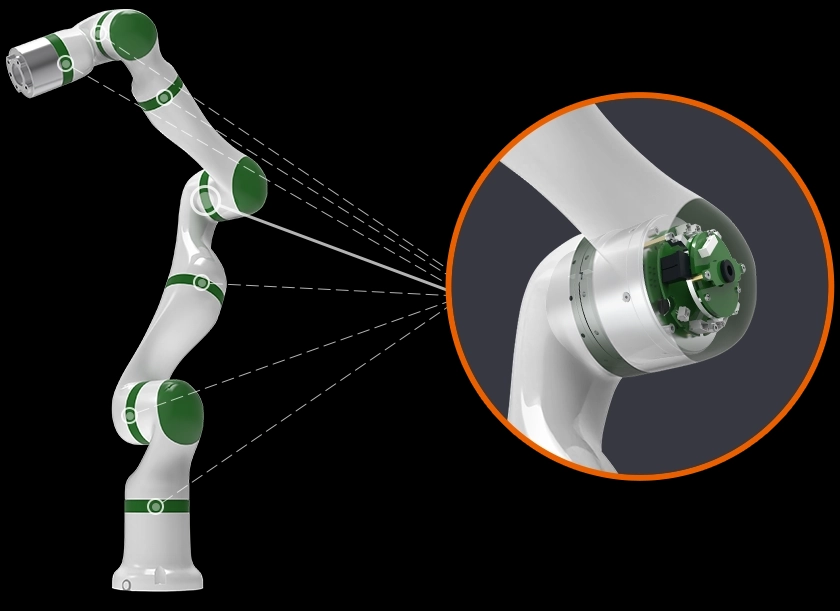
Joint modules are typically sealed for life, so the grease must survive without re-lubrication. The source sets out three red lines for such sealed systems: an oil separation rate no higher than 5% at 100°C for 24 hours, an evaporation loss no higher than 1.0% at 99°C for 22 hours, and a cone penetration change no greater than 15% after 10,000 working cycles. The operating temperature window of -30 to 180°C is given as the design envelope. Any grease that exceeds these limits will eventually leave the contact dry, and the vibration returns.
Wide-Temperature Damping as a Design Lever
Because vibration is the complaint, the source recommends considering the viscoelastic damping of the grease: a grease that keeps a stable structure across the temperature window absorbs micro-vibrations at the meshing interface instead of transmitting them. This damping behavior is tied to thickener structure and consistency, which is why shear stability (the penetration change limit) matters as much as oil properties. A grease that softens at high temperature loses both film and damping at once.
Validation / Selection Conclusion
Select grease for sealed joint modules by checking the three red lines first: oil separation, evaporation loss, and shear stability. Then run noise and temperature validation across the full -30 to 180°C envelope, and confirm the friction coefficient stays low during dry-start and cold-start events. The source’s message is that lubrication is a multiplier: it cannot fix a bad transmission, but it can amplify or suppress the noise that every other defect produces. Measure noise on the actual joint, not on a bench, and re-test after the 10,000-cycle shear mark.