
The hinge mechanism in a spring-assisted knife is compact, sealed, and demanding
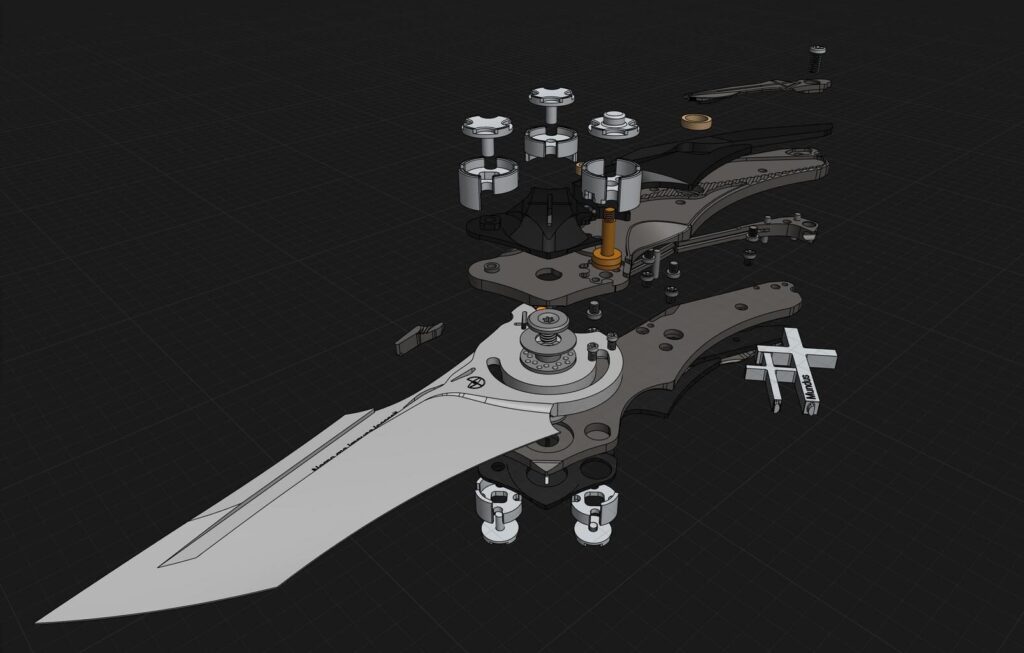
A spring-assisted knife uses a torsion bar or leaf spring built into the pivot to help propel the blade open once the user initiates deployment. The spring, pivot bearing, and detent ball are all located inside a compact hinge assembly that is difficult to relubricate in the field. Over the life of the knife, the blade may deploy hundreds or even thousands of times, and each cycle subjects the lubricant to shear, compression, and contamination. To keep the hinge operating smoothly, the lubricant must remain in place, resist degradation, and stay compatible with the surrounding materials.
Conventional oils and greases can create problems in a knife hinge
Traditional mineral oils and general-purpose greases are often not ideal for this kind of application.
Evaporation and migration
A conventional mineral oil applied to the pivot may gradually migrate out of the hinge and onto the blade or into the handle. After weeks or months of regular use, the pivot may feel dry and the deployment action can become slower. Frequent reapplication is possible, but in practice most users do not maintain a knife hinge that often.
Thermal instability
A knife carried outdoors in summer or left inside a vehicle can easily see temperatures above 50°C. Mineral oils may begin to degrade not far above that range, while PFPE oils remain stable at temperatures up to around 260°C.
Material incompatibility
Spring-assisted knives may include stainless steel liners, titanium scales, polymer washers, and detents. Some oils and greases contain additives or base oils that can damage certain plastics, causing swelling or brittleness over time. PFPE avoids this issue because it is chemically inert toward most metals, plastics, and elastomers used in knife construction.
PFPE lubricants match the demands of knife hinge lubrication
Perfluoropolyether, or PFPE, is a fully fluorinated synthetic fluid composed only of carbon, fluorine, and oxygen atoms. This structure gives PFPE a set of characteristics that make it especially suitable for knife hinge lubrication.
Wide temperature range
PFPE oils can operate from approximately -90°C to +250°C without significant changes in viscosity or chemical structure. This allows a knife lubricated with PFPE to deploy consistently in cold weather while still resisting lubricant breakdown in high-temperature conditions.
Chemical inertness
PFPE does not react with acids, alkalis, most solvents, fuels, or oxidising agents. It is also compatible with the metals, plastics, and elastomers commonly used in knife assemblies.
Low volatility and long service life
PFPE oils have extremely low vapour pressure, so they do not readily evaporate under normal or elevated temperatures. A small amount applied to a knife pivot can remain in place for a long time without drying out. Combined with the oxidation resistance of a fully fluorinated molecule, this gives PFPE a much longer service life than conventional hydrocarbon oils and greases.
Low friction
PFPE-based greases thickened with PTFE can achieve a coefficient of friction at or below 0.05. In practical terms, this supports smooth and consistent blade deployment with minimal resistance at the pivot.
PFPE must be used in the right form and in the right amount
For knife hinges, PFPE is typically used in two forms. A low-viscosity PFPE oil is suitable for disassembled pivots where the lubricant can reach the bearing surfaces directly. A PFPE grease thickened with PTFE, typically around NLGI 1 or 2, is often more practical for field application because it stays at the pivot and is less likely to migrate into the handle.
Application is straightforward: apply a small amount to the pivot pin and detent ball channel, cycle the blade several times, and wipe away any excess. Because PFPE is compatible with surrounding materials, it can be applied without risking damage to the knife assembly.
How VNOVO supports PFPE lubricant selection for knife hinge applications
VNOVO provides technical support for selecting PFPE lubricants in precision hinge and spring mechanism applications. This support includes guidance on matching product form, viscosity, and consistency to hinge geometry and operating conditions. It also includes material compatibility assessment to confirm that the lubricant is safe for the metals, plastics, and elastomers used in the assembly.
In addition, VNOVO helps customers align lubricant specifications with temperature exposure, duty cycle, and expected service life. Process and packaging consultation is also available to support both assembly-line use and field-service lubrication procedures.
When PFPE is the right choice—and when it is not
Use PFPE lubricant when:
- the hinge is sealed or difficult to relubricate in the field
- the knife may be exposed to extreme temperatures, moisture, or chemical contaminants
- the hinge contains plastics or polymers that may not be compatible with hydrocarbon oils
- a clean, non-migrating lubricant is required that will not stain the handle or blade
Do not use PFPE lubricant when:
- the application requires load-carrying performance beyond what a PTFE-thickened PFPE grease can provide
- the cost is not justified for a disposable or low-durability component
- the original manufacturer has specified a different validated lubricant
In either case, VNOVO can support the selection process through application review, material matching, and operating-condition analysis to determine whether PFPE is the correct lubricant for a specific hinge mechanism and service environment.