

By VNOVO Technical Support Team
Keywords: Speed Field, Grease Life, Shear Stability, Thixotropic Recovery, PFPE
Last week, Figure AI released a piece of data that lit up my social media for days.
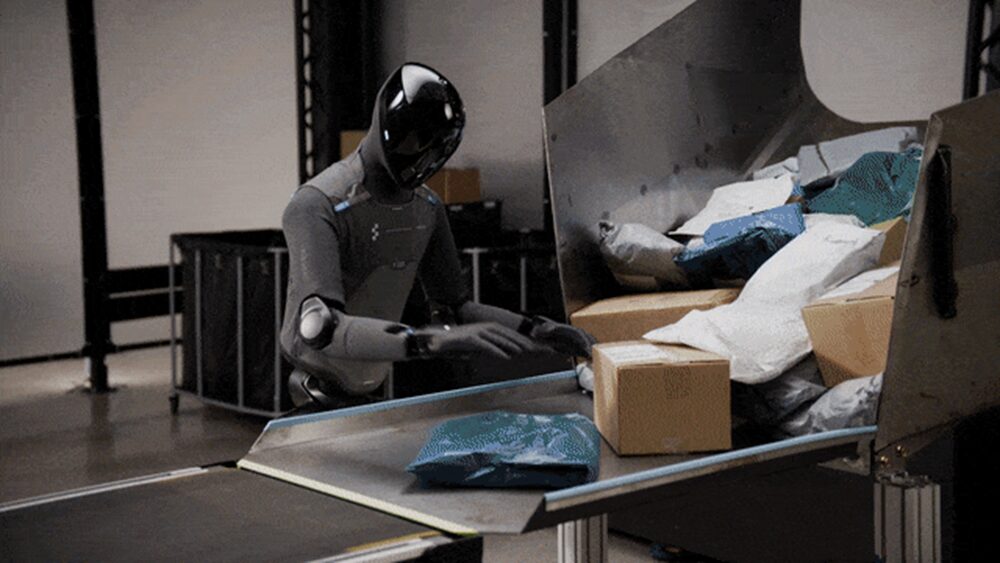
Figure 03 operated continuously for 33 hours at a logistics sorting center, processing 45,000 packages. 1,364 packages per hour, each complete cycle approximately 2.6 seconds. Four standard work shifts — all crammed into one robot. No downtime. No maintenance.
Honestly, this number excited me. But my immediate second reaction was —
There is a problem the industry collectively overlooks, and it is more worth noting than the production number itself.
45,000 packages correspond to approximately 200,000 complete meshing cycles. Each cycle, grease undergoes shear, recovery, and re-shear. Tens of thousands of cycles overlay — problems normally overlooked become impossible to hide.
But what truly unsettles me is not Figure 03 itself — it is that in the same month, at the Beijing Yizhuang Humanoid Robot Half Marathon, 70+ robots raced at night. At Shenzhen CITE2026, dozens of robot companies exhibited side by side. Industry attention is entirely on “how long can robots run” — but nobody asks: how long can they endure?
There Is an Failure Chain, Not a “Snap”
The speed field in a dexterous hand planetary reducer is inherently non-uniform. Each planet gear simultaneously does two things: revolves around the sun gear and rotates around its own axis. The internal tooth ring is fixed, so the relative slip velocity between planet gear and internal tooth ring tooth surfaces depends on the vector sum of these two motions.
The key point: this slip velocity varies along the tooth profile direction. From tooth root to tooth tip, vector angle changes, slip velocity gradually increases — tooth tip is typically 2 to 3 times tooth root, with extreme conditions even greater.
This creates a problem: the same grease entering the mesh zone experiences completely different shear rates at different tooth surface positions.
High-speed zone requires grease to rapidly decrease viscosity under high shear, forming a thin oil film. Low-speed heavy-load zone requires viscosity to remain at a higher level, ensuring load-bearing capacity. The directions are opposite. Traditional selection only focuses on “absolute indicators” like extreme pressure and oil separation rate — basically no direct response to this problem.
Grease is a non-Newtonian fluid. Viscosity changes with shear rate, described by the power-law equation τ = K·γ̇ⁿ. When shear thinning index n < 1, viscosity decreases at high shear, helping oil film form in high-speed zones.
But n value is only one aspect. Thixotropy — the speed at which viscosity recovers after shear — is equally important.
In high-frequency start-stop planetary reducers, grease is repeatedly sheared. If thixotropic recovery time is too long, viscosity has not recovered before entering the next high-speed zone, and elastohydrodynamic lubrication cannot be established. If recovery is too fast, the low-speed zone oil film may be too thin.
Therefore, grease rheological curves must simultaneously satisfy two opposing requirements: dynamic viscosity must be low in high-speed zones, and static viscosity must be high in low-speed zones.
This failure chain progresses in three steps:
Step 1: Speed field difference causes high-zone grease to fail first. Tooth tip slip velocity is 2–3× tooth root. Under high shear, viscosity stays low, oil film is thin. If this grease’s thixotropic recovery time is long, viscosity has not fully recovered upon exiting the mesh zone, and next entry into the high-speed zone cannot establish elastohydrodynamic lubrication.
Step 2: Load secretly shifts to low-speed zone. After tooth tip high-speed zone fails, the load it originally shared transfers to the tooth root area, forming local overload. Micro-cracks appear under alternating load at the tooth root, silently initiating.
Step 3: Oil film continuously attenuates, crack propagation accelerates. 33 hours ≈ 200,000 meshing cycles. Each cycle, grease undergoes a complete shear-recovery cycle. If shear stability is insufficient, viscosity cannot fully recover after each cycle, base viscosity continuously attenuates, and overall oil film thins.
Reference data: When a tooth root has an initial crack of 0.3–0.5mm, good lubrication can delay extension for over tens of thousands of hours. After lubrication fails, it can develop to the tooth breakage threshold within a few thousand hours. For a humanoid robot planned for commercial operation, this could mean just a few months.
Grease Characteristics Become Critical Here
The same grease performs with completely different life on planetary reducers with different speed field characteristics — the reason is often found here.
Conventional indicators — extreme pressure, oil separation rate, cone penetration, evaporation loss — measure grease absolute performance but do not directly reflect grease’s matching degree with specific speed fields.
For dexterous hand planetary reducers with high reversal frequency, small module, and enclosed space, it is recommended to look beyond conventional indicators at one more dimension: grease viscosity stability and thixotropic recovery characteristics across wide shear rate ranges.
Specifically, grease needs to simultaneously function at three levels:
- **Tooth root penetration protection:** Grease needs to penetrate the tooth root zone, providing metal surface protection during boundary lubrication phase, preventing fretting wear from initiating initial cracks.
- **High-speed zone shear adaptation:** Grease maintains stable viscosity response across wide shear rate ranges — rapidly decreases viscosity at high shear to form thin oil film, timely recovers at low speed to maintain load-bearing capacity. This requires shear thinning index and thixotropic recovery time to work in coordination.
- **Long-life shear stability:** Synthetic base oil has strong antioxidant capacity, maintaining stable lubrication performance under high-temperature conditions, preventing crack acceleration due to continuously thinning oil film.
The X500 grease formulation is designed precisely with this logic — PFPE fluorinated oil base with -90°C to +250°C working temperature range, chemically inert to oxygen, ozone, and acid-base media, not easily degrading in complex environments over long periods. PTFE microparticles with ultra-low friction coefficient form a solid protective cushion on tooth surfaces at startup before oil film is established, avoiding metal direct contact causing initial damage.
Meanwhile, X500 cone penetration attenuation rate after 10,000 cycles is controlled within 15% (test conditions: room temperature 25°C, frequency 1Hz, load 500N), far better than ordinary mineral oil-based grease 30–50% attenuation level. This means under actual dexterous hand planetary reducer working conditions, X500 can extend grease replacement cycle by 2–3×, directly reducing maintenance frequency and downtime cost.
Closing
Industry is indeed focused on “how long robots run.” But the question of “how long they can endure” is equally critical. Figure 03’s 33-hour operation is impressive, but behind it is a lubrication system that must sustain 200,000 meshing cycles — and that is where the real engineering challenge lies.
Search “VNOVO” or visit our website for more information.