
The act of opening a trunk is becoming increasingly hands-free. Power liftgates have migrated from luxury trim to entry-level family SUVs — one press of the key fob and the gate swings open or closed. But behind that convenience sits a gearbox reduction mechanism performing high-frequency repetitive work every single day. Once the lubricant fails, tooth surface wear brings noise, hesitation, and in severe cases, motor burnout — turning the tailgate into a top source of aftermarket complaints.
How Does a Power Liftgate Gearbox Work?
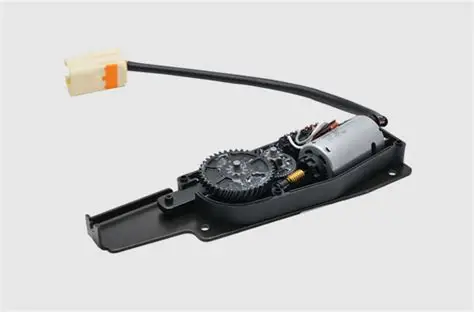
A power liftgate drive system has three components: a DC motor, a gearbox reduction mechanism, and an electric strut. The motor outputs approximately 3,000–5,000 rpm, which the gearbox reduces before delivering rotational motion through a leadscrew or rack-and-pinion mechanism, converting it to linear motion to open and close the tailgate.
Two mainstream approaches dominate the market:
- **Worm-and-wheel with leadscrew:** Strong self-locking — the gate will not drop under gravity when power is cut. High safety. The most common solution today.
- **Rack-and-pinion:** Higher transmission efficiency and lower noise, but requires an additional latching mechanism to prevent gate drop.
The gearbox and motor are integrated into a single unit mounted inside the tailgate, in a compact space requiring IP65 or higher protection. The industry standard QC/T 949-2013 mandates a minimum of 10,000 open/close cycles without functional failure or abnormal noise.
────────────────────────────────────────
Four Paths to Tooth Surface Wear
Path 1: Insufficient EP Capacity Causing Surface Crushing
With large tailgate area and concentrated weight — models with panoramic roofs can exceed 15 kg — wind loads impose instantaneous impact on the gearbox during travel. Peak contact stress at tooth surfaces reaches 300–500 MPa. Standard greases deplete their EP additives under this contact stress, the oil film collapses, and the tooth surface suffers plastic deformation and crushing pits.
Path 2: High-Frequency Start-Stop Initiating Fretting Wear
3–10 open/close cycles per day means the motor undergoes constant start-accelerate-decelerate-stop transitions, with gear teeth switching from loaded to unloaded state repeatedly. This is not steady-state friction — it is impact load combined with micro-slip: fretting wear. The amplitude is tiny (microns), but the frequency is extreme. Tooth surface fatigue cracks propagate from the edge inward, eventually forming pits or spalling.
Path 3: Seal Failure Causing Lubricant Emulsification
The tailgate sits near road level — the least sealed area of the vehicle. Rain, snow, and car wash moisture all infiltrate through seal edges. Once the seal ages, water mixes with lubricant, causing emulsification. Tooth surfaces run unprotected, and wear accelerates dramatically. Industry data shows lubricant loss from seal failure accounts for over 30% of all power liftgate gearbox complaints.
Path 4: Lubricant Performance Drift Under Wide Temperature Cycling
Summer cabin temperatures exceed 60°C after parking; winter cold regions reach -30°C. Ordinary greases see base oil viscosity change by more than 10× across this range — thick and resistant at low temperatures, thin with insufficient boundary film at high temperatures. After each thermal cycle, gears operate in progressively degraded lubrication condition.
────────────────────────────────────────
Five Core Parameters for Grease Selection
① Extreme-Pressure and Anti-Wear Performance (Hard Requirement)
With high tooth contact stress, grease PB value should be ≥392 N; premium products target ≥600 N. Four-ball machine wear scar diameter dw(60 min) ≤0.5 mm. Worm-and-wheel pairs, with their high proportion of sliding friction, demand even higher anti-wear performance than gear pairs.
② Wide-Temperature Stability
Across the -30°C to +80°C range, cone penetration change must stay within NLGI 0#–2# effective range. Polyurea or complex lithium-based greases offer significantly better wide-temperature stability than ordinary mineral oils.
③ Water and Rust Resistance
The last line of defense after seal failure — greases should pass ASTM D4049 water washout test and ASTM D1743 rust protection test. Complex calcium sulfonate thickened greases have natural advantages in water resistance.
④ Low-Noise Performance
Power liftgate gearbox noise requirement is ≤55 dB(A); premium models demand ≤50 dB(A). The high sliding friction proportion in worm-and-wheel pairs makes noise particularly prominent — grease must deliver both friction reduction and noise suppression.
⑤ Material Compatibility
Gearboxes involve aluminum alloy worms, steel worms, and plastic gears (POM, PA66). Grease must be compatible with all contacting materials without causing corrosion or swelling. Volume change ΔV should be controlled within ±5%.
────────────────────────────────────────
Conclusion
Tooth surface wear in power liftgate gearboxes is fundamentally a case of lubricant failing to maintain an effective oil film under extreme operating conditions. Prevention requires addressing waterproof sealing and thermal management at the design stage, while simultaneously evaluating EP performance, wide-temperature range, water resistance, and noise characteristics during selection — to eliminate wear and noise at the source.
────────────────────────────────────────
*If you are wrestling with power liftgate grease selection, or already seeing related complaints in the field, feel free to describe your specific operating conditions — tailgate weight, cycle frequency, and regional climate — in the comments. I can help analyze the most suitable lubrication solution for your situation.*