
As the core transmission components of automated precision equipment, THK ball screws and linear guides determine the operating efficiency of the equipment through their precision, life and stability. They are made up of core parts such as the screw, the guide rail, the balls and the nut, and because each part moves under different conditions and carries load in different ways, their lubrication pain points differ greatly. Most equipment failures come from uniform, coarse lubrication that does not match each part’s working conditions. Following THK’s original technical standards, this article breaks down the pain points of each part and gives a practical, dedicated lubrication plan.
1. Breaking Down the Core Components: Lubrication Pain Points by Part
1. Guide rail and slider: They complete linear reciprocating motion through circulating balls and carry impact loads over the long term. Dust from the working environment easily gets into the cavity, and ordinary grease has insufficient oil film strength, so the film is easily stripped and grease is lost, causing crawling and abnormal noise in the equipment. Over time, deposits clog the circulation circuit and directly reduce transmission precision.
2. Ball screw and nut pair: They carry the equipment’s continuous axial load, and the balls perform combined rolling and sliding friction inside the raceway. High-speed operation easily generates high temperature, causing the grease to dry and the base oil to evaporate; at low speed, stick-slip easily occurs and causes positioning deviation. Prolonged lack of oil causes irreversible damage such as raceway pitting and nut jamming.
3. Precision balls: As the core transmission medium, balls are small in size and carry extremely high contact stress. Even slight under-lubrication causes surface spalling, and the resulting metal debris in turn scratches the raceway, forming a vicious cycle that ultimately sends the entire ball screw and linear guide to early scrapping and greatly increases maintenance costs.
2. Original Standards: Putting a Targeted Lubrication Plan Into Practice
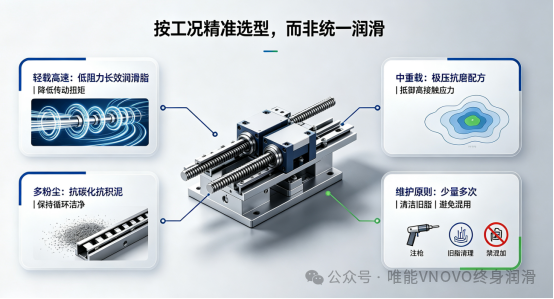
Following the original maker’s requirement to match lubrication to working conditions, reject one-size-fits-all lubrication and select precisely by need: for light-load, high-speed precision stations, choose a low-resistance, long-life grease to reduce transmission torque and safeguard precision operation; for medium and heavy loads, prioritize an extreme-pressure anti-wear formulation to withstand high-stress friction; for sites with dust and oil contamination, choose a lubricant that resists carbonization and mud buildup to keep the cavity clean. For daily maintenance, follow the “small amounts, many times” principle: before replenishing grease, thoroughly clean out the old grease, metal debris and dust, and never mix old and new grease, so that lubricating performance does not decay and problems such as wear, jamming and precision drift are avoided at the source.
3. Dedicated Fit: The VNOVO Precision Lubrication Solution
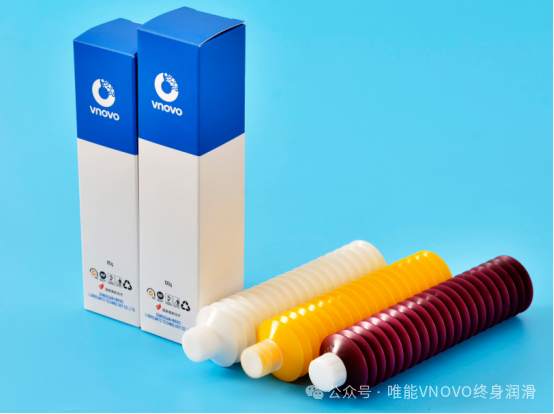
VNOVO precision lubricating grease is strictly matched to the original technical parameters of THK ball screws and linear guides. It uses a high-quality synthetic base oil and a compounded extreme-pressure anti-wear additive system, forming a tough oil film that resists loss and covers the contact surfaces of balls, raceways and guide rails for a long time, effectively suppressing wear, crawling noise and sludge buildup. The product offers excellent high- and low-temperature stability and suits machine tools, semiconductors, automated production lines and other scenarios. Long-lasting and free from frequent re-greasing, it keeps equipment running at high precision while greatly reducing maintenance frequency and consumable costs, giving precision transmission equipment long, stable endurance.