

Open up a dexterous hand micro planetary reducer and the grease color doesn’t look right. Replace the grease, keep running, or tear down and inspect?
Most judgments stop at “looking at the color” — dark is bad, light is fine. Color is a result, not a cause. What really needs judging is: what reactions are happening inside the grease, what those reactions mean for the gears, and whether at this stage the problem can still be solved by changing the grease.

The Chemical Pathways of Color Change
A grease’s color change is not a single cause; it is the result of three pathways advancing in parallel.
Base oil oxidation. Under high temperature and oxygen, the base oil first oxidizes into aldehydes, ketones and acids, then polymerizes into colored products. For every 10 to 15 degrees of temperature rise, the oxidation rate roughly doubles. The housing of a dexterous hand reducer is usually at 40 to 80 degrees, but micro-zone temperatures on the tooth surface can exceed 100 degrees. When the base oil oxidizes in these high-temperature micro-zones, colored products accumulate and the color gradually deepens.
Additive depletion. Under boundary lubrication conditions, extreme-pressure anti-wear additives react with the metal surface to form a protective film. The additives are consumed in this process. Once they are consumed to a certain degree, extreme-pressure performance drops, metal contact increases and wear accelerates.
Metal wear particle generation. Metal debris from wear mixes into the grease. Iron powder is black and copper powder is brown-red. Once the concentration of wear particles builds up to a certain level, the overall color of the grease starts to darken.
With the three pathways superimposed, the color gradually darkens. But how fast it darkens depends on which pathway dominates.
Why Micro Reducers Are More Sensitive to Grease Degradation
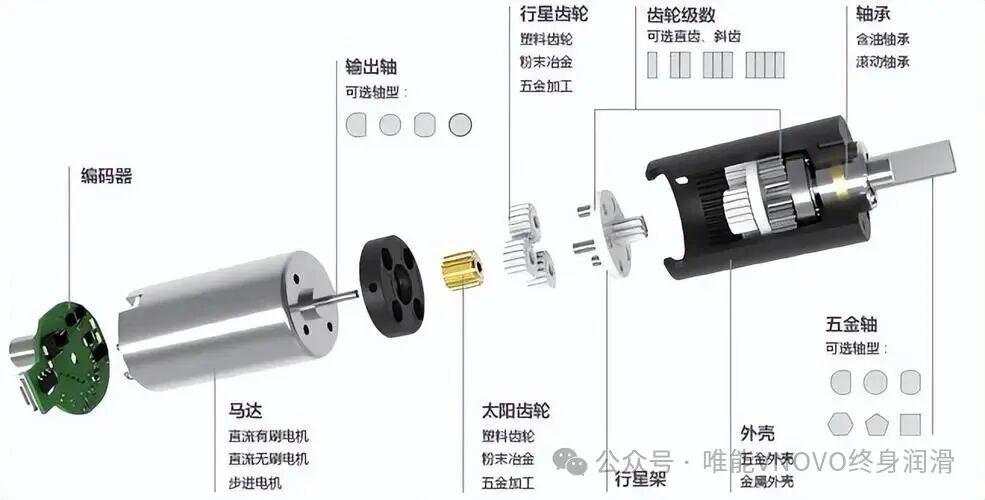
Gear modules are only 0.3 to 0.8 mm, a few tenths of those in ordinary industrial reducers. The smaller the module, the narrower the tooth surface clearance and the higher the load per unit area. For the same torque, the contact stress on the tooth surface is greater. The greater the contact stress, the higher the proportion of boundary lubrication, and the faster the extreme-pressure additives are consumed.
The repeated positioning accuracy of humanoid robots is often at the ±0.02 mm level. A change in grease condition means the friction characteristics drift, and repeated positioning accuracy declines at the same time. But the decline in accuracy is gradual and very hard to detect early on.
A few micrograms of iron powder mixed in might be filtered out in a large reducer, but in a micro reducer it is enough to form three-body wear particles and accelerate fretting wear.
Four Stages: From Chemical Change to Mechanical Damage
Stage One: Uniform color change, unchanged texture.
Base oil oxidation begins, and colored products are distributed evenly through the grease. Additives start to be consumed, but the amount is still small. Metal wear particles are very few and invisible to the eye.
The grease still lubricates, and the gear surfaces show no obvious damage. Changing the grease is effective and costs the least. But this stage is the hardest to notice — the color change is slight and the texture shows no obvious change.
Stage Two: Color deepens noticeably, texture begins to change.
Base oil oxidation accelerates and colored products accumulate. Additives are consumed to a certain degree, and metal contact under boundary lubrication increases. Metal wear particles start to form, but the concentration is still low. The texture of the grease begins to change — it may thin out or it may harden.
Microscopic wear marks begin to appear on the gear surfaces, but no visible scratches or pitting have formed yet. Changing the grease is still effective, but the gear surface condition should be checked at the same time. If the tooth surface already shows slight wear, shorten the observation interval after changing the grease.
Stage Three: Grease is dark and uneven, texture clearly abnormal.
Base oil oxidation products and metal wear particles accumulate at the same time. The grease color is uneven, and there may be dark spots locally. The texture is clearly abnormal — it may thin and flow, harden and clump, or be unevenly soft and hard. Additive depletion is severe and extreme-pressure performance drops sharply.
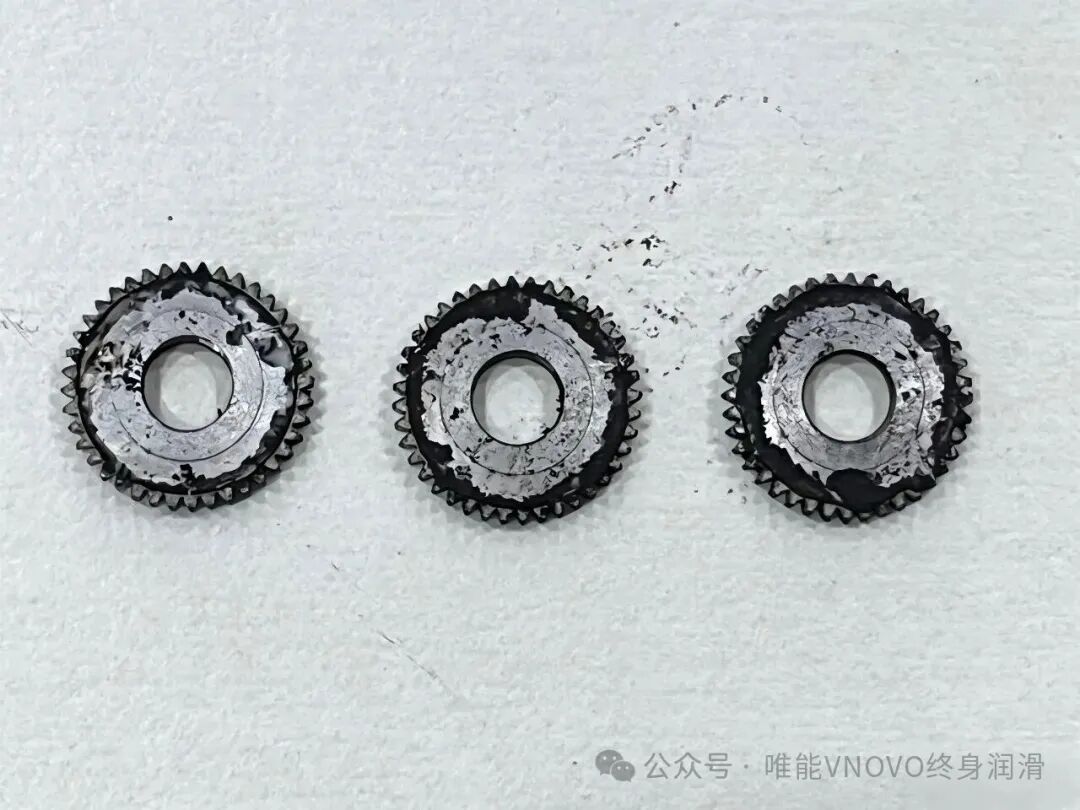
Visible wear marks have appeared on the tooth surface — fine scratches, slight pitting, local discoloration. The bearing raceway may already show fatigue marks. At this stage the wear is irreversible; changing the grease can only slow further degradation, not restore the already-damaged surface.
Stage Four: Carbonized residue or severe separation.
The base oil carbonizes and polymerizes and the oil film disappears. The grease is like carbon residue and feels dry. Or the grease body dries out and the base oil separates severely from the thickener, and lubrication function drops to zero.
Micro-cracks are very likely already present on the tooth surface, and the risk of tooth breakage is extremely high. Changing the grease cannot solve the problem; the reducer must be torn down to inspect the condition of the gears and bearings and to assess whether to replace the reducer.
What to Look at After Teardown
After opening the reducer, look at the grease condition together with the condition of the tooth surfaces and bearings.
Grease dark but evenly textured, with no obvious grinding marks on the tooth surfaces — wear is still early, so change the grease and keep observing.
Grease dark with abnormal texture, metal debris present, and fine scratches on the tooth surfaces — wear has entered Stage Three, so assess whether the reducer can still be used.
Grease in a carbonized state or severely separated, with micro-cracks or pits on the tooth surfaces — irreversible damage; the reducer needs to be replaced.
What to Look at When Choosing a Grease
Oxidation resistance. Look at the chemical inertness of the base oil. The working temperature of a dexterous hand reducer fluctuates widely, and the base oil’s oxidation rate across a wide temperature range determines the grease’s long-term stability.
Shear resistance. Look at the type and concentration of the thickener. Dexterous hand joints swing at high frequency, and the grease is repeatedly sheared on the tooth surfaces and raceways. If the thickener’s shear resistance is insufficient, the grease consistency keeps dropping until it finally flows out of the contact zone.
Material compatibility. Dexterous hands commonly use plastic gears such as PEEK and POM and rubber seals. When choosing a grease, confirm that its base oil and additives do not attack these materials.
These three indicators judge the long-term performance of a grease in a dexterous hand reducer better than dropping point and penetration.
Closing
Grease turning black is a result, not a cause. Behind the color change, three pathways — base oil oxidation, additive depletion and metal wear particle generation — advance in parallel.
Whether to tear down and inspect depends not on the color itself, but on the degradation stage the color corresponds to and whether that stage can still be solved by changing the grease.
A changed color does not mean the grease is unusable. But a changed color plus a changed texture plus a changed tooth surface condition — when these three signals appear at the same time, changing the grease no longer solves the problem.