
Without the conductive medium provided by thermal paste, even the most capable heat sink would be rendered ineffective.
Thermal paste can effectively reduce the risk of component burnout in electronic devices during operation, thereby enhancing both their safety and overall quality. Thermal paste is suitable for thermal management in most electronic appliances—essentially, any device requiring heat dissipation can benefit from its use.
In the electronics industry, CPU thermal paste may seem like an inconspicuous detail, yet it plays a pivotal role in achieving effective heat dissipation. It is entirely possible for it to create a temperature differential of 5°C or even more, thereby fulfilling its essential cooling function. Regardless of its specific chemical composition, the primary factors to consider when evaluating thermal paste are its fluidity and—most importantly—its thermal conductivity. Typical thermal pastes possess a thermal conductivity rating of around 5 W/m·K. Therefore, a comprehensive assessment requires evaluating thermal conductivity, fluidity, and material composition in combination. When applying thermal paste, the primary objective is to fill the microscopic gaps between the heat sink and the CPU’s heat spreader (IHS), ensuring a tight, intimate contact that facilitates superior thermal conduction. One should never underestimate the importance of thermal paste; without its conductive properties, even a heat sink with exceptional inherent capabilities would be unable to perform its intended function.
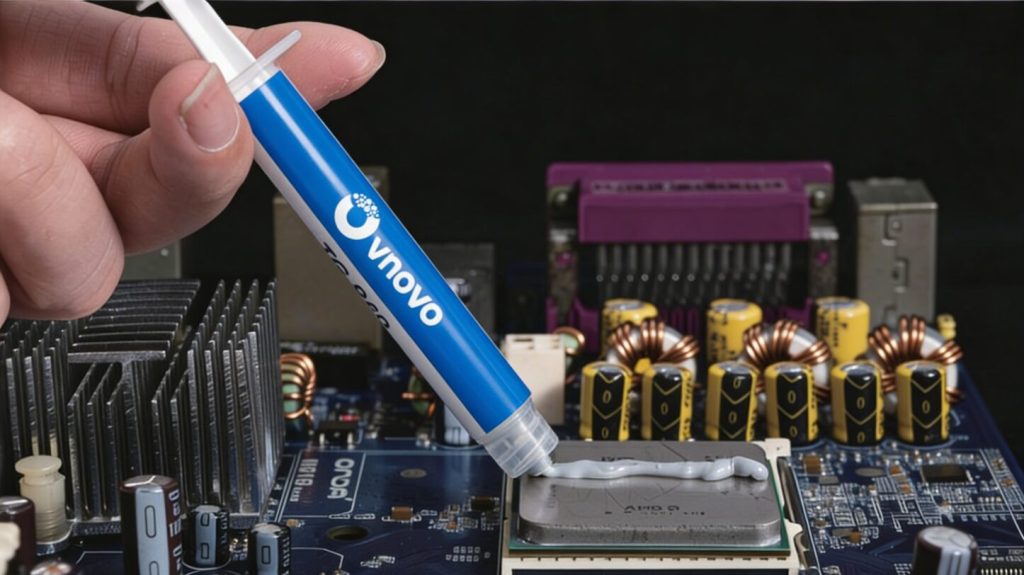
Vnovo Thermal Paste offers the following key features:
- When utilizing thermal paste in electronic devices, ensuring reliable heat dissipation requires selecting a high-quality product. Premium-grade thermal pastes not only excel in thermal performance but also possess excellent electrical insulation and thermal stability, making them suitable for a much wider range of applications.
- Furthermore, during the application phase, applying the thermal paste either too thickly or too thinly will prevent the device from achieving optimal heat dissipation. Consequently, during application, the thickness of the thermal paste layer should not exceed 3 mm.
- High-quality thermal pastes are environmentally friendly; during use, they do not cause corrosion to metal components and do not release harmful substances that could pose a risk to human health.
- If thermal paste exhibits signs of drying out or hardening during operation, it indicates poor performance. Specifically, once cured, the thermal paste will either lose its heat-dissipating capabilities entirely or suffer a significant decline in performance, leaving its other functional properties similarly compromised.
- Only thermal pastes characterized by low volatility and minimal oil bleed (separation) can be considered of sufficiently high quality; users should pay close attention to these specific attributes when making a purchase.
The correct method for applying thermal paste involves extruding a measured amount onto the center of the CPU (you may start with a small amount and apply a second dab if needed), and then spreading it evenly outwards. It is crucial to ensure that no excess paste spills over the edges of the CPU surface; if it does, it must be wiped clean immediately. Otherwise, the pressure from the CPU cooler can force the excess paste to seep down into the socket base, potentially causing a short circuit and resulting in component failure. It is also recommended to apply a thin, even layer of thermal paste to the base of the heat sink itself; this ensures a tighter contact between the components, thereby enhancing heat dissipation efficiency.
In CPU and electronic thermal management applications, the performance of thermal silicone grease directly affects heat transfer efficiency and system reliability. Proper selection and correct application help fill microscopic gaps between the CPU and heatsink, improving thermal conductivity and preventing overheating or performance degradation. A high-quality thermal grease with stable thermal conductivity, good flowability, and low volatility is essential for maintaining long-term performance.
If you are looking for a reliable thermal interface material for CPUs or other electronic components, VNOVO can provide suitable solutions tailored to different operating conditions and performance requirements.