
By VNOVO Technical Support Team
Printer guide rods – the steel shafts along which the printhead carriage slides – are among the most motion-critical components in any printer. Smoothness, quietness, and consistency directly affect print quality, mechanical longevity, and user perception. Guide rods operate at low speed with frequent reversals over years of maintenance-free operation. PTFE grease – polytetrafluoroethylene dispersed in a carrier – is the standard lubricant choice because it provides low and consistent friction, resists dust accumulation, and maintains performance across office temperature and humidity ranges.
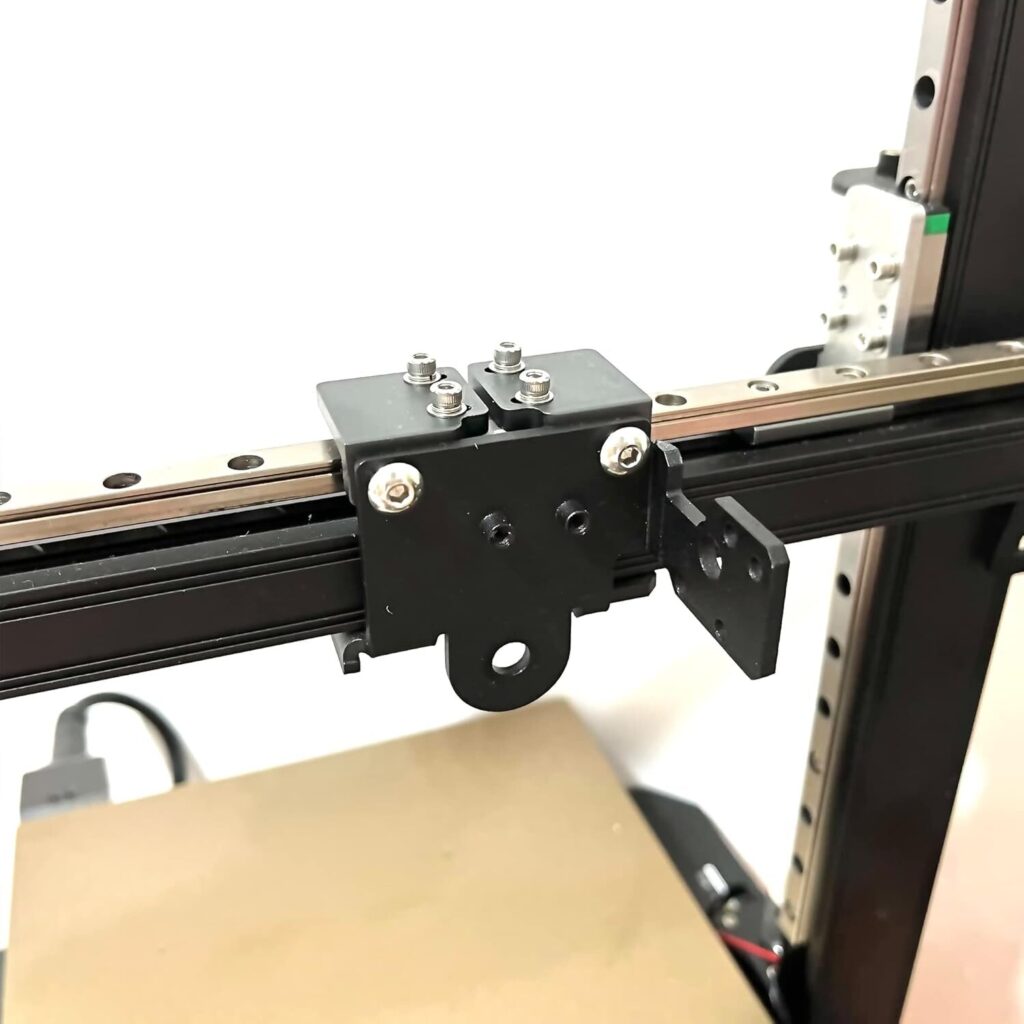
What Makes Printer Guide Rod Lubrication Demanding?
– Precision sliding at low speed. The printhead reverses direction hundreds of times per page. Any friction variation creates positional error and visible banding.
– Frequent start-stop cycling. Movement is intermittent – starting, stopping, and reversing thousands of times per day. The lubricant must maintain film during boundary lubrication at each start.
– Consumer-quiet operation. Office printers must operate below approximately 50 dB. Friction noise is immediately noticeable and unacceptable.
– Dust and paper debris exposure. Toner and paper fibers accumulate on horizontal surfaces. Wet lubricants attract these particles, forming abrasive paste that scratches the guide rod.
– Wide temperature and humidity range. Office environments range from cold unheated rooms to sustained summer operation. The lubricant must maintain consistent viscosity across these conditions.
– Maintenance-free for product life. Consumer printers are not serviced – the guide rod lubricant must perform for the product’s entire life without reapplication.
Why Do Printer Guide Rod Lubrication Problems Persist Even When Grease Is Applied?
1. Grease too thick causes start-up resistance. High-viscosity greases create static friction exceeding the stepper motor’s capacity, creating starting jerk and positional error.
2. Grease too thin provides insufficient film. Low-viscosity lubricants are squeezed from the contact zone, leading to metal-to-metal contact and wear.
3. Migration onto optics or paper path. Low-surface-tension greases migrate toward sensitive areas.
4. Dust accumulation from wet surface. Paper dust adheres to wet lubricant, forming abrasive paste that accelerates wear.
5. Odor in enclosed office equipment. Some petroleum greases emit noticeable odor during warm conditions.
6. Inconsistent friction across temperature. Low-VI greases change viscosity dramatically between cold start and sustained operation, causing print quality drift.
What Properties Make PTFE Grease Suitable for Printer Guide Rods?
– Low and consistent coefficient of friction. PTFE provides CoF 0.04-0.20, maintaining consistent sliding friction regardless of speed or load.
– Non-stick surface. PTFE does not retain dust and paper debris the way wet lubricants do, keeping the guide rod cleaner over its service life.
– Chemical inertness. PTFE is non-reactive with printer materials, ensuring no degradation of polymer bushings or seals.
– Wide temp range and low outgassing. Silicone-PTFE and PFPE-PTFE formulations operate from approximately -45 °C to 260 °C, far exceeding office requirements, with minimal odor in enclosed equipment.
– Thickener compatibility with steel and polymer. Silicone grease thickened with silica is compatible with steel guide rods and polymer (POM, PBT, nylon) carriage bushings.
– Non-migrating and quiet. Appropriate tackiness keeps grease in place; PTFE’s lubricity reduces friction noise below 50 dB.
How to Select the Right PTFE Grease for Printer Guide Rods
Step 1 – Identify printer and guide rod conditions:
| Printer Type | Configuration | Key Requirement |
| Consumer inkjet | Steel rod + polymer bushing | Low CoF, non-migrating, dust-resistant |
| Office laser | Steel rod + sealed linear bearing | Consistent friction, maintenance-free life |
| Wide-format / 3D printer | Dual rail, heavy load | PFPE-PTFE, wide temp, heavy load |
| Label / thermal printer | Small steel rod, high cycle | Low torque, quiet, clean surface |
| High-speed production | Hardened rod + precision linear guide | Ultra-low CoF, zero contamination |
Step 2 – Match formulation: Consumer inkjet / office laser → silicone-PTFE grease (low CoF, non-migrating, wide temp). Wide-format / 3D → PFPE-PTFE grease (wider temp, chemical inertness). Label / thermal → light silicone grease (low torque, clean). Production → ultra-low CoF PTFE.
Step 3 – Verify: Confirm CoF produces smooth, quiet carriage movement. Confirm non-migration on extended run. Confirm dust accumulation lower than wet lubricant. Confirm compatibility with polymer bushing. Confirm no odor in enclosed conditions.
Quick Reference: PTFE Grease Selection for Printer Guide Rods
| Printer Type | Grease Priority | Direction |
| Consumer inkjet | Low CoF + non-migrating | Silicone-PTFE grease |
| Office laser | Consistent friction + maintenance-free | Silicone-PTFE grease |
| Wide-format / 3D | Wide temp + chemical inertness | PFPE-PTFE grease |
| Label / thermal | Low torque + clean surface | Light silicone grease |
| High-speed production | Ultra-low CoF | High-PTFE grease |
How VNOVO Provides Technical Support
VNOVO does not supply off-the-shelf “PTFE grease” with universal claims:
Application-Oriented Selection Guidance – VNOVO reviews your printer type, guide rod load, speed profile, temperature range, and expected product life, recommending PTFE content level, base oil type, and tackiness.
Material Compatibility Verification – VNOVO helps assess candidates against steel guide rods, polymer bushing materials (POM, PBT, nylon), and adjacent components – confirming no degradation or migration.
Scenario-Based Communication Support – VNOVO explains *why* a direction is suggested, what trade-offs exist (silicone-PTFE = non-migrating and wide temp but lower load vs. PFPE-PTFE = broader temp and chemical resistance but higher cost; higher PTFE = lower CoF but potentially thicker consistency vs. lower PTFE = better penetration but higher CoF), and what validation to prioritize.
Conclusion
When to use PTFE grease on printer guide rods
When low and consistent friction across a temperature range is required, when dust and debris would degrade wet lubricant performance, when maintenance-free operation for the product’s full life is specified, when consumer-quiet operation below 50 dB is required, or when chemical inertness is needed to protect polymer bushing materials.
When an alternative grease may be more appropriate
When guide rod loads exceed PTFE grease capacity, when specialized industrial chemical exposure is present, or when food-grade certification is required.
What VNOVO can support
1. Selection guidance – translating printer type, load, speed, and temperature into PTFE content and base oil recommendation
2. Material matching – assessing PTFE grease candidates against guide rod and bushing materials
3. Scenario communication – providing the rationale to specify, test, and validate the right PTFE grease for your printer guide rods
*This article is provided for informational purposes based on industry references and precision motion lubrication principles. Specific product selection should always be verified through friction coefficient testing, migration testing, and material compatibility confirmation.*