
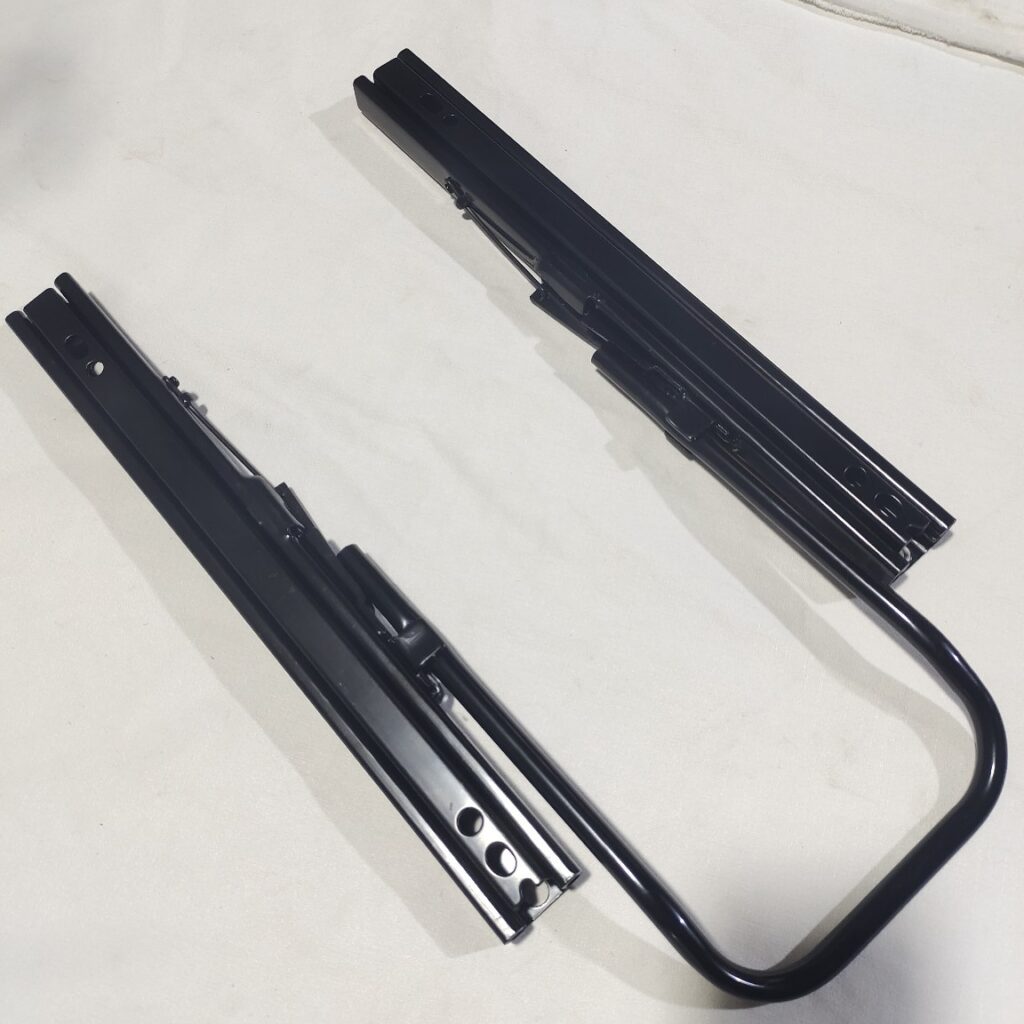
Seat sliders are quite revealing. When new, adjustment feel is excellent — a single push gives that sense of uniform smoothness, with actuation force around 30–50 N, essentially inaudible. After some use, the situation deteriorates: adjustment force rises to 80–120 N, pushing becomes noticeably heavier, a ‘rustling’ friction sound appears during sliding, and some positions require a sharp push to get past. At the dealership, the technician cleans the guide rail and sprays something on it — it improves for two weeks, then recurs.
This process is familiar to many engineers, but the underlying mechanism is usually not taken seriously.
First, Let’s Talk About Stick-Slip Vibration.
Seat slider blocks use POM or PA66 + glass fiber; the guide rail is galvanized steel or stainless steel. The two friction surfaces have surface roughness of Ra 0.4–0.8 μm and Ra 0.2–0.4 μm respectively. When new, with grease in between, there are no problems.
The issue lies in the seat adjustment operating condition itself. Speed is low — below 10 mm/s — while the block承受负载是300 bears a load of 300–1,000 N, including seat assembly and passenger weight. This combination of speed and load falls precisely in the boundary lubrication or mixed lubrication regime, making it extremely sensitive to the difference between static and kinetic friction coefficients of the grease.
In ordinary grease, the difference between static and kinetic friction coefficients (Δμ) progressively increases with aging. When Δμ exceeds 0.08, system stiffness coupled with negative damping produces self-excited vibration, with vibration frequency in the 200–800 Hz band — exactly the range most sensitive to the human ear. The ‘rustling’ sound you hear is not a broken slider; it is the grease’s friction-reducing capability decaying.
This process develops gradually. Initially, stick-slip amplitude is only a few micrometers — imperceptible to users, detectable only by instruments. With continued use, Δμ continues to increase, amplitude grows to tens of micrometers, and users begin to feel handle vibration — at which point the ‘rustling’ sound becomes audible.
Now Let’s Discuss Three-Body Wear — This Is What Actually Causes Slider Problems.
Many people are unaware that seat sliders operate in an open environment, near the footwell area. Sand particles carried in by shoe soles range from 20–200 μm in diameter, primarily silicon dioxide and aluminum oxide — hardness far exceeding POM and PA66. These particles enter the slider with foot movement, and ordinary high-viscosity grease encapsulates them tightly.
What happens after encapsulation? Particles are trapped between the block and guide rail, pressing into the softer plastic block surface and plowing grooves during来回运动. Each cycle removes 0.1–0.5 μm of material — sounds small, but after 3,000 adjustment cycles the cumulative effect produces plow grooves 10–30 μm deep on the block surface, clearly visible under a microscope.
But that’s not all. Plastic debris scraped off mixes with the original sand particles, creating new abrasive sources for the next round of wear. Simultaneously, the rail’s galvanized coating or phosphate film is scratched through, exposing the base metal to direct contact with plastic — friction coefficient jumps a whole level.
This process is irreversible. Once plow grooves have formed on the block surface, no amount of grease can fill them — only slider rail assembly replacement can resolve it.
Electric Sliders Have Their Own Unique Problem.
Electric seat adjustment uses a DC motor on each side, driving the lead screw or gear rack via a soft shaft, with the controller performing closed-loop speed regulation via Hall sensors. A hidden assumption of this system is that resistance on both sides is essentially equal.
When resistance on one side becomes significantly greater than the other due to contamination or wear — and the difference exceeds 15% — the system begins exhibiting limit cycle oscillation. The lower-resistance side moves first, the seat tilts, the tilt applies additional bending moment to the other slider, resistance further increases, and the controller repeatedly adjusts — the seat exhibits ‘crooked creeping,’ accompanied by low-frequency ‘humming’ at 100–200 Hz that transmits through the seat frame to the vehicle body sheet metal, exciting structural noise in the cabin. There is also a ‘click’ impact sound during emergency stops.
This failure mode is easily misdiagnosed as a motor problem or control strategy problem — the actual root cause is slider resistance mismatch.
Temperature Is Easy to Overlook, but It Is Always at Work.
Parking in summer sun beneath the seat can reach 80–95°C; in winter it drops to as low as –40°C. Ordinary mineral oil grease after 1,000 hours at 80°C can experience 10–20% evaporation, with thickener oxidation and hardening — grease consistency gradually increasing from NLGI 2 to NLGI 3 or even 4. Once the grease hardens, its ability to encapsulate dust particles disappears; dust makes direct contact with metal, accelerating wear — a vicious cycle.
The low-temperature end is equally real. Grease with a poor viscosity index undergoes ‘glassy transition’ below –20°C, with starting torque increasing 3–6 times. Electric seats in winter clearly move more slowly; some vehicles even exhibit stuttering — the issue is here. Normal-temperature test performance is similar; only with elevated temperature conditions can the gap be seen.
Ordinary lithium or complex lithium grease develops obvious black discoloration after 3–6 months — not because the grease is dirty, but because it has partially lost mass at high temperature while encapsulating a large amount of abrasive particles, losing its original friction-reducing capability.
This is why dealership guide rail cleaning only lasts two weeks: cleaning removes abrasive particles, but does not change the fact that the grease itself has aged. Base oil continues to evaporate at high temperature, thickener continues to oxidize and harden, and abrasive particles continue to generate — the cycle restarts.
What seat slider grease truly needs to solve is not just one problem but three simultaneously: no loss at high temperature, ability to start at low temperature, and the capacity to handle invading hard particles.
Ordinary grease was not designed with these three problems considered together, so individually each parameter may be acceptable — but not in combination.
The VNOVO dedicated grease approach: low-volatility synthetic oil (PAO plus ester) solves high-temperature evaporation; PTFE solid lubricant reduces friction coefficient and narrows the static-kinetic friction coefficient difference; high-thixotropy design reduces grease viscosity during motion, pushing invading dust particles away from the friction interface, reducing three-body wear. It also maintains compatibility with POM, PA66, galvanized steel, and other materials, handling temperature cycling conditions.
Actual coating quantity does not need to be large — apply 0.5–1 g per slider rail, at both ends of the block travel trajectory. Excessive quantity actually tends to encapsulate more particles.
What are the requirements in your slider durability targets for adjustment force decay, resistance difference, and noise increase? If you are evaluating slider lubrication solutions or encountering durability test data that fails to meet standards, message me with the specific operating conditions and I can help you review the selection direction.