

When the electric tailgate durability test reaches 5,000 cycles (approximately equivalent to 1–2 years of normal user use), NVH indicators begin systematic deterioration. This is not a random occurrence — there is a clear failure chain that can be traced.
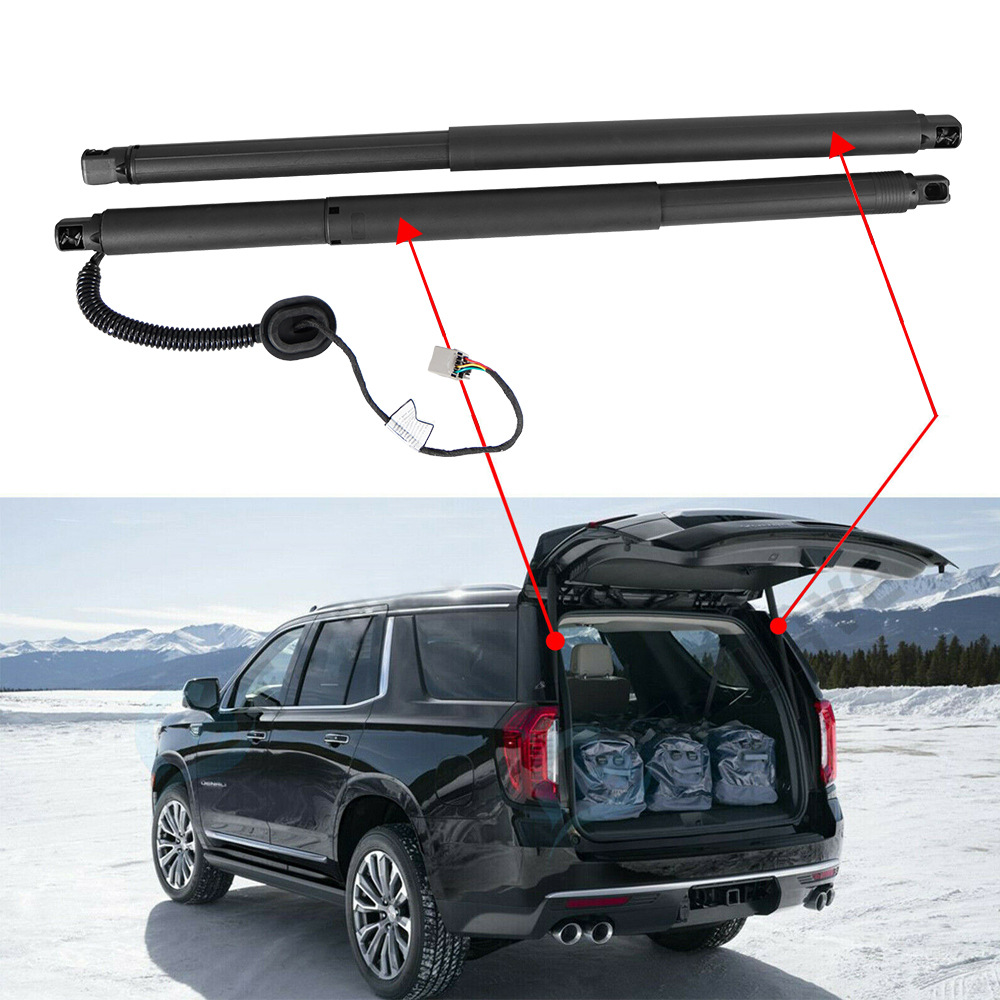
Design Baseline: Reference Condition
At the start of bench testing — 0 cycles — the electric tailgate’s initial state should meet three requirements: motor running sound is low without abnormal high-frequency components; strut extension/retraction is uniform without jitter or binding; lifting/lowering speed is stable at 50–80 mm/s, with allowable deviation ±10%.
These three indicators form the comparison baseline for durability testing. Problems typically emerge after 5,000 cycles.
Typical Failures After 5,000 Cycles
At this stage of durability testing, struts typically exhibit three categories of abnormal noise:
First, concentrated frequency bands. Low-frequency 150–400 Hz superimposed with high-frequency 800–2,000 Hz; semi-anechoic chamber bench measurements typically show noise increase exceeding 5 dB(A) over the original baseline — subjective perception is ‘squeak’ and ‘gurgle.’
Second, speed pulsation. The original ±10% fluctuation band is broken, with frequent deviations exceeding ±20%. Motor current curves show peaks corresponding to resistance changes.
Third, binding or overcurrent protection. Once nut internal thread wear reaches a certain level, fit clearance expands from the initial 0.02–0.05 mm to 0.10–0.20 mm; radial play-induced lateral force is sufficient to trigger motor protection.
Disassembly Analysis: Failure Mechanism Chain
Disassembly of failed struts reveals damage concentrated at four levels.
Lead screw thread surface axial scratches, depth 10–30 μm. Metal lead screw (45# steel or carburized steel, HRC 50–60) meshes with POM/PA66+GF nut. Under 100–300 N axial load superimposed with opening/closing impact, ordinary grease (e.g., lithium-base grease) is extruded from the meshing zone, followed by boundary lubrication or even dry friction. Adhesive wear generates 5–20 μm wear debris, which mixes into the grease forming three-body abrasive wear, elevating wear rate by an order of magnitude.
Nut internal thread tooth profile flattening — tooth profile height can lose 30–50% within 5,000 cycles. After fit clearance expands to 0.10–0.20 mm, radial play directly causes low-frequency ‘gurgle’ sound (150–400 Hz band); motion resistance pulsation triggers speed fluctuation (±20% or more); increased lateral force causes motor current peaks, triggering overcurrent protection in severe cases.
Guide ring and tube wall scratching. Axial scratches appear on the fit surfaces between the guide ring (POM/PTFE) and inner/outer tubes, depth 5–20 μm. Friction coefficient rises from initial 0.08–0.12 to 0.25–0.40; the bench directly observes ‘creep-pause’ stick-slip phenomena.
Grease condition deterioration: discoloration to black, abnormal viscosity, drying or leakage from seals. At –30°C, ordinary grease viscosity increases 3–5 times; starting torque rises from 1–2 N·m to 6–10 N·m. At 70–80°C, low-drop-point grease softens and flows, extruded from seals under vibration.
Environmental Acceleration Factors
The above failure chain has several accelerating factors.
Low temperature sharply reduces grease flowability. At –30°C ordinary grease viscosity increases 3–5 times; starting torque jumps to 6–10 N·m, directly affecting low-temperature starting performance.
High temperature causes grease loss. At 70–80°C low-drop-point grease softens and flows, leaking from seals, and effective lubrication in the meshing zone is lost.
Water immersion is an equally non-negligible threat. Water mist intrusion causes grease emulsification or washout — particularly evident in car wash scenarios and rainy-day usage.
Conclusion: Lubrication Solution Failure Is the Primary Driver of NVH Degradation
The starting point of the above failure chain is essentially a mismatch between the lubrication solution and the operating conditions. The three factors — high contact stress in the lead screw-nut pair, sensitivity of the plastic nut to abrasive wear, and environmental temperature/humidity changes — together impose requirements on the grease for anti-extrusion, anti-wear, anti-water-washout, low-temperature flowability, and high-temperature stability that exceed the design limits of ordinary greases.
Discussion: Durability Test Index Settings
I would like to exchange practical insights with peers: when setting up electric tailgate durability tests, what levels are typically set for the following indicators?
Lifting/lowering noise increase upper limit: <3 dB(A)? <5 dB(A)?
Speed fluctuation tolerance: ±15%? ±20%?
Lead screw wear depth acceptance criteria: ≤10 μm? ≤20 μm?
If you can provide the strut structure type (lead screw-nut type/sliding inner-tube type) and specific durability targets, I can deliver a matching lubrication solution selection table and coating process parameters. Message me for details.