

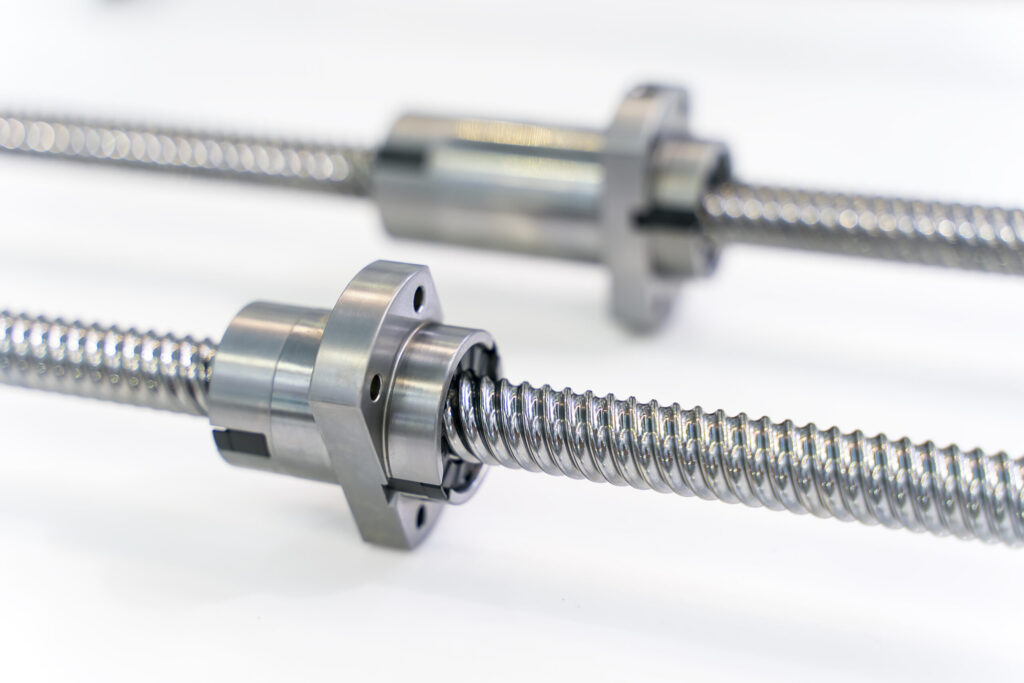
Ball screws are critical components in CNC machines, medical devices, semiconductor equipment, automation systems, and linear positioning platforms. Their accuracy depends directly on the condition of the contact zone between the balls, raceways, and related guide surfaces. Lubrication is essential, but silicone grease is not a universal answer. It works well in some ball screw applications and performs poorly in others.
When silicone grease makes sense
Silicone grease is most suitable for light to moderate loads and low to moderate speeds, where the main lubrication priorities are surface protection, low stick-slip, damping, and long-term stability during extended static periods. It can also be a practical choice in assemblies that combine steel, aluminum, elastomers, and common plastics, because silicone grease is generally compatible with a wide range of engineering materials.
It also becomes relevant where fretting corrosion is a concern. Ball screws used in vibration-damping systems, optical stages, instrumentation equipment, or short-stroke positioning mechanisms may experience micro-oscillation without full rotation. In these cases, a properly selected silicone grease can help protect the contact points.
Another advantage is its wide temperature stability. Silicone grease maintains a relatively flat viscosity-temperature profile, which supports reliable cold starts and more stable consistency across changing temperatures. In noise-sensitive or tactile-sensitive equipment, higher-viscosity silicone grease can also improve motion feel and reduce audible noise.
Why lubrication problems still happen
Even when silicone grease is applied, several failure modes remain possible.
The most important is insufficient load-carrying capacity. Silicone base oils have a lower pressure-viscosity coefficient than PAO, mineral oil, or ester-based oils. In heavily loaded or preloaded ball screws, the grease can be squeezed out of the contact zone, leading to boundary lubrication and faster wear.
Another issue is shear stability. Most silicone greases use fumed silica as the thickener. This system performs well in intermittent or mostly static conditions, but it may soften and lose consistency under long periods of continuous cycling.
Material compatibility is usually good, but not universal. Silicone grease can create stress cracking risks in polycarbonate and some engineering plastics, so assemblies containing PC parts or covers require special review.
There are also contamination and process risks. Standard silicone greases may not meet the outgassing limits required in cleanroom, optical, or semiconductor applications. In addition, solvents, cutting fluids, washdown water, or process chemicals may displace or degrade silicone grease faster than alternative formulations. Finally, over-application can create excessive drag and heat, especially when high-viscosity grease is used for damping.
What properties matter most
A suitable silicone grease for ball screws should be evaluated through a few practical parameters.
Base oil viscosity affects both film thickness and damping. For light-duty ball screws, the original article identifies a typical range of 100 to 2,000 cSt at 40°C. Higher viscosity improves damping but also increases drag. Silicone type also matters: PDMS is the general-purpose option, phenylmethyl silicone offers better lubricity, and fluorosilicone adds solvent resistance.
Most industrial silicone greases are silica-thickened. This gives them non-melting behavior and good thermal stability, but usually lower shear stability than lithium complex, calcium sulfonate, or polyurea systems. For ball screw use, NLGI 1 to 2 is the typical consistency range.
The key performance checks should include:
- load-carrying capacity
- fretting test performance
- operating temperature range
- shear stability
- compatibility with all contacting materials
How to decide
A practical selection process starts with the duty profile:
- screw lead and rotational speed
- thrust load and preload condition
- cycling pattern: continuous, intermittent, or mostly static
- vibration or micro-oscillation
- minimum and maximum operating temperature
- nearby materials, seals, and covers
- exposure to cleanroom limits, process fluids, or chemical agents
As a rule of thumb:
- Light-duty positioning stages, instrumentation screws, and low-preload assemblies: silicone grease is often a reasonable choice
- Preloaded CNC-grade ball screws, heavy actuators, and high-thrust systems: PAO-based or lithium-complex greases with AW/EP additives are usually safer defaults
- Applications with vibration, short-stroke oscillation, or motion-feel sensitivity: silicone grease may add real value through damping and anti-fretting behavior, as long as the load remains within its limits
How VNOVO can help
VNOVO supports ball screw lubricant selection through three areas: selection guidance, material matching, and scenario communication. This includes reviewing screw specifications, load and speed profile, cycling pattern, temperature range, materials of construction, and environmental exposure. The goal is to help users decide whether silicone grease is appropriate and, if so, what viscosity range, consistency, and performance priorities make the most sense for the application.