

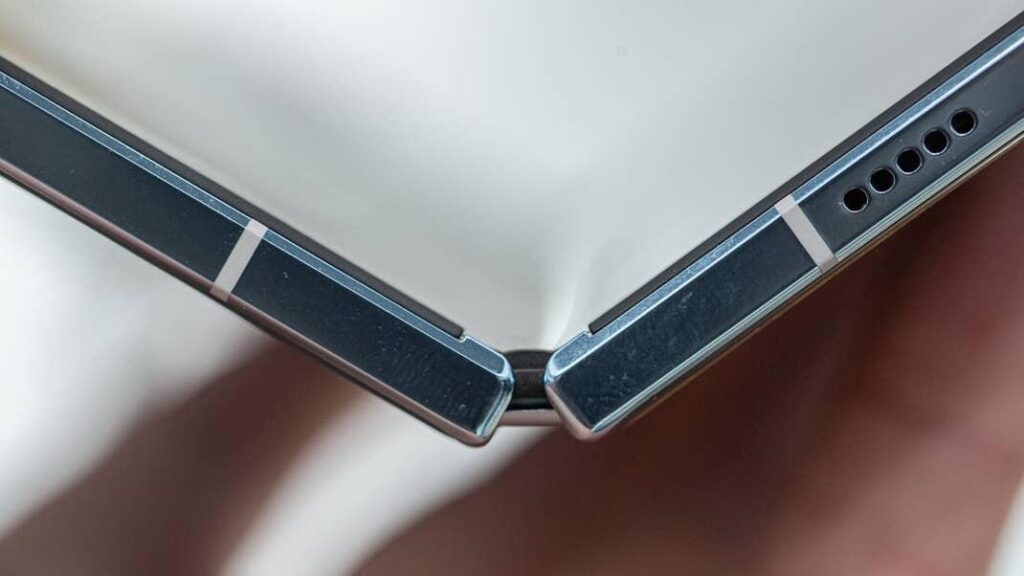
In foldable and flip phones, the hinge is one of the most demanding mechanical parts. It must deliver smooth opening and closing, stable torque feel, and long cycle life, all within a very small space. In this type of design, damping grease does more than lubricate. It directly affects motion quality, user perception, and long-term hinge reliability.
Why phone hinges are a special lubrication case
Phone hinges work under conditions that are very different from industrial hinges or general metal joints.
First, the lubricant volume is extremely small. A hinge may need only a few milligrams of grease. If too much is applied, it can migrate to nearby electronics, display edges, or outer surfaces. That is why small-package formats such as syringes, micro-tubes, and pre-metered doses are not just convenient but necessary in production.
Second, torque consistency is part of perceived product quality. Users judge a hinge by how smooth, even, and controlled it feels. In phone hinges, grease is chosen not only for wear control but also for motion feel, free-play suppression, and the absence of notchiness.
Third, the operating environment is broad. Phones may be used in winter, carried in warm pockets, or left in vehicles under direct sunlight. The grease must maintain usable consistency across this range without hardening, separating, or becoming too loose. At the same time, it must stay compatible with mixed materials such as stainless steel, zinc alloy, LCP, PEEK, POM, elastomers, and nearby coatings or adhesives. Once assembled, the hinge is effectively sealed, so the grease must last through tens of thousands of cycles without relubrication.
Why hinge problems still happen even when grease is applied
Applying damping grease does not automatically solve hinge problems.
A common issue is grease migration. If adhesion is poor, grease can move under vibration, gravity, or thermal cycling and contaminate the display edge, camera area, or housing surface. Another issue is torque drift. Some greases become too stiff in low temperatures or too loose when warm, while others soften over time under repeated shearing.
There are also material compatibility risks. Some products sold as plastic-compatible are still unsuitable for certain engineering plastics, including polycarbonate and ABS blends. In addition, because the dosage is so small, even slight over-application can create assembly problems, visible residue, or excessive hinge drag. Oil separation is another serious concern, since separated oil can migrate toward sensors, fingerprint modules, or display layers. Finally, not all damping greases can maintain performance through the full design cycle life of the device.
What properties matter most
A suitable phone hinge damping grease should be evaluated in four areas.
1. Base oil type and viscosity
Synthetic hydrocarbon greases are the most common general-purpose option. Silicone-based products offer excellent temperature stability, while PFPE is used where maximum stability and chemical inertness are required. Dynamic viscosity must be matched to the target torque profile: lower grades reduce resistance, while heavier grades provide stronger damping and motion control.
2. Tack and adhesion
The grease must stay where it is placed. Higher tack reduces migration risk, which is especially important in compact phone assemblies.
3. Oil separation
Low oil bleed is essential. A stable formulation helps prevent contamination of nearby optical or electronic components over time.
4. Temperature and shear stability
The grease should maintain usable torque feel from low to high temperature and resist consistency change during repeated hinge cycling. For high-cycle devices, shear stability is critical.
How to select the right damping grease
Selection should start with the hinge design itself: hinge type, torque target, angular range, notchiness tolerance, and design cycle life. Next, review all materials in and around the hinge zone, including metals, polymers, coatings, and nearby parts that could be affected by migration. Then match the grease to the real operating conditions: temperature range, cycle-life target, cleanliness requirement, and dispensing method. Finally, validate through prototype testing, including torque-vs-angle measurement, thermal cycling, cycle-life testing, contamination inspection, and subjective feel evaluation.
How VNOVO can help
VNOVO supports phone hinge damping grease selection in three ways: selection guidance, material matching, and scenario-based communication. This includes reviewing hinge type, target torque, material list, operating temperature, cycle-life requirements, and assembly process, then identifying the most relevant formulation direction and the key risks that should be verified before production.
When damping grease is the right answer
Small-package damping grease is the right choice when the hinge requires controlled torque, smooth motion feel, minimal free-play, precise dosing, material compatibility, and long cycle life without relubrication. Alternatives such as dry-film coatings, self-lubricating materials, or different lubrication systems may be worth considering when the mechanism is extremely miniature, tightly regulated, or better served by another lubrication strategy.