
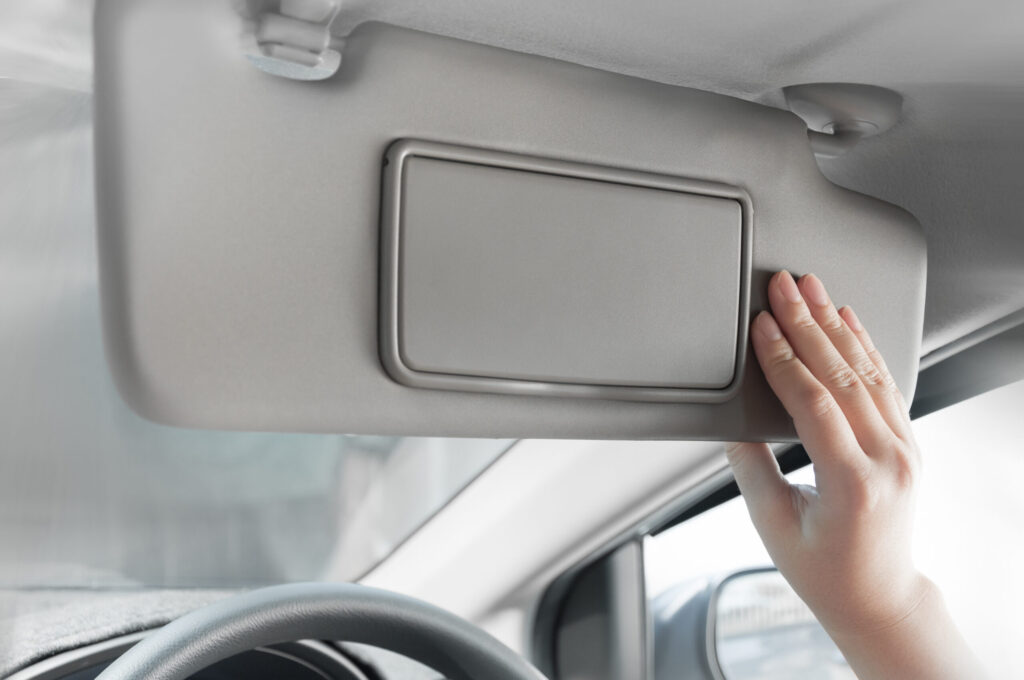
When the car is new, the sun visor flip feels consistent to everyone: even damping, stops wherever you position it, no “squeak” sounds, and flips back flush with the headliner. This is essentially the baseline at 0 endurance test cycles.
But after 2,000 to 3,000 flip cycles (roughly one to two years of daily use), problems emerge. First, noise — flipping produces “squeak” and “creak” sounds at frequencies around 300 to 800 Hz, precisely the range human ears are most sensitive to. Then, the sun visor can no longer hold position: it slowly creeps down during driving, or simply cannot be locked at the desired angle. When flipped up, it fails to return flush, leaving a gap with the headliner that causes “tick-tick” impacts from road vibration.
Disassemble the mechanism and you will find: the clearance between the metal shaft and POM (polyoxymethylene) bushing has worn from the new-part specification of 0.05 to 0.1 mm to 0.2 to 0.5 mm. The grease has either turned black and hardened, or has already been completely squeezed out.
Why Does This Happen?
Several mechanisms are at play.
Stick-Slip Vibration Is the Direct Cause of the “Squeak”
During low-speed flipping, if the difference between the static friction coefficient and the dynamic friction coefficient of the damping grease is too large (typically Δμ > 0.08), the bushing will “stick and slip” on the shaft, forming self-excited vibration — that sharp “squeak” sound. When the grease dries out, the static friction coefficient can surge above 0.3, making the noise far worse.
Insufficient Damping Means the Sun Visor Cannot Hold Position
The visor can hover at any position thanks to the viscoelastic resistance of the damping grease against gravity. With a low-viscosity grease or one that has already been squeezed out, dynamic viscosity at extremely low shear rates is too low to resist the gravitational torque, and the visor creeps downward very slowly. After bushing wear increases radial clearance to 0.1 to 0.3 mm, vehicle vibration causes the visor to bounce up and down, striking the headliner.
Wear and Creep Rapidly Amplify the Problem
POM bushings are inherently prone to creep — the inner bore gradually enlarges. If the grease’s anti-wear performance is also insufficient, the combined effect of wear and creep causes clearance to expand to 3 to 5 times the initial value after 3,000 cycles. Once clearance becomes this large, damping feel disappears entirely.
Temperature and Material Compatibility Add Further Complications
In summer, cabin temperatures exceed 80°C; low dropping-point damping greases simply thin out and flow away. In winter at -20°C, the grease becomes as hard as chewing gum, and flip torque can increase two to three times. Selecting the wrong grease — mineral oil-based or certain silicone greases — can be incompatible with POM, PC (polycarbonate), causing bushing swelling or cracking after high-temperature storage.
VNOVO Damping Grease Test Performance
We compared several damping greases on our test bench. VNOVO has a dedicated damping grease for sun visor pivot shafts with particularly outstanding performance data.
After 3,000 flip cycles, thermal cycling from -20°C to 80°C, with simultaneous simulated vibration:
- Torque variation across the temperature range was controlled within ±20% (ordinary silicone grease changes by more than ±50% with temperature)
- The difference between static and dynamic friction coefficients was extremely small — measured at less than 0.04, essentially eliminating stick-slip noise
- Evaporation loss after 100°C/24h baking was below 2%, so grease volume does not noticeably decrease even after years of use
- It shows no adverse reactions with POM, PA66, PC, ABS, or common metal shafts
- After 500 hours at 80°C, no swelling or cracking occurs
- Available in light, medium, and heavy damping grades, allowing selection based on sun visor weight and tactile feel requirements
For more detailed data (torque-temperature curves, wear volume, coating quantity), feel free to send a private message and I will send the report directly.
What Durability Indicators Are You Testing?
Different OEMs have widely varying durability requirements for sun visor pivot shafts. Some only require room-temperature torque within ±20% to pass; others must simultaneously verify no sagging after thermal cycling; still others require flip noise increase not to exceed 3 dB.
Which indicators are you testing for? What is the pivot shaft structure — metal shaft with POM bushing, or all-plastic? If convenient, please send your targets and I will directly match the damping grease type, application location, and coating quantity to your requirements.
Contact VNOVO
What specific durability indicators does your company test for? What is the pivot shaft structure — metal shaft with POM bushing, or all-plastic? Feel free to send me your targets directly and I will match the appropriate damping grease model, application location, and coating quantity.