
Sunroof Roller Blind Sticks After a Year — Not Insufficient Lubrication, but Plastic Gears Gradually Worn Out Over Time
Have you noticed this phenomenon:
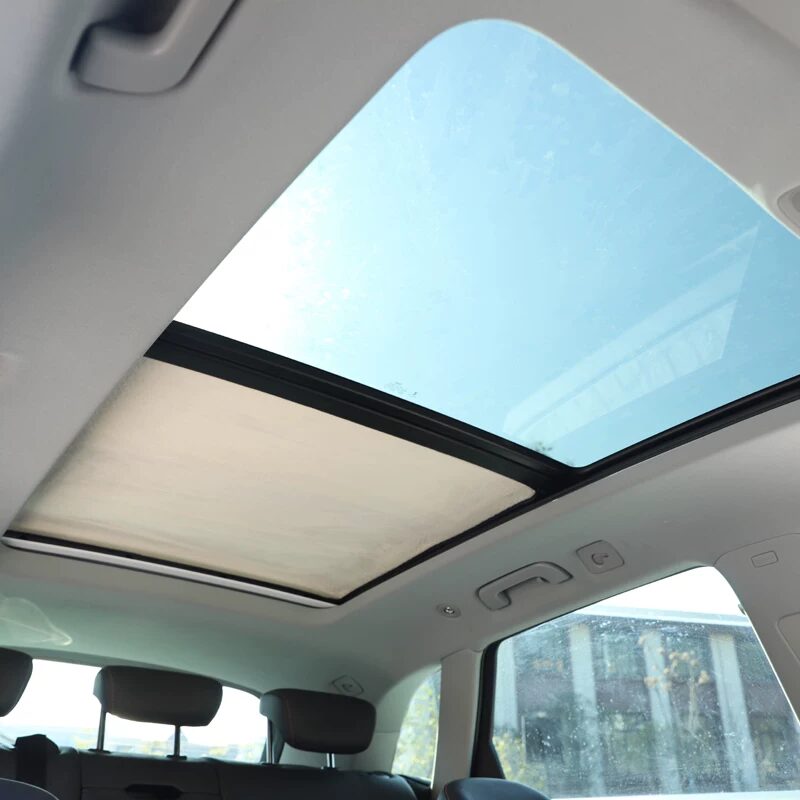
The same sunroof model feels smooth and slides effortlessly when new. After one year, resistance noticeably increases and the roller blind begins to “hesitate” and run unevenly. Further down the road — it gets stuck mid-travel, the motor emits a humming overload sound, and the user complains it “won’t budge.”
At the 4S shop, cleaning the guide rails and applying grease does briefly restore the feel. But within a month, the sticking recurs. Year after year, complaints continue.
Most people attribute the cause to: not enough grease applied, or lubrication intervals too long. But if you have conducted push-pull force durability testing on the sunroof roller blind, you will see a different set of data:
Initial push-pull force: approximately 8–12 N. After 100,000 cycles: some vehicle models实测have already exceeded 25 N, and some have experienced sticking failure.
Resistance has more than doubled — yet the tooth surface may have worn only a few dozen microns. This means that from the design stage, the grease selected determines whether this degradation curve rises slowly or deteriorates sharply.
The issue is not “whether the grease is sufficient,” but “whether the selected grease can last through the vehicle’s entire service life.”
Why Ordinary Grease Cannot Last a Year
The sunroof roller blind drive mechanism uses POM (polyoxymethylene) or PA66 (nylon 66) plastic gears. Both materials are lightweight, self-lubricating, and inexpensive — making them the optimal choice for the space-constrained sunroof environment — but they have a natural weakness: low surface hardness.
When new, gear engagement precision is high, tooth surfaces are smooth, grease uniformly covers the contact surfaces, friction coefficient is low, and resistance is naturally small. But as time goes on, things begin to change.
Step 1: The grease fails first.
Summer sun exposure inside the vehicle easily pushes local temperatures above 80°C. Ordinary grease cone penetration increases dramatically and it begins to flow and migrate out of the gear meshing zone. In winter cold regions, temperatures drop to -30°C, the grease becomes viscous and hardened, and cannot form an effective oil film at start-up. Once the grease leaves, the gear pair transitions from boundary lubrication into dry friction.
Step 2: Dry friction generates wear debris.
The dry friction wear rate of POM and PA66 is far higher than that of metal. Micron-scale plastic wear debris is generated in large quantities — these debris particles have hardness close to or exceeding that of the base material. When mixed with residual grease, they form an “abrasive paste” — a self-sustaining abrasive source.
Step 3: Wear debris drives accelerated wear.
The abrasive paste repeatedly grinds between gear tooth meshing surfaces, surface roughness rapidly increases, the modulus gradually distorts, and the meshing clearance enlarges. This process has positive feedback characteristics: more debris means faster wear; faster wear means more debris. The better the grease lubricates, the slower this process progresses; the earlier the grease fails, the faster it accelerates.
Step 4: Geometric deformation locks in the failure.
Once tooth surface wear reaches a certain level, the gear center distance increases, the meshing backlash exceeds design tolerances, and the roller blind run becomes skewed and unsteady. Skewed motion causes local contact stress to spike and resistance to worsen further. Even if grease is reapplied at this point, the gear geometry has already been compromised, and resistance can only be partially restored — this is the root cause of why “every 4S shop visit provides relief, yet the problem returns after each visit.”
There is also an underestimated issue: material compatibility between grease and plastic gears. Some grease formulations contain solvents or plasticizer components that can infiltrate the surface layer of POM and PA66, causing the gear surface to swell and soften or develop microcracks — gear geometry distortion similarly triggers meshing abnormalities.
Solution: Slow the Degradation Curve, Rather Than Firefighting After Each Service
Solving this problem requires establishing the correct technical logic from the selection stage — not merely “lubrication that gets the job done,” but making the push-pull force degradation curve progress as gently as possible throughout the vehicle’s entire lifecycle.
The first dimension: extreme-pressure anti-wear, reducing wear debris at the source.
VNOVO’s dedicated grease uses high-viscosity synthetic base oil combined with extreme-pressure additives to establish a tough oil film in the high-pressure gear meshing zone, dispersing contact stress and reducing tooth surface wear rate. PTFE or MoS₂ solid lubricant maintains low friction under boundary lubrication conditions. With good coordination, the friction coefficient can be reduced to the 0.05–0.1 range — each 0.01 reduction corresponds to a multi-percentage-point improvement in resistance degradation after 100,000 cycles.
The second dimension: high adhesion, keeping grease where it needs to be.
Tackifiers improve the grease’s retention capability — no flow or drip at high temperatures (above 80°C), no drying at low temperatures (below -30°C) — ensuring the grease remains in the gear meshing zone for the long term rather than migrating elsewhere. A dropping point ≥200°C is the basic threshold for high-temperature stability.
The third dimension: complete plastic compatibility validation.
POM, PA66, ABS, PPS, and other engineering plastics commonly used in sunroofs all require compatibility validation with the grease formulation. The swelling rate acceptance criterion is ≤3%; acceptable hardness change ranges also need to be defined. Without this report, the grease’s “non-aggression toward plastics” is merely a subjective judgment, not an engineering basis.
The fourth dimension: wide temperature range supporting the full lifecycle.
An operating temperature range covering -40°C to 150°C is necessary to handle China’s temperature span from Mohe to Turpan, and to withstand the greater temperature fluctuations in the sunroof area when electric vehicles lack engine shielding.
These four dimensions combined address not just “how smooth it is right now,” but “whether it remains smooth one year, two years, or five years from now.”
A Question for the Engineer
In your project specification, what are the durability test targets for sunroof roller blind push-pull force values? Is it “functional normality after 100,000 cycles,” or “push-pull force value degradation not exceeding 30% of the initial value after 100,000 cycles”?
If it is the former — perhaps this is precisely the window to individually include push-pull force degradation as a metric in the grease selection evaluation review.
If you are currently selecting a sunroof roller blind lubricant and need technical support, please私信 describe your application conditions and performance requirements — VNOVO can provide formulation recommendations and full-lifecycle degradation analysis.