

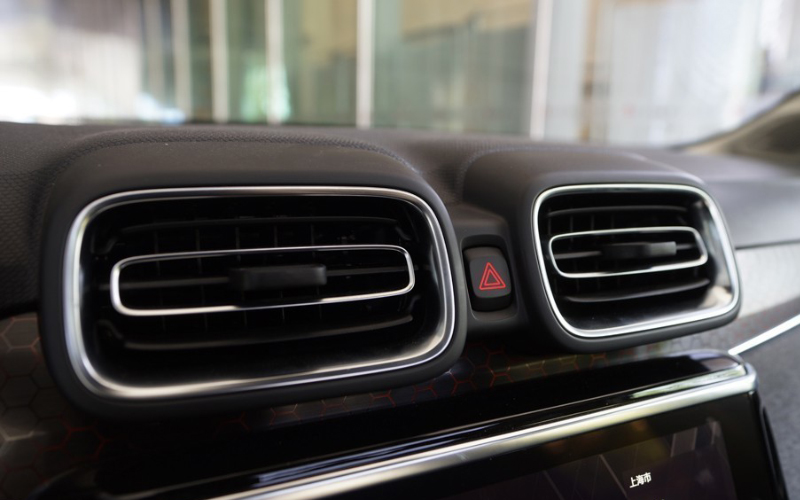
Once, I went car shopping with a friend at a 4S dealership. As I sat in the driver’s seat, the sales consultant enthusiastically introduced the vehicle: “This car has dedicated NVH optimization…” The moment he finished, he reached for the HVAC air vent adjuster—click—the blade stuck momentarily.
I laughed. They claimed NVH optimization but did not take the air vent seriously.
This detail is something only those who have experienced it can understand. It is not a major issue, but that little catch every time you adjust the vent while driving is genuinely annoying. What is even more frustrating is that by the time you notice this problem, it is generally too late to fix.
Why “Late Grease Application” Cannot Save You?
After checking some data, I found something surprising.
There is a common saying in the industry: approximately 82% of interior noise and rattle issues are design problems, not material problems.
In plain terms—this issue was built in at the drafting stage. The blade spindle clearance was set too large, the linkage fitting tolerance was not calculated clearly, and the lubrication solution was never included in the BOM… By the time the vehicle reaches consumers, the problem slowly surfaces.
What is even more painful is that once the structure is finalized, mold modification starts at hundreds of thousands, plus several months of validation at minimum. Lubricating grease in this situation is like a band-aid—it may help somewhat, but do not expect it to fix the underlying problem.
So I have been wondering: why can the lubrication solution not be considered as a designable variable from the very beginning?
Why Air Vents Are Particularly Prone to Noise
You might think: it is just a plastic blade spindle, how complicated can it be? Let me walk you through how extreme these operating conditions really are.
First: temperature differential. In winter, the air vent blows 70°C hot air; in summer, it sprays air at -20°C. One component, subjected to repeated heating and freezing. This kind of thermal cycling puts extremely demanding requirements on lubrication materials.
Second: materials. Air vents extensively use engineering plastics such as ABS and PC, which are extremely sensitive to conventional lubricating grease—the non-crystalline portion absorbs oil and causes swelling, meaning the plastic can expand, become brittle, and crack. So not just any grease will do.
Third: friction type. The air vent blade friction pair is mainly “plastic-to-plastic” and “plastic-to-metal.” At low sliding speeds, the static friction coefficient is much greater than the dynamic friction coefficient—the blade does not slide smoothly; instead it “sticks, then suddenly slips, then sticks again.” This is the stick-slip effect, not a term invented by product managers—it has a proper name.
Choosing the Wrong Lubrication Solution Is Worse Than Not Lubricating at All
I saw a case that left a deep impression.
A certain vehicle model’s air guide vane motor plastic gear aged and became brittle under thermal cycling conditions, ultimately leading to motor tooth skipping and extensive customer complaints. The manufacturer took a long time to address this, and customers were still dissatisfied.
What was the root cause? Material aging combined with lubrication failure—both problems stacking up and exploding at once. If, during the selection stage, the lubrication solution parameters had been synchronized and embedded simultaneously—eliminating dual risks at the design level—this would never have escalated to this point. The logic of forward development is to eliminate problems at the design stage. It is easy to say, but few actually do it.
There is another pitfall I must mention—oil bleed contamination.
If anti-migration design is not properly implemented, conventional lubricating grease slowly migrates along the plastic surface, ultimately leaving an oil stain ring on the air vent panel. Once this appears on an interior surface, the customer’s perception is “this car looks dirty.”
This is worse than noise and rattle. Because noise can be classified as a driving experience issue, while oil bleed contamination is a perceived quality issue. The latter has a more direct impact on purchase decisions.
Therefore, the air vent lubrication solution must simultaneously meet: minimal residue after curing plus low migration rate. And dry film lubricant is precisely purpose-built for this scenario.
Why Dry Film Lubricant Is the Optimal Solution for Air Vents
Currently, in the industry, the proven solution for precision plastic components like air vents is mainly dry film lubricant.
Several reasons:
First: ultra-thin, uniform film. After curing, it forms a dry film only a few microns thick that does not affect dimensional accuracy of precision components.
Second: extremely low migration rate. The cured film bonds firmly to the substrate and does not migrate, completely eliminating the oil bleed contamination problem.
Third: wide temperature range stability, handling both high and low temperatures. The cured film maintains lubricating performance across an ultra-wide temperature range from -40°C to +200°C—no cold start seizure in northern winters, no melting or dripping in southern summers under cabin sun exposure. Performance does not degrade under thermal cycling.
Fourth: eliminates the stick-slip effect. Dry film lubricant effectively reduces the static-dynamic friction coefficient difference, converting blade sliding from stick-slip to smooth motion. The root cause of noise is addressed at the source.
Fifth: dry and transparent, does not affect appearance. After film formation it is nearly colorless and transparent; applied inside the air vent, it is invisible from the outside. Does not affect interior aesthetics or customer perceived quality.
How Much Is It Worth to Embed Lubrication at the Design Stage?
Let me break down the cost comparison for you.
Changing design before SOP: dry film lubricant parameters included in BOM, additional cost is controllable—just a discussion to update the design.
Rectification after complaints post-SOP: mold modification hundreds of thousands, plus several months of validation cycle, brand reputation damage, and after-sales costs.
This comparison, you do not need me to do the math.
How exactly to integrate it? It is recommended to synchronize dry film lubricant selection parameters (film thickness, temperature resistance range, plastic compatibility index, low-temperature starting torque) into the design guidelines at the Class-A surface review, cross-section fitting analysis, and CAE friction simulation checkpoints. Let lubrication change from a “post-design fix” into a “design stage output.”
Have you encountered this pitfall? Or do you have any complaints about in-vehicle noise and rattle? Share your thoughts in the comments. DM me to get the “HVAC Air Vent Plastic Component Lubrication Selection Test Data Package + Material Compatibility Quick Reference + BSR Noise Test Standard Comparison Table”—I have compiled them; just say if you need it.