
By VNOVO Technical Support Team
In fluid control systems, the valve core is where lubrication decisions matter most. A valve that is hard to turn, slow to seal, or develops leaks after a short service interval is rarely a defect. It is usually a lubrication problem unaddressed at the specification stage.
PTFE grease is one of the most widely specified solutions for valve core lubrication in industrial fluid systems. Here is where it fits, where it does not, and how to specify it correctly.
What Makes Valve Core Lubrication a Distinct Challenge
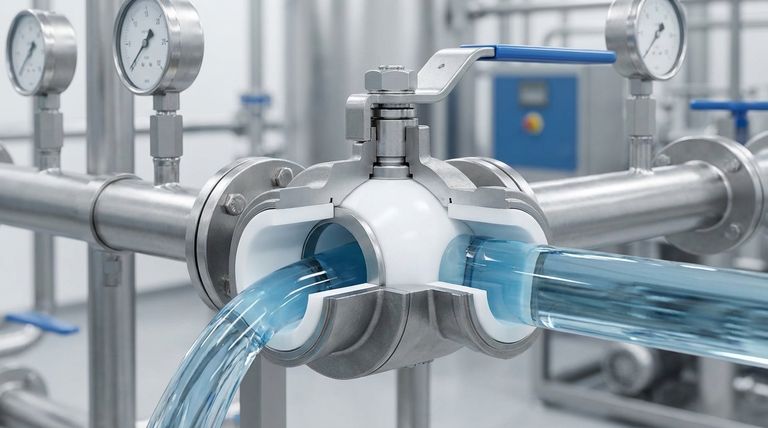
Valve cores operate under conditions that challenge most lubricants. The contact surfaces between stem, seat, and sealing elements experience side load, seating torque, and frequent direction reversal — all while exposed to the process medium, temperature extremes, and washdown or cleaning cycles.
In ball valves, globe valves, and solenoid valves, the core travels through its full range of motion with each actuation. The lubricating film at the seating face must survive compressive seating loads without being squeezed out, yet remain thin enough not to interfere with the seal. In high-cycle pneumatic actuation, this happens hundreds or thousands of times per day.
A second layer of complexity comes from material compatibility. Valve stems are commonly stainless steel or nickel-plated. Sealing elements are elastomeric O-rings, PTFE seats, or graphite packings. The lubricant must be compatible with all of these simultaneously.
Why Standard Greases Often Fail Prematurely on Valve Cores
Three failure patterns recur across valve maintenance records.
First, washout. Many processes involve water, steam, or chemical cleaning. Standard greases lose adhesion under washdown. The film is stripped from the seating face, and the valve operates dry.
Second, carbonization at elevated temperature. In steam or hot media service, temperatures at the seat can reach 150 degC or higher. Greases with insufficient thermal stability leave carbonaceous residues on the seating face that act as abrasives, accelerating wear.
Third, seal incompatibility. O-rings and stem seals made of NBR, EPDM, or FKM have specific requirements for base oil chemistry. Specifying the wrong grease creates a seal reliability problem that may not become apparent until a leak occurs.
What Properties Make PTFE Grease Suitable for Valve Core Applications
Chemical inertness. PTFE remains stable across a wide range of media including oxygenated solvents, mild acids, and alkaline solutions, making it compatible with broader process conditions than hydrocarbon-based greases.
Wide temperature margin. PTFE-thickened formulations maintain lubricity at temperatures where conventional thickener systems exceed their limits, with useful ranges from -30 degC to well over 200 degC depending on the base fluid.
Seal compatibility. Correctly formulated PTFE greases using PFPE or appropriate synthetic ester base fluids are compatible with NBR, EPDM, and FKM seal materials, eliminating secondary seal failure modes.
Water and washdown resistance. PTFE and PFPE-based greases exhibit low solubility in water and strong adhesion to metal surfaces under washdown conditions.
How to Select the Right PTFE Grease for a Valve Core Application
Step 1 – Identify operating conditions: valve type, actuation method, process medium, maximum continuous temperature, washdown or steam exposure, and seal material.
Step 2 – Match base fluid to media: PFPE base for oxidizing media, oxygen service, or temperatures above 150 degC. Synthetic ester base for general chemical process fluids – verify against specific medium.
Step 3 – Confirm seal compatibility: NBR, EPDM, and FKM seals each require specific verification against the candidate grease base fluid.
Step 4 – Verify actuation frequency: High-cycle applications require a grease with demonstrated film stability under repeated load reversal and sufficient adhesion to resist being wiped from the seating face.
Step 5 – Check environmental conditions: outdoor or process-adjacent installations require washdown resistance and corrosion protection.
Quick Reference: PTFE Grease Selection for Valve Core Applications
| Condition | Base Fluid | Key Benefit |
| Ambient water / air, NBR seals | Petroleum / synthetic ester + PTFE | General purpose, cost-effective |
| Steam / hot media above 150 degC | PFPE + PTFE | Anti-carbonization, wide temp margin |
| Strong oxidizing media / oxygen | PFPE + PTFE | Chemical inertness required |
| EPDM seals present | Synthetic ester (verified) | Seal compatibility critical |
| High-cycle actuation | Synthetic ester or PFPE + PTFE | Film stability, anti-wear |
| Outdoor / washdown exposure | PFPE or synthetic ester + PTFE + corrosion inhibitors | Water resistance + rust protection |
How VNOVO Provides Technical Support
VNOVO does not supply a single universal valve grease. Valve core lubrication is application-specific.
Application-Oriented Recommendation: VNOVO reviews valve type, actuation frequency, process medium, temperature profile, and seal material, recommending base fluid chemistry, thickener system, and consistency grade for the actual conditions.
Compatibility Verification: VNOVO confirms candidate grease compatibility with stem material, seating face finish, elastomer seal compound, and process medium.
Scenario Communication: VNOVO explains the technical basis for formulation recommendations, including trade-offs between PFPE-based and synthetic ester-based options, and supports documentation for engineering specifications.
Conclusion
When to specify PTFE grease for valve core lubrication
When the process medium, temperature range, or seal material requires chemical inertness beyond what petroleum-based greases can provide. When washdown resistance or steam service is a condition. When the valve operates in an environment with chemical splash or outdoor exposure.
When an alternative grease may be more appropriate
When the valve is a standard low-pressure water or air valve at ambient temperature with NBR seals and no washdown – a standard lithium-complex grease is typically sufficient and more cost-effective. When the valve manufacturer specifies a specific OEM lubricant not to be substituted without validation.
What VNOVO can support
Selection support: matching base fluid chemistry, thickener system, and consistency grade to valve type, actuation frequency, temperature profile, and process medium. Compatibility verification: confirming compatibility with stem materials, seating surfaces, and elastomer seal compounds. Documentation support: providing technical rationale for grease specification for procurement and engineering records.
This article is provided for informational purposes based on industry references and general lubrication knowledge. Specific valve core lubrication selection should be verified through valve manufacturer documentation and grease compatibility testing for the specific valve series and seal materials.