
In aftermarket repair, a common pattern emerges: wheel bearing noise, vibration, and deviation — even on replacements that are less than two years old. Blame often falls on bearing quality itself. But when the old part is disassembled, the raceway surface is covered with dense small pits — classic fatigue pitting. The real problem is usually in the lubrication.
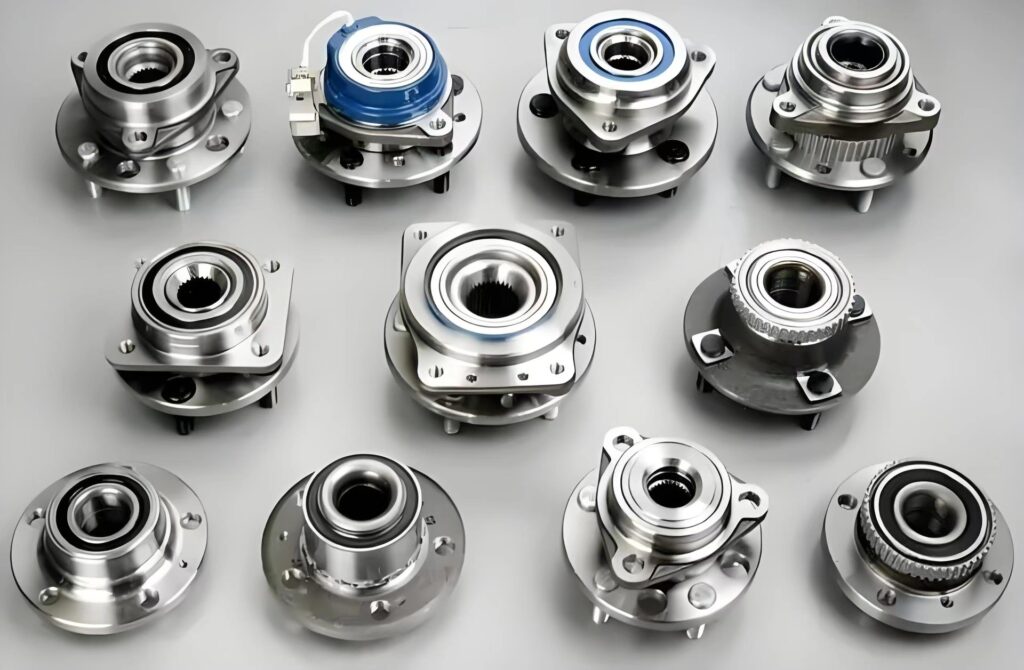
How Do Wheel Bearings Work?
Wheel bearings are installed between the wheel and half-shaft, among the most highly loaded positions in the vehicle.
During acceleration, the bearing承受驱动力; during braking, braking force returns from the brake disc; when traversing rough roads, the entire suspension system’s impact loads act upon it. Under normal use, a bearing endures over 2,000 rolling cycles per minute — approaching 4,000 at highway cruising speeds.
Inside the bearing, rolling elements循环 between the inner and outer raceways, converting sliding friction to rolling friction. Grease fills the raceway, forming an extremely thin film on the rolling contact surface that separates metal from metal. When this film fails, raceway surfaces directly承受 Hertz contact stress. After tens of thousands of cycles, micro-cracks begin to nucleate — fatigue damage is seeded.
This is the fundamental difference between fatigue pitting and ordinary wear: it is not abrasion — it is damage accumulated progressively beneath the surface from repeated stress.
────────────────────────────────────────
How Does Fatigue Pitting Form?
Subsurface crack initiation is the starting point. When a rolling element passes over the raceway, maximum shear stress occurs not at the surface but approximately 0.5 to 1 mm below it. After sufficient cycles, micro-cracks quietly appear at this depth. When lubrication is good, these cracks propagate slowly; under poor lubrication, propagation speed multiplies.
Load fluctuation acts as catalyst. Real-world vehicles operate far beyond factory design conditions. Overloading, aggressive driving, frequent hard braking — these conditions push actual bearing loads far above rated values. Peak Hertz contact stress climbs, subsurface cracks accelerate, and visible pits can form on raceway surfaces within weeks.
Centrifugal force accelerates lubrication failure. Higher speed means higher bearing RPM, which increases centrifugal force on the grease. Greases with insufficient density or adhesion are thrown out of the raceway, accumulating at the raceway edges while the contact zone dries out. The bearing removed at a repair shop is packed full at both ends but the center raceway is bone dry — a classic centrifugal oil throw pattern.
Water contamination worsens the situation. Water crossing flood roads or hosing the undercarriage easily enters the bearing cavity. Grease emulsifies upon contact with water, and the protective film completely fails. Metal surfaces are exposed directly to the atmosphere, with oxidation corrosion and fatigue damage accelerating simultaneously.
Vibration stripping is an easily overlooked factor. Continuous vibration during driving causes grease to gradually detach from metal surfaces. The process is slow, but once it begins, localized dry friction appears in bearing zones, with pitting gradually spreading from edges inward.
Combined, these factors mean wheel bearing actual service life in the aftermarket environment is often only 50%–70% of factory-rated value.
────────────────────────────────────────
Why the Aftermarket Sees More Problems
At the factory, wheel bearings undergo strict grease fill quantity control and installation process control, using OEM-validated greases.
In the aftermarket, conditions are entirely different. When technicians replace bearings, grease application quantity depends entirely on feel: too little and the raceway is not fully covered; too much and it throws oil severely during high-speed operation. Most repair shops use general-purpose greases, with adhesion and high-temperature stability falling short. Problems emerge after just tens of thousands of kilometers.
More critically, many shops overlook the sealed bearing unit’s lifetime design philosophy — bearings are filled with the specified quantity of grease at the factory, and maintenance should not add more. Over-lubrication actually increases centrifugal throw risk.
────────────────────────────────────────
Lubrication Solutions
For wheel bearing fatigue pitting, several key lubrication control points matter.
Adhesion must be strong enough. At high rotation speeds, grease cannot be thrown from the raceway by centrifugal force. Highly adhesive greases remain stably attached to metal surfaces even above 20,000 rpm. Complex lithium or complex calcium sulfonate base greases perform better in this regard.
High-temperature stability must pass muster. During continuous braking or prolonged high-speed driving, bearing temperature peaks can reach 150°C, with局部 areas approaching 180°C. Grease cannot soften or be lost at this temperature, otherwise the raceway dries quickly. Dropping point ≥200°C is the basic requirement; premium products reach 250°C or higher.
EP and anti-wear performance must meet requirements. Wheel bearing EP performance requirement is PB value ≥294 N (GB/T 3142); premium products can reach 392 N or higher. EP anti-wear additives form metallic protective films under contact zone high temperature and pressure conditions, suppressing pitting initiation and propagation. Without this protective film, bearings under high-load conditions operate almost naked.
Water resistance deserves serious attention. Complex calcium sulfonate greases perform especially well under water contamination — neither emulsifying easily nor losing their ability to form stable protective films on metal surfaces. Vehicles frequently crossing water should prioritize these product types.
Bearing life must be considered. ASTM D3527 bench testing is the industry standard for measuring wheel bearing grease life. Requirement is ≥80 hours; premium products reach 120+ hours; top-tier products can exceed 200 hours. If a grease’s D3527 data does not meet standards, actual drain intervals will shorten noticeably.
────────────────────────────────────────
Practical Grease Selection Recommendations
Summarizing: when replacing wheel bearings in the aftermarket, focus on these parameters:
- Consistency: NLGI 2# — closest to factory bearing fill condition
- Dropping point: ≥200°C — to handle brake heat
- PB value: ≥294 N — industry minimum threshold; prefer higher when available
- Bearing life D3527: ≥80 hours — the higher the number, the longer the drain interval
- Water resistance: ASTM D4049 — especially important for vehicles frequently exposed to water
A quality grease combined with the correct fill quantity — typically 1/2 to 3/4 of the bearing cavity — is what allows wheel bearings to truly reach their full service life. Bearing quality itself accounts for only half; the other half is determined by lubrication.
────────────────────────────────────────
*This article systematically analyzes the formation mechanism of fatigue pitting from wheel bearing operating principles and provides targeted lubrication solutions. If you have related questions in after-sales service, feel free to discuss them in the comments.*