
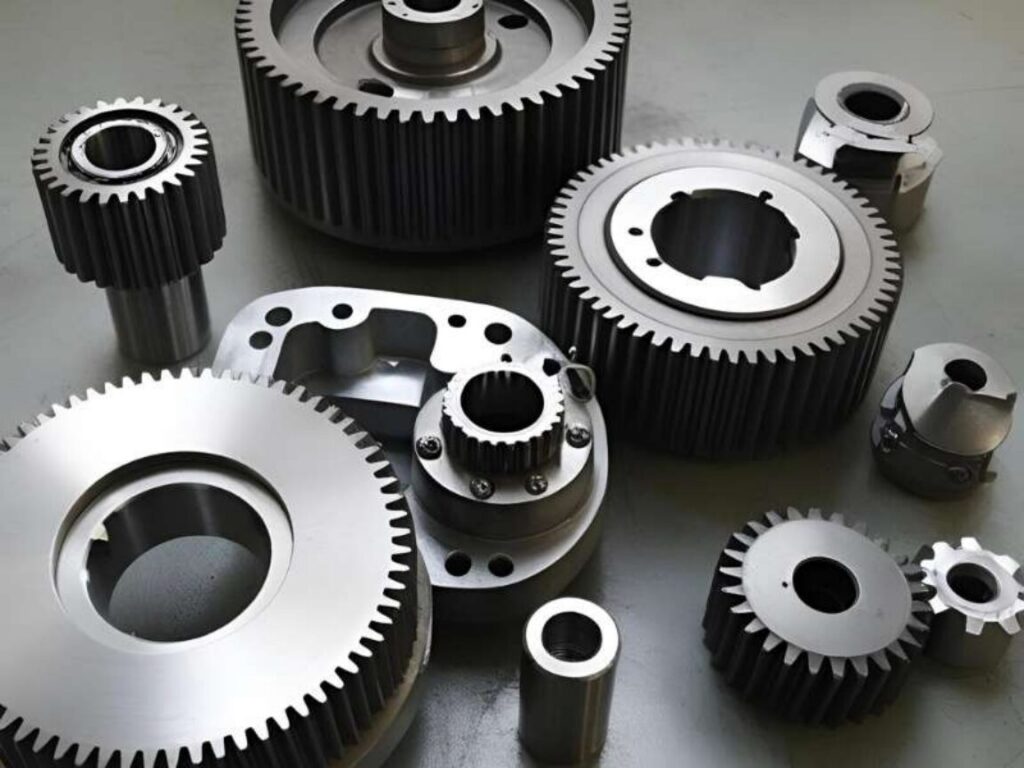
In industrial machinery, metal gears are among the most heavily loaded parts in the power transmission chain. From packaging lines and conveyors to machine tools, agricultural equipment, and material handling systems, spur, helical, bevel, worm, and planetary gears all rely on stable lubrication to prevent pitting, scoring, tooth breakage, and early fatigue failure. When oil circulation is not practical, grease becomes the preferred lubrication method.
Why industrial metal gears are difficult to lubricate
Metal gear trains in industrial machinery operate under conditions that are far more demanding than those in light-duty equipment.
They often face:
- high sliding contact, especially in worm gears
- heavy loads and shock loading during start-up, stopping, reversing, or jamming
- elevated operating temperatures from friction and nearby process heat
- long service intervals with limited maintenance access
- exposure to water, dust, chemicals, and outdoor conditions
- mixed metallurgy, such as steel gears running with bronze or brass components
These factors mean the grease must deliver film strength, thermal stability, corrosion protection, and compatibility with all contacting materials.
Why metal gear lubrication failures still happen
Routine maintenance does not always prevent gear failure. In many cases, the issue is not whether grease was applied, but whether the selected grease matches the application.
Common failure causes include:
Insufficient load-carrying capacity
A general-purpose lithium grease may work in light-duty gearing, but it can fail quickly in heavily loaded helical or worm gear sets. When film strength is inadequate, metal-to-metal contact leads to scoring, pitting, and scuffing.
Thermal degradation
When operating temperature approaches or exceeds the grease’s practical thermal limit, oxidation accelerates. This can produce acids, sludge, and varnish while also hardening or softening the thickener structure.
Wrong EP chemistry for yellow metals
In worm gear systems that use bronze or brass, sulfur-based EP additives may attack copper alloys if the chemistry is not inactive sulfur. This can cause corrosive wear that develops quietly until failure occurs.
Over-greasing
Too much grease creates churning losses, raises operating temperature, increases oxidation, and may force grease past the seals.
Contamination and grease mixing
Dust, metal particles, and process contaminants accelerate wear once embedded in grease. In addition, switching grease types without purging the old product can cause thickener incompatibility, softening, bleeding, or loss of consistency. PTFE-thickened greases are especially sensitive in this regard.
What properties matter most in a metal gear grease
A metal gear grease is defined by its base oil, thickener system, additives, and service performance.
Base oil viscosity and chemistry
Higher base oil viscosity helps maintain thicker lubricating films under heavy contact pressure. The original article notes that industrial metal gear greases may range from about 100 cSt for high-speed, lighter-load duty to more than 400 cSt for low-speed, heavily loaded service. PAO offers a wide temperature range and good oxidation stability, while mineral oil is more cost-effective but less thermally capable. PFPE offers the widest temperature and chemical resistance at higher cost.
Thickener type
Lithium is the baseline general-purpose option. Lithium complex is a common industrial default because it offers higher dropping point and better mechanical stability. Calcium sulfonate is valued for water resistance and inherent EP behavior. Polyurea offers oxidation stability and long life, but compatibility must be verified before switching.
Additives and performance indicators
For industrial metal gears, anti-wear additives are broadly recommended, while EP additives are essential in heavily loaded applications. For assemblies containing bronze or brass, inactive sulfur chemistry is preferred. Solid lubricants such as MoS₂ or graphite may also help in slow-speed, high-load service. Key indicators include dropping point, four-ball weld load, load wear index, shear stability, water resistance, and Timken OK Load.
How to choose the right grease
A practical selection process starts with the gearbox itself.
Check:
- gear type: spur, helical, bevel, worm, planetary, or hypoid
- materials: including any yellow-metal components
- operating temperature range
- speed and pitch line velocity
- torque and shock load
- environmental exposure
- relubrication interval and maintenance access
Then match the grease to the duty:
- High-speed, moderate-load planetary gears: lower-to-moderate viscosity PAO, often 100–200 cSt
- Low-speed, heavy-load drives: higher-viscosity PAO or mineral base, often 300–460 cSt, with EP and sometimes solid lubricants
- Worm gears with bronze wheels: higher-viscosity oil plus EP additives based on inactive sulfur
- Wet or outdoor environments: calcium sulfonate is often preferred
- High-temperature duty: synthetic base oils become more important above roughly 130 °C
How VNOVO can help
VNOVO supports metal gear grease selection in three areas:
- Selection guidance based on gear type, temperature, speed, load, environment, and maintenance conditions
- Material matching to assess compatibility with steels, yellow metals, seals, elastomers, and coatings
- Scenario communication to explain the technical logic, trade-offs, and validation priorities behind a recommendation