

On August 7th, CASBOT made its official debut in Changsha. At the launch event, the L1 lightweight general-purpose dexterous hand, designed for rapid operation scenarios, presented very impressive specifications: a total weight of about 610g, close to a bottle of mineral water. A grasping load of up to 25kg, equivalent to 40 times its own weight. 11 Degrees of freedom (DOF). A full hand open/close time of just 0.2s; and a price point controlled at the few-thousand-yuan level.
At the event, the CASBOT BAND robot band used the L1 to play the guitar, bass, and electronic keyboard, perfectly keeping up with the band’s fast rhythm.
610g, 25kg, 0.2s, and a few thousand yuan — viewed individually, these four numbers are product selling points. But combined, each represents a rigorous test for the dexterous hand’s transmission system grease.
25kg Load / 610g Deadweight — 40x Load Pushes Micro-Friction Pairs to the Limit

The L1 weighs 610g but has a grasping load of 25kg, making its load-to-weight ratio exceed 40 times.
The L1 uses a motor and linkage drive system. The 25kg load is transmitted through the linkage mechanism to micro-bearings, pins, and articulation points at the joints. The contact stress borne by each friction pair is far higher than under normal operating conditions. In linkage transmission, the friction pair undergoes intermittent high loads during reciprocating motion — the load spikes when grasping and drops when releasing.
If the grease lacks sufficient extreme-pressure (EP) and anti-wear performance, the oil film will be squeezed out under heavy load, causing direct metal-to-metal contact. Fretting wear will initiate within a few thousand cycles, leading to irreversible precision degradation.
Under a 25kg load, the oil film on every micro-friction pair must hold up — not just “occasionally,” but during every single grasp.
11 Degrees of Freedom — More Transmission Nodes Demand Stricter Friction Consistency
The L1 has a total of 11 DOF, driven by motors and linkages. Across the 11 transmission nodes, the friction characteristics of the bearings, pins, and articulation points at every joint must be perfectly consistent.
In linkage transmission, multi-node consistency relies heavily on the batch-to-batch consistency of the grease and its friction stability during reciprocating motion. If the grease consistency fluctuates between batches, the friction resistance in a specific joint will increase, disrupting the coordination of the entire hand — for example, if one finger is half a beat slow while strumming, the whole rhythm falls apart.
The fact that the L1 could keep up with the band’s rhythm while playing instruments relies not only on the motor’s response speed but also on the consistent friction characteristics of the 11 transmission nodes in every millisecond.
0.2s Full Hand Open/Close — Millisecond Response Means Grease Must Not Drag
The L1’s full hand open/close time is only 0.2s. 0.2 seconds is 200 milliseconds — the time it takes for the fingers to fully open, fully close, and return to an open state.
Within these 200 milliseconds, the motor must start, accelerate, decelerate, and stop, while the transmission components complete a full load-unload cycle. There are two mechanisms by which grease causes response delays: first, high consistency leads to high overall starting torque, requiring the motor to draw extra current to overcome viscous resistance. Second, a high static-to-kinetic friction ratio causes stick-slip jumping upon startup, resulting in micro-tremors in the fingers.
In a 0.2s rapid open/close scenario, high starting torque causes the fingers to fall behind the rhythm, while a high static-to-kinetic friction ratio causes a noticeable “shudder” at the moment of actuation.
At the launch event, the L1 was used to play instruments in a robot band, demanding millisecond-level response speeds. A slight error in grease viscosity selection leads to starting torque drift, making the fingers miss the beat. A slight flaw in the static-to-kinetic friction ratio causes a tremor when strumming a string. A 0.2s response speed requires the grease to provide consistent starting torque and a stable static-to-kinetic friction ratio during every start-stop cycle.
Thousands-of-Yuan Pricing — Cost-Sensitive, Grease Must Not Be a “Hidden Cost” on the Assembly Line
CASBOT has controlled the L1’s price to the few-thousand-yuan level. A dexterous hand at this price point means it is destined for mass volume — the production line must run smoothly, and the lubrication state of every unit leaving the factory must be identical.
If the grease consistency fluctuates between batches, the starting torque of each L1 will vary. The production line might not detect it (they all test “good” at the factory), and the difference will only manifest after thousands of grasps — by which time that batch of L1s has already strummed strings tens of thousands of times at the customer’s site.
A few-thousand-yuan price point means zero tolerance for costly aftermarket repairs — replacing a hand costs thousands, and customers will not accept “the grease failed first” as an excuse.
Four Numbers Combined: The VNOVO X500 Logic
Looking at 610g, 25kg, 0.2s, and a few thousand yuan together means four conditions must be met simultaneously by the grease.
25kg heavy load → Extreme pressure (EP) and anti-wear properties must be rock-solid. A fluorinated base oil paired with EP additives forms a stable protective film on the micro-bearings and pins of the linkage transmission. The oil film remains intact under heavy loads, delaying the onset of fretting wear.
11 transmission nodes → Friction consistency must be locked in. PTFE thickeners have minimal batch-to-batch consistency fluctuation, ensuring the starting torque and response speed of every finger are repeatable across batches. PTFE itself provides solid lubrication, stabilizing the friction coefficient during reciprocating motion and locking in multi-node coordination from the lubrication end.
0.2s response → Starting torque and static-to-kinetic friction ratio must not drag. The naturally low friction coefficient of fluorinated base oils, combined with a PTFE thickener whose static-to-kinetic friction ratio is naturally close to 1, ensures minimal stick-slip jumping upon startup. The fingers neither “lag half a beat” nor “shudder” during rapid opening and closing.
Thousands-of-yuan pricing → Batch consistency must be repeatable. The extremely low oil separation rate of PTFE thickeners guarantees minimal batch variation, eliminating the need to frequently recalibrate grease dispensing equipment on the assembly line. The lubrication state of every L1 is consistent when it leaves the factory, and remains consistent even after thousands of grasps.
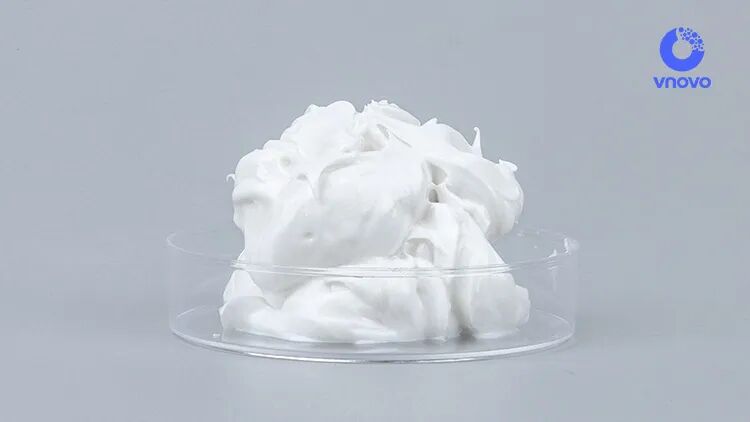
Bench test data: The X500 solution showed no visible pitting after 100,000 high-frequency cycles on the precision transmission components of dexterous hands. Currently, products are being designed following this exact logic, such as the VNOVO X500 .
The CASBOT L1 dexterous hand has drawn four bottom lines for transmission system grease with its four numbers: a 25kg load demands rock-solid EP anti-wear. 11 DOF demands locked-in friction consistency. A 0.2s response demands no drag from starting torque or friction ratios. And a few-thousand-yuan price demands repeatable batch consistency.
25kg grasping, 0.2s open/close, 11 joints synchronized — the L1 kept the rhythm perfectly in the live band performance. Once in mass production, every L1 must keep that same rhythm. The thin layer of grease on the micro-bearings and pins is the final line of defense to ensuring that rhythm is never missed.