

“Nowadays, after two hours of operation, the outer shell of many robots’ joint modules reaches 70 to 80 degrees Celsius, hot to the touch.”
This was stated by Tan Peng, Board Secretary of Zhuoyu Technology, in an interview just ahead of the 2026 World Robot Conference.
What does 70 to 80 degrees Celsius mean? According to industrial standards, if a robot’s surface temperature exceeds 55°C, a 10-second contact can cause full-thickness skin burns. A robot with a 70°C outer shell is inherently a safety hazard if it enters households or works collaboratively on a production line.
The heating problem is already an industry consensus. But heating is not an isolated phenomenon — it is a different facet of the same problem encompassing torque density, lightweight design, and power density.
Tan Peng explained the correlation in the same interview: “An increase in torque density means stronger physical performance under the same volume and weight — the robot becomes lighter, jumps higher, runs faster, and has longer endurance.” However, in a compact volume where the motor, driver, and reducer are highly integrated, nearly 90% of the electrical energy is converted into waste heat.
The industry is pushing joint modules towards being “smaller, lighter, and stronger,” but the heat dissipation space is simultaneously shrinking. This article attempts to dismantle several core sources of heat generation in joint modules.
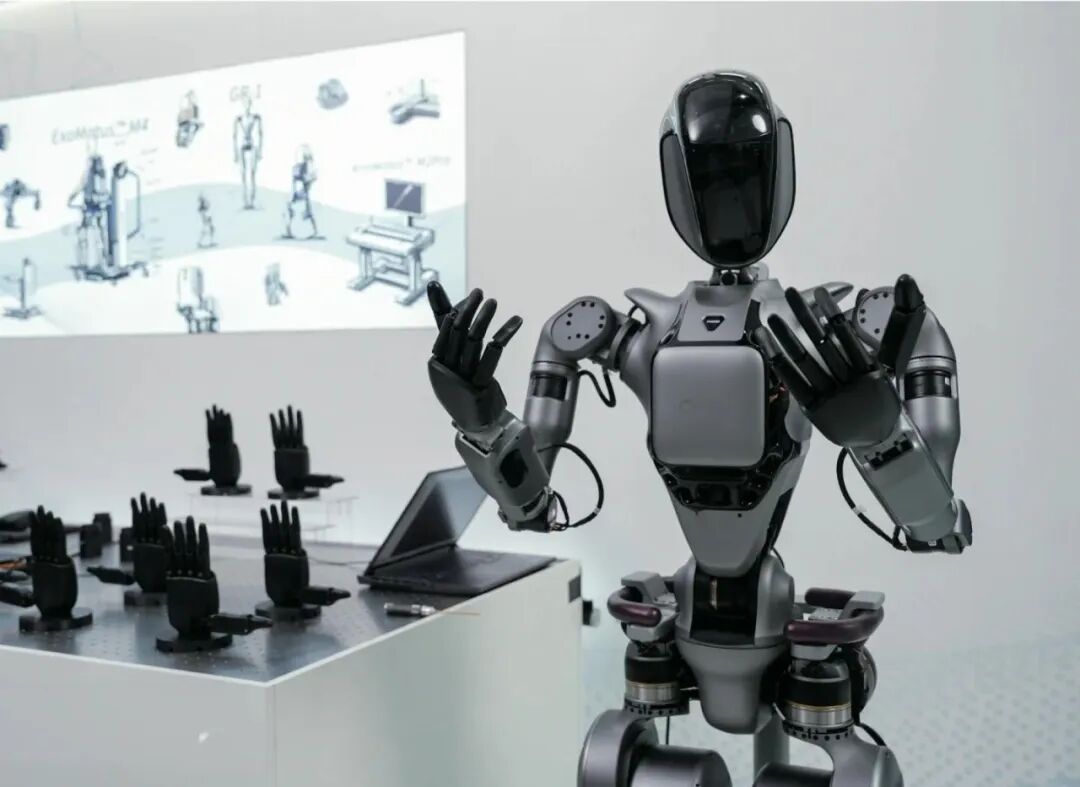
I. The Motor: The “Primary Contributor” of Heat
In humanoid robot joint modules, over two-thirds of the heat comes from motor loss. Motor heat generation mainly stems from two channels:
Copper Loss — When current flows through the motor windings, the resistance of the windings generates Joule heat. The higher the load and current, the higher the copper loss. When humanoid robots squat, lift, or brake rapidly, the joint motors must output large currents over short durations, causing copper loss to spike.
Iron Loss — The motor core in an alternating magnetic field generates eddy current loss and hysteresis loss. While a high switching frequency can reduce torque ripple and improve control precision, it also introduces additional iron loss.
The combined result of these two losses is an extremely rapid temperature rise in the motor windings. Research shows that the thermal time constant of motor windings is only 5 to 30 seconds, while that of the outer shell and reducer is 5 to 20 minutes. This means that the motor’s interior heats up rapidly first, and the heat then slowly conducts to the outer shell and reducer.
When the outer shell feels “hot to the touch,” the internal motor temperature may have already far exceeded safe limits.
II. The Reducer: The “Amplifier” of Friction Heat
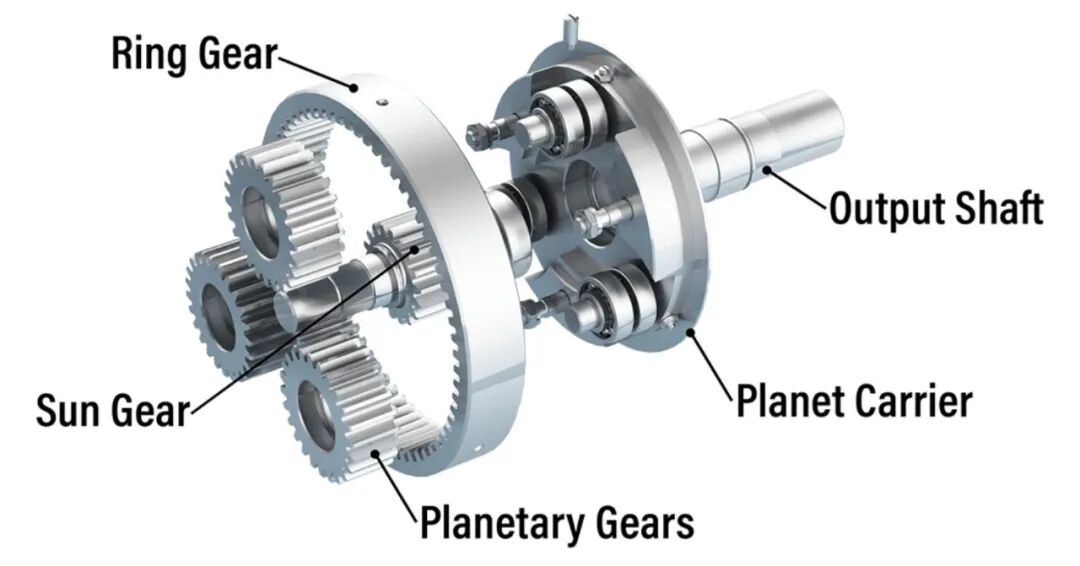
The reducer is the second heat source in the joint module. The heat from the planetary reducer primarily comes from three aspects:
Gear Meshing Loss: Friction and sliding exist during the gear meshing process, and the tooth profile and machining precision directly determine the amount of ineffective friction. The efficiency of a single-stage planetary reducer is about 95% to 97%, meaning 3% to 5% of the input energy is lost as heat. The efficiency of a two-stage planetary reducer further drops to 92% to 94%. If the gear surfaces are rough and assembly concentricity deviations are large, extra friction heat will continuously pull down transmission efficiency.
Bearing Friction Loss: The multiple sets of bearings inside the planetary reducer continuously generate friction heat during high-speed rotation. Bearing friction loss and gear friction loss are the main causes of temperature rise in the reducer.
Oil Churning Loss: When the grease is churned by high-speed rotating gears, it also generates additional energy loss.
These three types of loss overlap in the reducer, and the heat is further conducted to the casing. The reducer sits right next to the motor — two heat sources crammed into the same compact cavity, causing their heat to compound.
III. The Compact Cavity: A Structural Dilemma of Trapped Heat
The design concept of the integrated joint module is to integrate the motor, reducer, encoder, and driver all within one compact cavity. The advantages of this design are small volume, light weight, and high power density, but the cost is that the heat dissipation space is compressed to the extreme.
Of the energy generated by a humanoid robot, 90% directly converts into heat, accumulating in confined spaces like the motor windings, reducer, and chips. Dozens of heat sources such as motors, chips, and batteries are distributed throughout the robot’s body. Under the coupled effects of narrow spaces and multiple heat sources, heat easily builds up inside the sealed cavity.
What’s even trickier: constrained by overall machine size and lightweighting requirements, the thermal management system cannot be equipped with fans or liquid cooling like industrial equipment. Heat goes in, but cannot get out. The 70°C outer shell temperature conceals a much harsher thermal environment inside the cavity.
Zhuoyu Technology’s countermeasure is to improve motor efficiency — the fourth-generation torque motor’s temperature rise can be reduced by about 20 degrees Celsius compared to the previous generation, with torque density increased by 15% to 30%. But this is only a mitigation, not an eradication.
IV. The Chain Reaction of Heat: Transmission Reliability Put to the Test
The terminal impact of joint module heat lands on the transmission reliability of the planetary reducer.
The internal cavity temperature of the planetary reducer continuously rises during operation. There is a basic consensus in the industry: when an abnormal temperature rise occurs inside the gearbox, the lubrication status should be checked first — dry metal friction caused by degraded grease can reduce transmission efficiency by more than 30%.
For planetary reducers running long-term, tooth surfaces face several challenges under high temperatures:
Thinning Oil Film: As temperature rises, base oil viscosity drops, and the oil film on the tooth surface thins. Tooth surface contact stress normally operates in the 1-3GPa range; once the oil film drops below a critical point, direct metal contact occurs.
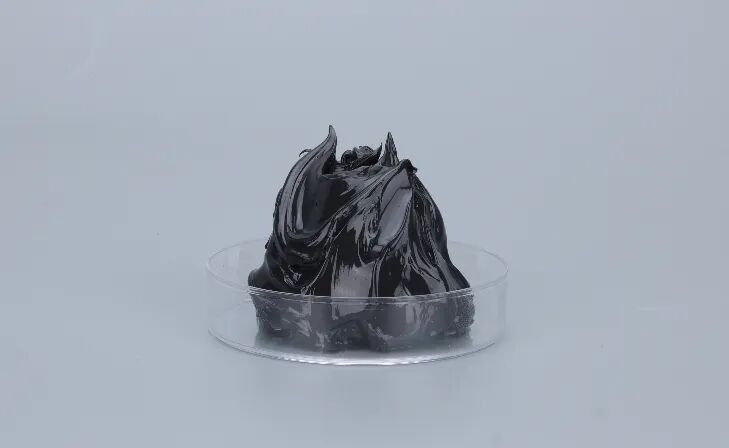
Accelerated Oxidation: High temperatures accelerate base oil oxidation, causing the grease to thicken and coke. Under long-term high-frequency, heavy-load operation, planetary gears face stubborn issues like micro-pitting, high-temperature coking, and loud operating noise.
Oil Separation and Loss: High temperatures accelerate base oil separation from the thickener. The grease dries out, hardens, and gradually loses its lubricating function.
The combined outcome of these changes is that the tooth surface slips from full-film lubrication into boundary lubrication, the friction coefficient rises, and heat compounds further — forming a cycle of “temperature rise – lubrication failure – increased noise.”
In a joint module with a 70°C outer shell, the internal temperature of the reducer is far higher than the shell. The tooth surface oil film slowly degrades under continuous high temperatures, wear accelerates, and wear in turn generates more friction heat. The starting point is heating, and the endpoint may well be the premature scrapping of the reducer.
Closing
Joint module heating is not an isolated issue of any single component. The motor generates heat, the reducer amplifies it, and the compact cavity traps it — these three elements link together to form a complete “thermal chain.”
The industry is seeking breakthroughs from multiple directions. Zhuoyu Technology reduced motor temperature rise by 20°C, and INF Robot launched a negative-pressure liquid cooling joint solution. But no matter how heat dissipation schemes evolve, localized heat in the micro-meshing zones of tooth surfaces will always exist. The ultimate answer to the heating problem is not just expelling the heat, but also ensuring that the transmission system remains reliable under continuous high temperatures.
A joint module with an outer shell at 70°C is already hot to the touch. But what truly merits attention are the internal cavity components slowly changing under high temperatures — they determine just how long a robot can reliably operate.