

In injection molding and die-casting production, precision components such as mold ejector pins and sliders undergo reciprocating motion in high-temperature environments of 80°C-250°C for extended periods. Many factories have encountered this scenario: despite adding grease on time, equipment frequently jams, and defect rates for issues like stress marks, galling, and flash remain stubbornly high.
Upon dismantling the mold, the grease has long carbonized into a black sludge, tightly adhered within the tiny 0.01-0.03mm clearance between the ejector pin and the guide bush.
This is the most hidden and fatal pain point of mold lubrication — high-temperature carbonization and coking.
Ordinary lithium-based greases, complex lithium greases, and even some synthetic high-temperature greases rapidly oxidize, harden, and carbonize at high temperatures. Carbides accumulate in the microscopic clearances between the ejector pin and guide bush, not only causing lubrication to fail completely but also acting like sandpaper, accelerating wear on the ejector pin and cavity walls. At best, the ejector pin jams and causes machine downtime.
At worst, it galls the mold cavity, resulting in the scrapping of the entire batch of products.
Even more headache-inducing is the cleaning problem posed by carbides. Once black sludge forms, routine wiping simply cannot clean it; the mold must be dismantled and soaked in cleaning agents. Frequent assembly and disassembly not only consume a massive amount of labor but also accelerate the degradation of mold precision.
Time and again: machine stops, mold is dismantled, sludge is cleaned, mold is reassembled — production capacity won’t go up, costs won’t come down, quality isn’t guaranteed, yet the problem cycles endlessly.
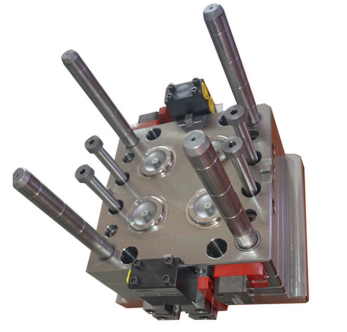
I. Doing the Math — How Much Money Are You Losing to “Cheap Grease”?
Many factories only look at the unit price when purchasing grease, ignoring the true logic of cost.
Let’s first calculate the visible cost: a jammed ejector pin takes an average of 15-30 minutes to clear. If it jams twice a day, that’s nearly 20 hours of lost production capacity in a month. Add to that the cost of galled pins, replacement pins, and the increased scrap rate from stress marks and flash — these losses combined are enough to buy three years’ worth of grease for the entire production line.
But the bigger pitfall lies hidden: cleaning the carbonized sludge requires dismantling the entire mold, soaking it in cleaning agents, brushing, drying, and reassembling. The cleaning cycle for a medium-sized mold takes about 2-4 hours. If dismantled and washed once a month, it adds up to nearly a hundred hours of maintenance labor a year. More fatally, frequent dismantling accelerates the loss of mold precision.
A mold designed for a 300,000-shot lifespan might not even last 100,000 shots before being scrapped prematurely.
Under this logic, the choice of grease becomes very clear: the real cost is not the price of the grease, but whether it can endure the working conditions.
The answer provided by the VNOVO high-temperature grease series is — a single application for long-lasting protection. Formulated with fully synthetic base oils and specialized thickeners, its structural composition is smooth and delicate, featuring excellent mechanical and chemical stability. Under continuous high-temperature conditions, it does not drop oil, soften, or coke, allowing a single application to cover tens of thousands of operating cycles.
Even in heavy-load, high-temperature scenarios like die-casting molds, it maintains stable lubricating film strength, extending maintenance intervals from “weekly” to “monthly” or even “quarterly.”
II. Why Ordinary Greases Fail at High Temperatures: VNOVO’s Technical Breakthrough from the Failure Mechanism
To solve carbonization and coking, one must first understand its formation mechanism.
Ordinary greases consist of three parts: base oil + thickener + additives. In high-temperature environments, the base oil accelerates evaporation, and the soap-based structure in the thickener undergoes irreversible oxidative decomposition, forming carbonaceous residues. These residues mix with moisture in the air and metal wear debris, eventually hardening into black sludge. The essence of this process is — the chemical structure of the grease has been destroyed by high temperatures.
Therefore, to eliminate carbonization and coking, you cannot rely on “applying a bit more”; you must start from the molecular structure of the grease.
The VNOVO fluorine grease series follows this technical path. Using Perfluoropolyether (PFPE) as the base oil — which is currently one of the base oils with the strongest known oxidation and thermal stability — combined with a PTFE thickener, it forms a stable lubrication system. The molecular structure of PFPE contains no easily oxidized C-H bonds, meaning it barely volatilizes or decomposes at high temperatures, naturally generating no carbonaceous residues.
The operating temperature range covers -50°C to 200°C, fully capable of handling the vast majority of high-temperature mold conditions.
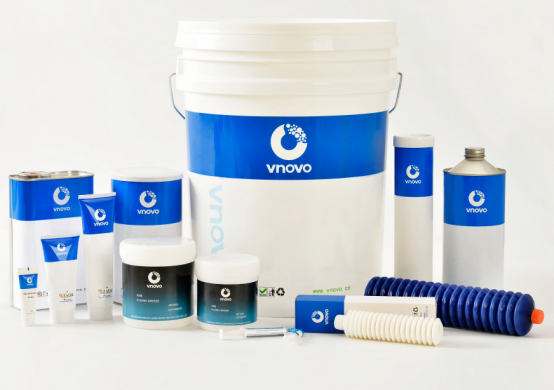
For optical-grade and medical-grade molds with extremely high cleanliness requirements, VNOVO dry film lubricants offer another technical approach: formulated by mixing non-flammable fluorine solvents with PFPE oil and ultra-low molecular weight PTFE particles. After the solvent evaporates, it forms a uniform dry lubricating film on the metal surface.