

By VNOVO Technical Support Team
In automotive brake systems, the brake pad must slide smoothly in the caliper, the caliper must float freely on its guide pins, and every threaded fastener must be removable at the next service interval. When any interface seizes, the consequences range from uneven pad wear and brake drag to caliper failure. Anti-seize paste prevents the problem – but the wrong paste can be as harmful as none at all.
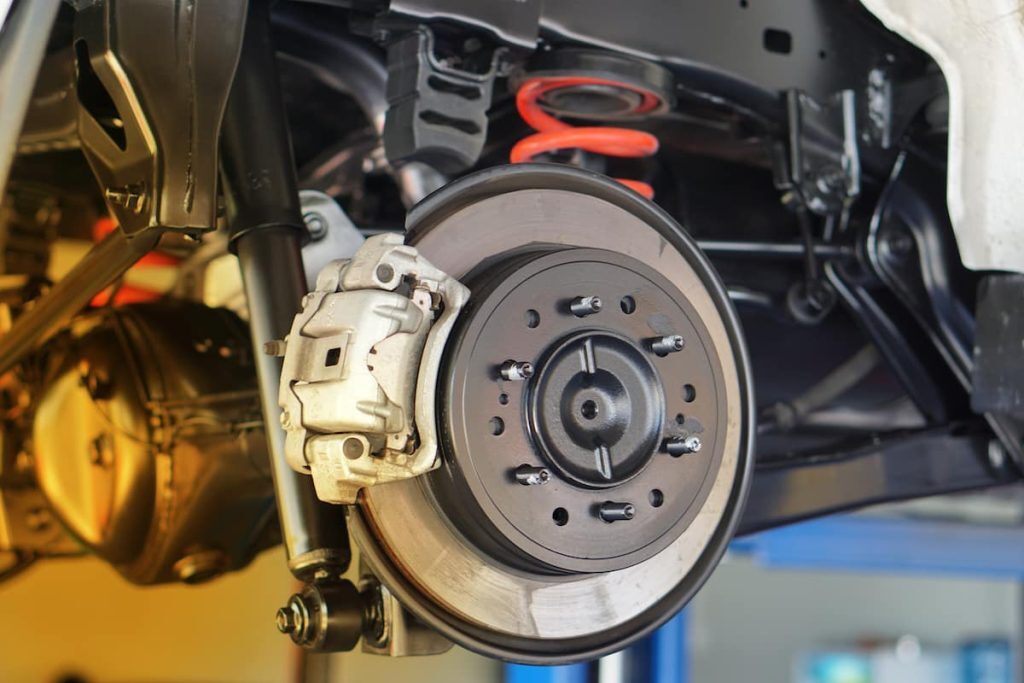
What Makes Automotive Brake Applications Demanding for Anti-Seize Paste?
Brake systems combine extreme conditions:
– High operating temperatures. Brake components reach 300-600 °C during heavy braking. The paste must not melt, carbonize, or lose its protective film.
– Galvanic corrosion risk. Brake systems combine cast iron rotors, steel calipers, and aluminum caliper bodies. Where different metals contact in moisture and road salt, galvanic corrosion accelerates.
– Exposure to road salt, water, and debris. Cold-climate components face continuous salt spray and slush. The paste must resist washout.
– Critical torque relationships. Brake bolts and hub fasteners have specified torque values. Anti-seize changes thread friction – incorrect application causes over-torquing and fastener failure.
– Brake dust contamination. The paste must not bind brake dust into an abrasive compound that accelerates wear.
– Brake pad friction sensitivity. Any paste migrating onto the pad face reduces braking effectiveness. The paste must stay where applied.
– Long service intervals. Vehicles may go 50,000-100,000 km between brake services. The paste must remain effective for years without drying or washing away.
Why Do Brake System Problems Persist Even When Anti-Seize Paste Is Applied?
Six failure modes continue to cause issues:
1. Paste migrating onto pad friction surfaces. Over-application or low-consistency paste spreads onto the pad face during caliper compression, reducing braking.
2. Copper-based paste causing galvanic corrosion on aluminum. Traditional copper anti-seize, applied between aluminum and steel, accelerates galvanic corrosion – copper acts as a cathodic material worsening the cell.
3. Over-torquing threaded fasteners. Anti-seize reduces thread friction, so the same torque produces higher clamp load. Applying dry-torque specs to lubricated threads over-stresses fasteners.
4. Paste drying or hardening between services. Some formulations oxidize at elevated brake temperatures, becoming a crust that no longer protects.
5. Wash-off in severe road-salt conditions. Pastes with inadequate water resistance are displaced from guide pins and hub interfaces during winter driving.
6. Incompatibility with rubber guide pin boots. Some formulations swell or deteriorate rubber boots, allowing water ingress and internal corrosion.
What Properties Determine Whether an Anti-Seize Paste Will Perform in Brake Systems?
Key properties:
– Temperature rating. Copper-based pastes survive to 1000 °C+; nickel-based and ceramic-based also offer high temperature capability; other formulations have lower limits.
– Metal composition and galvanic compatibility. Copper-based pastes suit steel-to-steel or steel-to-cast iron but risk galvanic corrosion on aluminum. Nickel-based, ceramic-based, or non-metallic pastes are preferred where aluminum is present.
– Water resistance. Must resist washout from road spray and salt, maintaining a continuous barrier.
– Thread friction coefficient. Anti-seize changes the torque-tension relationship. When applied to threads, torque must be adjusted – typically reduced 20-30% depending on paste and application.
– Rubber and elastomer compatibility. Must not swell, soften, or degrade rubber guide pin boots or other seals.
– Consistency and stay-put behavior. Thick enough to stay on vertical surfaces without slumping, but soft enough to distribute evenly under assembly pressure.
– Non-contaminating to friction surfaces. Low mobility after application – must not flow onto brake pad faces.
How to Select the Right Anti-Seize Paste for Your Brake Application
Step 1 – Identify the interface and materials:
| Interface | Materials | Key Requirement |
| Caliper guide pins | Steel pin / aluminum caliper / rubber boots | Galvanic safety, rubber compatibility, water resistance |
| Pad-to-caliper ear contacts | Steel pad ear / aluminum or cast iron caliper | High temp, low migration, smooth slide |
| Hub-to-rotor face | Cast iron hub / cast iron rotor | Corrosion barrier, high temp, re-serviceability |
| Caliper bracket bolts | Steel bolt / aluminum bracket | Thread friction control, corrosion prevention |
| Lug studs / wheel hub | Steel stud / alloy or steel wheel | Corrosion barrier, torque control, re-serviceability |
Step 2 – Match paste type: Copper-based for steel-to-steel/cast iron only. Nickel-based or ceramic-based for any interface involving aluminum. Non-metallic for maximum galvanic safety.
Step 3 – Adjust torque: When anti-seize is applied to threads, reduce torque from dry specification. Consult the paste manufacturer’s guidance or vehicle service manual for lubricated-thread torque values.
Quick Reference: Selection Guide
| Interface / Condition | Key Properties | Direction |
| Guide pins (aluminum caliper) | Aluminum-safe, rubber-compatible, water-resistant | Nickel or ceramic-based; non-copper; verify boot compatibility |
| Pad ears / abutment clips | High temp, low migration, smooth slide | High-temp paste; minimal slump; apply sparingly |
| Hub-to-rotor face | High temp, corrosion barrier, re-serviceable | Copper acceptable (iron-to-iron); or ceramic for broader safety |
| Bracket bolts (aluminum) | Aluminum-safe, torque adjustment | Nickel or ceramic; reduce torque 20-30% |
| Lug studs / wheel | Corrosion barrier, torque control | Light application; follow vehicle spec for lubricated threads |
| Severe salt / winter | Maximum water resistance, long-term barrier | Marine-grade or tackifier-enhanced; non-copper if aluminum present |
How VNOVO Provides Technical Support
VNOVO does not supply off-the-shelf “brake anti-seize paste” with universal claims:
Application-Oriented Selection Guidance – VNOVO reviews your brake system materials, interface types, operating temperature, and environmental exposure, mapping them against paste categories to recommend metal content (copper/nickel/ceramic/non-metallic), temperature rating, water resistance level, and torque adjustment guidance.
Material Compatibility Verification – VNOVO helps assess candidates against all materials: caliper body alloy, guide pin steel, rotor cast iron, rubber boot elastomer, and any coatings – with emphasis on galvanic compatibility with aluminum and rubber boot safety.
Scenario-Based Communication Support – VNOVO provides rationales explaining *why* a direction is suggested, what trade-offs exist (copper = excellent high-temp and steel compatibility but galvanic risk on aluminum vs. nickel/ceramic = broader material safety but higher cost; more paste = better barrier but higher migration risk onto friction surfaces), and what validation steps to prioritize.
Conclusion
When to use specialized anti-seize paste in brake systems
When the brake system includes aluminum caliper bodies requiring galvanic-safe formulations, operates in high-temperature or salt-exposed environments, has threaded fasteners requiring controlled torque-tension relationships, or has a history of seizure at pad-to-caliper or guide pin interfaces.
When a general-purpose approach may suffice
When all interfaces are steel-to-steel or steel-to-cast iron with no aluminum present, the vehicle operates in mild climate with minimal salt exposure, and service intervals are short enough that corrosion has not been an issue.
What VNOVO can support
1. Selection guidance – translating brake materials, interface types, temperature, and environment into paste category, metal content, temperature rating, and torque adjustment
2. Material matching – assessing compatibility between paste candidates and all metals, rubber boots, and elastomeric seals
3. Scenario communication – providing the technical rationale and decision framework to specify, validate, and apply the right anti-seize paste for your brake system
*This article is provided for informational purposes based on publicly available industry references and established lubrication engineering principles. Specific product selection should always be verified against the vehicle manufacturer’s service guidelines, OEM recommendations, anti-seize paste supplier technical data sheets, and material compatibility data.*