
By VNOVO Technical Support Team
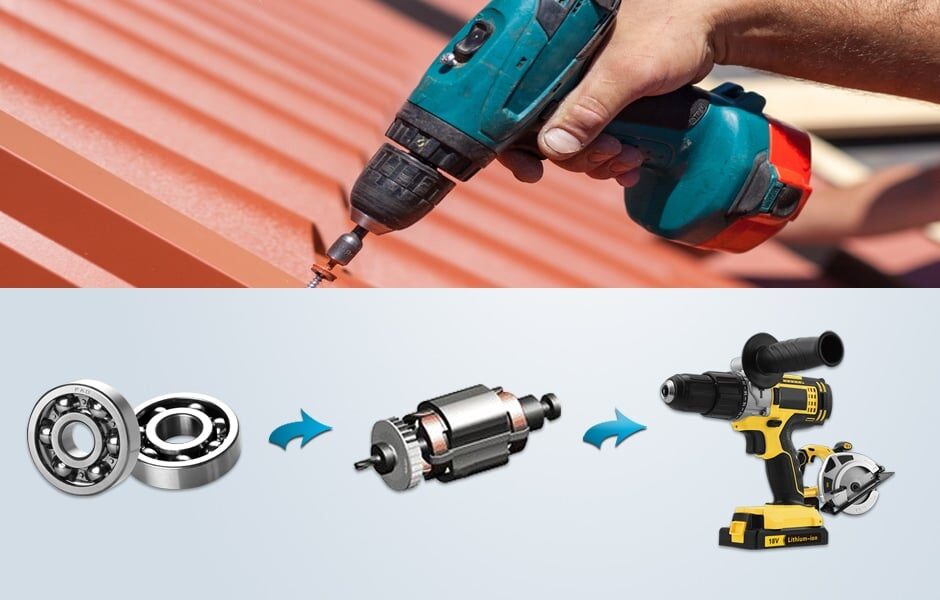
Inside every power tool – angle grinders, drills, impact drivers, circular saws, rotary hammers – bearings support the motor armature, transmission shafts, and output spindle at high speed under load. When the wrong grease is used, the bearing fails prematurely and the tool stops. Selecting the right bearing grease requires understanding conditions that differ from general industrial applications.
What Makes Power Tool Bearing Lubrication Demanding?
Power tool bearings push grease beyond typical limits:
– High rotational speeds. Motor armature bearings routinely operate at 20,000-35,000 rpm. The speed factor (DN = rpm × bore diameter in mm) often exceeds 500,000, placing these bearings in the high-speed category. The grease must provide film while generating minimal viscous drag.
– Heavy and shock loads. Impact drivers and hammer drills transmit repeated impacts through spindle bearings. Grinders carry radial loads from cutting forces. The grease must maintain film under dynamic, shock-type loading.
– Elevated temperatures. Motor heat, gear friction, and cutting load combine to raise bearing temperatures to 80-120 °C in sustained heavy use. General-purpose greases rated for 50-100 °C may not last.
– Frequent start-stop cycles. Tools are switched on and off repeatedly. Each start requires boundary lubrication before full film is established, increasing wear risk.
– Compact bearings with minimal grease fill. Power tool bearings are small (6xx and 62xx series). Fill quantity is measured in tenths of a gram. The grease must perform with this minimal charge.
– Dust, debris, and moisture exposure. Construction tools operate in dirty, wet conditions. The grease must help seals exclude contaminants and resist washout.
– Long intervals between service. Many tools are not re-lubricated until failure. The grease must last the bearing’s intended service life.
Why Do Power Tool Bearing Problems Persist Even When Grease Is Applied?
Six failure modes continue to cause issues:
1. Grease softening at high speed and temperature. At 30,000 rpm and 100+ °C, some greases shear-thin, losing consistency and leaking from the bearing.
2. Insufficient EP protection under shock loads. General-purpose greases without EP additives may not protect raceways under repeated impacts, causing pitting and spalling.
3. Excessive viscous drag at high speed. Too-high viscosity generates excessive heat at high DN, accelerating thermal degradation.
4. Grease oxidation at elevated temperatures. Continuous operation above 100 °C accelerates oxidation in mineral oil greases, causing hardening and loss of effectiveness.
5. Contaminant ingress. Greases with poor water resistance (ASTM D1264) or low tack allow contaminants to penetrate, accelerating wear and corrosion.
6. Under-filling or over-filling. Too little grease → under-lubrication; too much → churning heat at high speed. Both reduce bearing life.
What Properties Determine Whether a Bearing Grease Will Perform in Power Tools?
Key properties:
– Base oil viscosity. Must balance film under load against drag at speed. Lower viscosity (32-68 cSt at 40 °C) for high-speed armature bearings; higher (100-220 cSt) for slower, heavily loaded spindle bearings.
– Thickener type. Lithium complex offers mechanical stability, water resistance, and temperature to 150+ °C. Polyurea offers excellent high-temperature life and noise characteristics.
– DN rating. The grease must be rated for the bearing’s operating DN value. High-speed greases minimize internal friction and heat.
– EP / anti-wear performance. For shock or heavy loads, greases with proven EP (Timken OK Load ASTM D2509, Four-ball EP ASTM D2596) protect raceways.
– Temperature rating. SKF classification: general-purpose to 100 °C, high-temperature to 150 °C, extreme above 150 °C. Must exceed expected operating temperature with margin.
– Water resistance. ASTM D1264 washout resistance matters for wet or dusty conditions.
– Mechanical stability. Must resist shear thinning at high speed, maintaining consistency throughout service life.
How to Select the Right Bearing Grease for Your Power Tool
Step 1 – Identify the bearing location and conditions:
| Bearing Location | Typical Conditions | Key Requirement |
| Motor armature | 20,000-35,000 rpm, 80-120 °C, moderate load | High DN, low drag, thermal stability |
| Transmission shaft | 5,000-15,000 rpm, 70-100 °C, moderate-heavy load | Load support, EP, moderate speed |
| Output spindle (grinder/saw) | 5,000-12,000 rpm, 60-100 °C, heavy radial load | Heavy load, EP, dust resistance |
| Impact mechanism | Shock loads, 3,000-8,000 rpm, 70-110 °C | EP, shock absorption, mechanical stability |
| Hammer drill spindle | Combined shock + radial, 60-100 °C | EP + heavy-load film, water resistance |
Step 2 – Match viscosity and thickener: High-speed armature → lower viscosity PAO or PAO/ester, Li-complex or polyurea. Heavier-loaded → higher viscosity, Li-complex with EP.
Step 3 – Fill correctly: 25-35% of free internal space for high-speed bearings. More grease = churning heat; less = under-lubrication.
Quick Reference: Selection Guide
| Bearing / Tool Type | Key Properties | Direction |
| Armature (high-speed) | High DN, low drag, thermal stability | Low-visc PAO/ester (32-68 cSt); Li-complex or polyurea; NLGI 2 |
| Transmission shaft | Moderate speed, EP, load support | Medium viscosity (68-100 cSt); Li-complex with EP; NLGI 2 |
| Grinder/saw spindle | Heavy radial load, dust, EP | Higher viscosity (100-150 cSt); Li-complex; EP; water resistance |
| Impact mechanism | Shock load, EP, mechanical stability | EP grease (Timken/4-ball verified); Li-complex |
| Hammer drill spindle | Combined shock + radial, wet | Heavy-load EP grease; water resistant; tackifier-enhanced |
How VNOVO Provides Technical Support
VNOVO does not supply off-the-shelf “power tool bearing grease” with universal claims:
Application-Oriented Selection Guidance – VNOVO reviews your bearing location, operating speed (DN value), load type and magnitude, temperature range, and environmental exposure, mapping them against formulation categories to recommend base oil type and viscosity, thickener system, EP level, and fill quantity.
Material Compatibility Verification – VNOVO helps assess candidates against bearing steel, cage material (steel, brass, polymer), seal elastomer, and polymer housing components – with emphasis on cage compatibility and seal safety.
Scenario-Based Communication Support – VNOVO provides rationales explaining *why* a direction is suggested, what trade-offs exist (lower viscosity = less drag at speed but thinner film vs. higher viscosity = better load support but more heat; EP = better shock protection vs. no EP = cleaner at moderate loads), and what validation steps to prioritize.
Conclusion
When to use specialized bearing grease in power tools
When the bearing operates at high DN values requiring controlled drag, under shock or heavy loads requiring EP protection, at temperatures above 100 °C requiring thermal stability, or in wet or dusty conditions requiring water resistance.
When a general-purpose approach may suffice
When the tool operates at moderate speed and load with intermittent use, bearing temperatures stay below 80 °C, conditions are clean and dry, and the service interval is short enough that degradation has not been an issue.
What VNOVO can support
1. Selection guidance – translating bearing location, speed, load, temperature, and environment into base oil type, viscosity, thickener, EP level, and fill quantity
2. Material matching – assessing compatibility between candidates and bearing steel, cage material, and seal elastomers
3. Scenario communication – providing the technical rationale and decision framework to specify, validate, and apply the right bearing grease for your power tool
*This article is provided for informational purposes based on publicly available industry references and established lubrication engineering principles. Specific product selection should always be verified against the tool manufacturer’s guidelines, OEM recommendations, lubricant supplier technical data sheets, and material compatibility data.*