
By VNOVO Technical Support Team
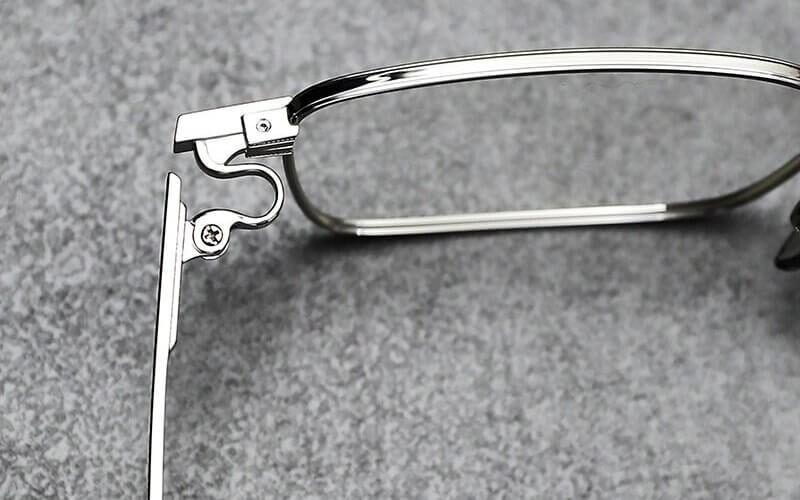
Eyewear hinges are among the smallest precision joints in consumer products. A typical pair of glasses opens and closes dozens of times daily, and the hinge must do so smoothly, silently, and without visible residue – for years. Conventional grease fails here: it attracts dust, migrates onto lenses and skin, and degrades with perspiration. Dry film lubricant – a thin, solid-bonded coating on the hinge’s metal contact surfaces – provides lubrication without any wet, sticky, or migrating film.
What Makes Eyewear Hinges Demanding for Lubrication?
– Micro-scale contact, high cycles. Hinge contact areas are measured in square millimeters, enduring thousands of open-close cycles – often exceeding 10,000 over the product’s life.
– Zero tolerance for residue. Any lubricant migrating onto lenses, frames, or skin is unacceptable. Greases and oils creep from the joint, creating oily films on lenses.
– Skin oil and perspiration exposure. The hinge sits against the wearer’s temple. Sebum, sweat, and cosmetics contact it continuously. Wet lubricants dissolve or degrade; dry films do not.
– Corrosion from humidity and salt. Perspiration contains salt. The lubricant must not wash away and ideally should contribute to corrosion protection.
– Aesthetic and tactile requirements. The hinge must open and close smoothly, consistently, and silently. Any squeak or roughness is perceived as poor quality.
– Tight tolerances. Eyewear hinges have clearances of tenths of a millimeter. Lubricant adding measurable thickness interferes with feel. Dry films at 0.5-1.0 microns maintain dimensional integrity.
– Temperature cycling. Glasses move between cold outdoor air and warm skin repeatedly.
– No re-lubrication. Once assembled, the hinge is sealed. The lubricant must perform for the product’s entire life.
Why Do Eyewear Hinge Problems Persist Even When Lubrication Is Attempted?
1. Grease migration. Conventional greases creep from the hinge along the frame, creating oily films on lenses that impair vision.
2. Dust attraction. Wet lubricants attract dust and skin debris, creating a gritty paste that accelerates wear.
3. Washout from sweat. Oils and soft greases dissolve in sweat, losing lubricating function and leaving metal unprotected.
4. Feel change after break-in. Wet lubricants thin or migrate after initial cycles, altering closing force and creating a loose feel.
5. Corrosion after washout. Once sweat displaces the lubricant, bare metal corrodes, staining the frame and stiffening the hinge.
6. Thick coatings altering tolerance. Some dry films applied too thickly (e.g., MoS₂ at 0.0005″) alter hinge clearances and feel.
What Properties Make Dry Film Lubricant Suitable for Eyewear Hinges?
– Zero migration. Bonded to the metal surface. Does not creep, flow, or transfer to lenses or skin.
– Ultra-thin coating. WS₂ at approximately 0.5 microns (0.00002″) maintains tight tolerances. PTFE-based films are slightly thicker but still sub-micron.
– Extremely low friction. WS₂ achieves coefficient of friction as low as 0.035 – among the lowest of any solid lubricant. Smooth, consistent hinge motion.
– Ambient application. WS₂ is applied at ambient temperature – no heat curing that could distort thin hinge components. PTFE coatings may require curing at 350-715 °F.
– Resistance to sweat and oils. Chemically inert, insoluble in water and oils. Does not dissolve, emulsify, or wash out.
– Corrosion protection. MoS₂ and PTFE-based coatings (Teflon, Xylan) offer stronger corrosion protection than WS₂ alone, suited to salt-exposure environments.
– Load capacity. WS₂ withstands contact pressures up to 100,000 psi, far exceeding hinge loads. The coating does not wear through under repeated stress.
– Wide temperature range. WS₂ functions from below -180 °C to ~650 °C. PTFE to ~260 °C. Both far exceed eyewear needs.
– Clean, dry surface. Remains dry to the touch, attracting no dust or debris.
How to Select the Right Dry Film Lubricant for Eyewear Hinges
Step 1 – Identify hinge conditions:
| Hinge Condition | Key Variables | Primary Requirement |
| Standard stainless hinge | Moderate cycles, indoor/outdoor | Low friction, zero migration, corrosion resistant |
| Nickel silver / alloy | Corrosion risk, skin contact | Corrosion protection + low friction |
| Titanium premium hinge | Tight tolerance, premium feel | Ultra-thin, lowest friction |
| Spring-flex hinge | Repeated flex, higher stress | Load capacity, adhesion under flex |
| Coastal / tropical use | Humidity, salt, sweat | Maximum corrosion protection |
| Safety / sports eyewear | Impact, sweat, frequent handling | Durability, corrosion, clean surface |
Step 2 – Match coating: Standard stainless → WS₂ (thinnest, lowest friction, ambient cure). Corrosion-prone alloy → MoS₂ (corrosion protective) or PTFE-based. Premium tight tolerance → WS₂. High corrosion → PTFE-based or MoS₂ with binder.
Step 3 – Verify: Confirm thickness does not affect tolerance. Confirm adhesion to specific alloy. Confirm no curing temperature risk. Confirm friction produces desired feel.
Quick Reference: Dry Film Selection for Eyewear Hinges
| Hinge / Condition | Key Properties | Direction |
| Standard stainless | Lowest CoF (0.035), ultra-thin | Tungsten disulfide (WS₂) |
| Corrosion-prone alloy | Corrosion protection | Molybdenum disulfide (MoS₂) |
| Titanium / premium | Ultra-thin (0.5 μm) | WS₂ |
| Spring-flex hinge | Load capacity, adhesion | WS₂ or MoS₂ (verify adhesion) |
| Coastal / high sweat | Max corrosion protection | PTFE-based (Teflon/Xylan) |
| Safety / sports | Durability, corrosion | MoS₂ or PTFE-based |
How VNOVO Provides Technical Support
VNOVO does not supply off-the-shelf “dry film lubricant” with universal claims:
Application-Oriented Selection Guidance – VNOVO reviews your hinge material, operating conditions (cycle count, skin contact, corrosion environment), tolerance constraints, and desired feel, recommending solid lubricant chemistry, coating thickness, curing method, and corrosion protection level.
Material Compatibility Verification – VNOVO helps assess candidates against the specific hinge alloy, spring material, and any plated surfaces – confirming adhesion, confirming no dimensional interference, and confirming no curing-temperature risk.
Scenario-Based Communication Support – VNOVO provides rationales explaining *why* a direction is suggested, what trade-offs exist (WS₂ = thinnest and lowest friction but no inherent corrosion protection vs. MoS₂ = thicker and corrosion-protective but may affect tight tolerances vs. PTFE = strongest corrosion resistance but requires heat curing; ambient cure = safe for all materials vs. heat cure = risk of distortion; thinner = no tolerance impact vs. thicker = corrosion buffer but potential fit change), and what validation steps to prioritize – including cycle life testing under perspiration exposure and feel assessment.
Conclusion
When to use dry film lubricant on eyewear hinges
When zero migration onto lenses and skin is required, when perspiration and skin oil would degrade wet lubricants, when dimensional tolerances demand sub-micron coating thickness, when a clean dry surface must be maintained, or when the hinge must operate for years without re-lubrication.
When a wet lubricant may be acceptable
When the hinge is enclosed in a sealed housing preventing migration, when the application is industrial rather than consumer-facing, or when loads require the film thickness and self-healing properties of grease.
What VNOVO can support
1. Selection guidance – translating hinge material, environment, and feel requirements into dry film chemistry, thickness, and cure method
2. Material matching – assessing coating adhesion and dimensional impact against specific hinge alloys and tolerances
3. Scenario communication – providing the rationale to specify, apply, and validate the right dry film lubricant for your eyewear hinges
*This article is provided for informational purposes based on industry references and dry film lubrication principles. Specific coating selection should always be verified through cycle life testing, dimensional verification, and feel assessment.*