
By VNOVO Technical Support Team
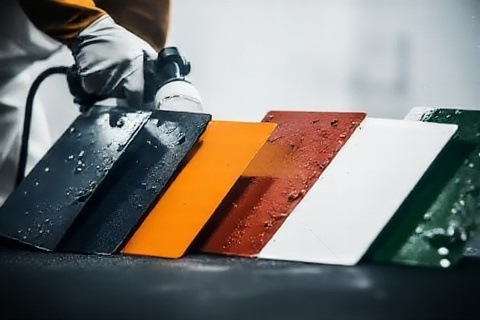
Steel structures – bridges, cranes, offshore platforms, and industrial buildings – operate in environments where corrosion, friction, and wear converge. Atmospheric moisture accelerates corrosion; wind-induced movement creates friction at joints; dynamic loads generate wear at contact points. Metal coating in this context means solid film anti-friction coatings applied to bolted, hinged, and sliding connections – providing wear protection, reduced friction, and often corrosion resistance – without the maintenance burden of wet lubricants.
What Makes Steel Structure Protection Demanding for Metal Coating?
– Atmospheric corrosion. Steel in coastal, industrial, or humid environments faces continuous moisture and chloride attack. Corrosion weakens members and accelerates joint failure.
– Fretting at bolted connections. Vibration and load cycling cause microscopic wear (fretting) at contact surfaces, gradually reducing clamp load and threatening joint integrity.
– Thread seizure in assembly and maintenance. Fasteners exposed to moisture seize, making future disassembly difficult or impossible without coating protection.
– Wear at sliding and hinged joints. Bridge bearings, crane guides, and building door hinges experience continuous motion under load. Uncoated, these surfaces wear rapidly.
– High temperature exposure. Steel near furnaces or process equipment faces temperatures that degrade conventional lubricants.
– Difficult maintenance access. Elevated or remote structural locations require permanent coatings rather than periodic relubrication.
Why Do Steel Structure Problems Persist Even When Coatings Are Applied?
1. Wrong coating for the failure mode. A decorative paint applied where wear protection is needed, or a low-friction coating where corrosion is the primary threat.
2. Coating thickness alters bolt clamp load. MoS₂ at 0.0005″ may affect torque specifications for precision bolting. WS₂ at 0.00002″ avoids this.
3. Cure temperature incompatible with structure. PTFE and Xylan require 350-715 °F – impossible for in-situ large structural members without disassembly.
4. Moisture under delaminated coating. Poor adhesion traps moisture against steel, causing worse underfilm corrosion than uncoated steel.
5. Inadequate surface preparation. Coatings on mill scale, rust, or contamination fail prematurely in field conditions.
6. Fretting not fully eliminated. Anti-friction coatings reduce fretting but do not eliminate it under extreme vibration – correct coating selection matters.
What Properties Determine Whether a Metal Coating Is Right for Steel Structures?
– Coefficient of friction (CoF). Primary selection criterion. WS₂ achieves CoF 0.035 (lowest available); MoS₂ 0.07; PTFE/Xylan 0.08. Lower CoF means more predictable clamp load at bolted connections.
– Coating thickness versus tolerance. WS₂ at 0.00002″ (0.5 µm) maintains bolt torque specifications. MoS₂ at 0.0005″ (12.5 µm) provides more lubricity but may affect tight clearances.
– Ambient temperature cure. WS₂ cures at ambient temperature – suitable for in-situ application to large structures. PTFE/Xylan require cure ovens at 350-715 °F.
– Operating temperature. WS₂ rated to approximately 650 °C (1,200 °F). MoS₂ and PTFE/Xylan rated to approximately 260 °C (500 °F).
– Corrosion protection contribution. Per Aalberts, interlayers in anti-friction coating systems “permanently protect steel against wear and oxidation.” MoS₂ and PTFE-based coatings provide inherent corrosion resistance. Nicklon (autocatalytic nickel + PTFE, CoF 0.065) combines low friction with corrosion resistance.
– Load-carrying capacity. MSC notes MoS₂ “withstands 100,000 psi” – relevant for high preload structural bolting.
– Load-carrying capacity. MSC notes MoS₂ “withstands 100,000 psi” – relevant for high preload structural bolting.
How to Select the Right Metal Coating for Steel Structures?
Step 1 – Identify the failure mode and conditions:
| Steel Structure Zone | Primary Failure Mode | Key Requirement |
| Bolted structural joints | Fretting, thread seizure | Low CoF, ultra-thin, ambient cure |
| Bridge bearing seats | Wear, corrosion | WS₂ or MoS₂, ultra-thin |
| Crane trolley guide rails | Sliding wear, corrosion | Anti-friction + corrosion protection |
| Threaded fasteners (field) | Seizure, galling | MoS₂ paste, ambient cure |
| High-temperature structural zone | Oxidation, wear | WS₂ (650°C rated) |
| Dissimilar metal contacts | Galvanic corrosion | Nicklon (Ni-PTFE) |
Step 2 – Match coating type: Bolted connections → WS₂ (CoF 0.035, thinnest, ambient cure). Heavy bolting/press-fit → MoS₂ (CoF 0.07, 100,000 psi). Corrosion + friction → PTFE/Nicklon. High-temp → WS₂. PFAS-free → GLISS-COAT® green.
Step 3 – Verify: Confirm surface preparation requirement matches structure condition. Confirm cure temperature compatible with in-situ application. Confirm thickness does not alter clamp load or clearances.
Quick Reference: Metal Coating Selection for Steel Structures
| Application | CoF | Thickness | Cure | Max Temp | Direction |
| Bolted joints | 0.035 | 0.00002″ | Ambient | 650°C | WS₂ |
| Heavy bolting / press-fit | 0.07 | 0.0005″ | Ambient | 260°C | MoS₂ |
| Bridge bearings / guides | 0.035 | 0.00002″ | Ambient | 650°C | WS₂ |
| Threaded assembly | 0.07 | 0.0005″ | Ambient | 260°C | MoS₂ paste |
| Corrosion + friction | 0.065 | 0.0002-0.002″ | 93°C | 260°C | Nicklon |
| High-temperature zone | 0.035 | 0.00002″ | Ambient | 650°C | WS₂ |
| Environmental / PFAS-free | Variable | Variable | Ambient | 260°C | GLISS-COAT® green |
How VNOVO Provides Technical Support?
VNOVO does not supply off-the-shelf “metal coating” with universal claims:
Application-Oriented Selection Guidance – VNOVO reviews your steel structure zone, primary failure mode, operating temperature, and bolt preload, recommending coating chemistry (WS₂ vs. MoS₂ vs. PTFE/Nicklon), thickness, and CoF target.
Material Compatibility Verification – VNOVO helps assess candidates against steel grade, surface condition, and adjacent materials – confirming no adhesion failure and no dimensional interference at connections.
Scenario-Based Communication Support – VNOVO explains *why* a direction is suggested, what trade-offs exist (WS₂ = lowest CoF and ambient cure but no inherent corrosion protection vs. MoS₂ = thicker and corrosion protective but affects tolerances vs. PTFE/Nicklon = corrosion protection plus friction but requires heat cure), and what validation to prioritize.
Conclusion
When to use metal coating on steel structures
When bolted or hinged connections require reduced friction and fretting protection, when threaded fasteners face seizure in wet environments, when sliding bearing surfaces need permanent wear protection, or when structural components must be coated in-situ without disassembly or heat cure.
When conventional surface treatment or wet lubrication may be preferred
When broad structural corrosion protection over large surface areas is the primary need (conventional paint or galvanizing is more cost-effective), or when friction coefficient must be zero.
What VNOVO can support
1. Selection guidance – translating steel structure zone, failure mode, and temperature into coating chemistry, thickness, and application method
2. Material matching – assessing coating compatibility with steel grade, surface condition, and adjacent materials
3. Scenario communication – providing the rationale to specify, apply, and validate the right metal coating for your steel structures
This article is provided for informational purposes based on industry references and metal coating principles. Specific coating selection should always be verified through surface preparation assessment, adhesion testing, and application compatibility confirmation.