
May 2026 brought a clear signal from the Suzhou Automotive Components Industry Development Conference: intelligent chassis has moved from concept to engineering implementation. China Automotive Research Institute launched the “Corner Module Joint Research Initiative Working Group,” dedicated to automotive NVH challenges such as abnormal noise — and EMB (electronic mechanical brake) is precisely the key technology frontier of brake-by-wire systems. Models like the Li Auto L9 and Chery Exeed EX7 have already taken the lead in deployment.
On the eve of mass production, NVH and lubrication reliability are precisely the industry’s concerns.
Three High-Frequency Complaints at the Design Stage
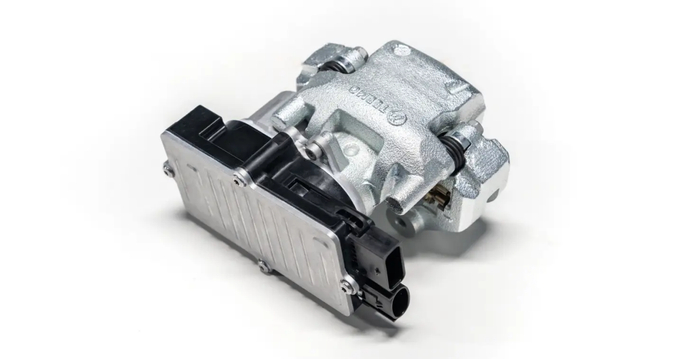
Within EMB actuators, the lead screw transmission mechanism repeatedly exhibits three categories of problems during bench durability or vehicle testing:
Low-speed “cooing” noise: during parking, garage entry, or creep-to-follow driving, 150-400 Hz low-frequency noise is clearly noticeable to users, generating concentrated complaints.
Clamping force decay: after wear between the lead screw and nut (metal-plastic or metal-metal), response slows, posing a threat to braking safety.
High/low temperature failure: grease flows away or dries out, causing lead screw seizure and motor overcurrent; mud/water intrusion leads to emulsification and accelerated wear.
Failure Mechanisms: Why Conventional Greases Cannot Handle It
The operating characteristics of EMB lead screw transmission are: high-frequency start-stop, high thrust (up to several kN), and extremely small stroke (millimeter-level reciprocation). This is completely different from conventional steering or seat lead screws. Conventional greases have several fatal weaknesses in this scenario:
First, boundary lubrication failure. Under micro-motion small-stroke conditions, the oil film struggles to form, metal surfaces make direct contact, and adhesive wear generates debris that becomes abrasive particles, accelerating wear — this is the root cause of excessive wear.
Second, stick-slip vibration. Under low-speed high-thrust conditions, the difference between static and dynamic friction coefficients is too large (delta-u > 0.08), generating self-excited vibration — that is the “cooing” sound. Audible on test benches, even more pronounced in actual vehicles.
Third, dual challenge of thermal management and compatibility. EMB actuators are located near the brake rotor, with operating temperatures reaching above 150 degC — conventional greases either flow away or carbonize; at the same time, they must coexist with FKM seals, motor bearings, and POM/PA66 plastic gears, with frequent compatibility issues.
Bench Test Data Speaks for Itself
We built a dedicated EMB actuator durability test bench, simulating actual braking conditions (1 million cycles, -40 to 150 degC, mud/water spray). VNOVO EMB Lead Screw Specialty Grease (PAO + ester synthetic base oil, composite lithium/polyurea thickener, with PTFE + extreme pressure additives) measured data:
Lead screw wear depth: <5 micrometers after 1 million cycles (conventional grease: 20-30 micrometers)
Static-dynamic friction coefficient difference: delta-u < 0.02, no stick-slip abnormal noise
High/low temperature torque stability: -40 degC starting torque increase <40%, no flow or carbonization at 150 degC
Water resistance: water washout loss <3%, no emulsification
Evaporation loss: <3% at 150 degC/24h
Material compatibility: verified with alloy steel, POM, PA66, FKM seals, and other materials — all passed compatibility testing
Selection Recommendations: Six Hard Requirements
When selecting grease for EMB lead screws, the following parameters must be specified:
Base oil: PAO/ester, pour point <-50 degC, evaporation loss <3%/150 degC/24h
Thickener: composite lithium or polyurea, drop point >280 degC
Solid lubricant: PTFE or MoS2
Static-dynamic friction difference: delta-u < 0.04
Low-temperature torque increase: <50% (at -40 degC)
Consistency: NLGI Grade 1-2
Coating quantity must be precisely controlled: 0.3-0.5 g per actuator assembly, focused on lead screw thread and nut contact surfaces.
What stage are you at?
The Suzhou conference has just concluded, but the buzz around intelligent chassis continues. What stage is your EMB project at? On the bench, are the main issues abnormal noise, wear, or high-temperature failure? Is the lead screw a ball screw or trapezoidal screw? Is the nut material metal or plastic?
Send me structural parameters and durability targets via private message, and I will provide a targeted lubrication solution.