
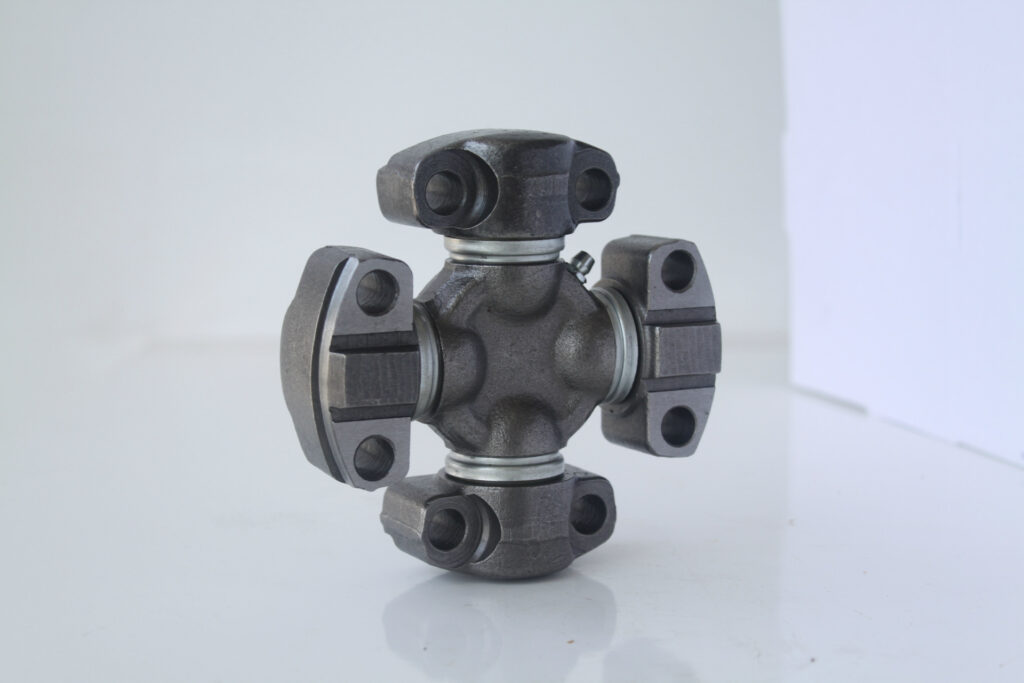
The driveshaft universal joint cross-axis bearing is a key component in the drivetrain of rear-wheel-drive or all-wheel-drive vehicles, carrying the combined loads of torque transmission, angular variation, and axial displacement. Its speed range typically falls between 3,000 and 6,000 rpm, and during vehicle start-up, cornering, and rough road passages, micro-angular oscillations occur between the cross journal and the bearing housing — this micro-movement is precisely the trigger point for NVH issues.
From a lubrication perspective, the cross-axis bearing simultaneously faces three mutually reinforcing harsh conditions: the centrifugal oil-throw effect at high speed, fretting wear (fretting) caused by micro-oscillating motion, and lubricant contamination from mud, water, and sand entering from under the chassis. Any one of these alone, an ordinary grease can handle; but the superposition of all three is the root cause of the high incidence of “clunk” noise in durability testing.
I. Failure Mechanism: Superposition of Centrifugal Oil Throw and Fretting Wear
Under high-speed operating conditions, the low-viscosity base oil components in the grease are thrown to the bearing periphery by centrifugal force. The contact zone between the needle rollers and bearing race enters an oil-starved lubrication state. At this point, the lubrication state degenerates from elastohydrodynamic lubrication to mixed or even boundary lubrication, significantly increasing the probability of direct metal surface contact.
Meanwhile, the micro-angular displacement of the cross journal during torque transmission (typically oscillating within a 0.5° to 2° range) induces fretting wear between the needle rollers and bearing race. The characteristic of fretting wear is: the extremely small oscillating slip causes repeated adhesion-tearing cycles on the contact surfaces — metal surfaces weld together and then tear apart, generating Fe₂O₃ reddish-brown wear debris that gradually accumulates in the contact zone. These debris particles are not simply physically packed inside the bearing; they act as abrasive media in secondary wear, causing the bearing clearance to progressively enlarge.
The two failure modes superimpose: centrifugal oil throw → oil-starved lubrication → fretting wear → Fe₂O₃ debris → secondary wear enlarges clearance → impact noise worsens. The wear rate exhibits nonlinear acceleration, and problems concentrate in the later stages of durability testing.
II. Bench Test Data Comparison
We conducted bench comparisons under the following conditions: 500,000 cycles, 3,000 rpm alternating, -40 to 120°C temperature cycling, and intermittent mud/water spray. Test bearings were standard cross-axis assemblies; grease fill quantity was two-thirds of the bearing cavity volume.
Item | Ordinary Lithium Grease | VNOVO Driveshaft Dedicated Grease
Wear depth (after 500k cycles) | Baseline | Reduced by ~65%
Fe₂O₃ debris generation | Significant | Noticeably reduced
Radial clearance increase | Out of spec | Within allowable range
Oil bleeding rate after temp. cycling | 3% | <1%
Grease loss after water spray | High | Significantly reduced
The difference in formulation logic: the driveshaft dedicated grease uses a complex calcium sulfonate thickening system, whose fiber structure resists destruction in centrifugal force fields and has stronger base oil retention. The base oil uses a PAO + synthetic hydrocarbon combination with 100°C kinematic viscosity controlled at 5–8 cSt, resulting in low cold-start torque and stable high-temperature oil film. Solid lubricants (PTFE/MoS₂) provide non-abrasive protective films during boundary lubrication at start-up. The combination of anti-rust and water-sensitivity inhibitors ensures structural stability even after mud/water contamination.
III. Grease Selection Recommendations
The dn value of driveshaft cross-axis bearings typically falls in the 3×10⁵ to 8×10⁵ range, approaching the selection boundary between grease and lubricating oil. On the lower dn value side (<5×10⁵), grease advantages are clear. When approaching the upper limit, matching the base oil viscosity with the bearing operating temperature requires attention.
Addressing the “rapid noise identification” requirement raised at the BAIC Technology Showcase event — the key lies in using grease formulation design to eliminate noise trigger conditions at the source, rather than passively dealing with them after bearing clearance exceeds specifications. The bench data for VNOVO driveshaft universal joint dedicated grease has validated the feasibility of this approach.
To learn more about driveshaft cross-axis bearing lubrication solutions, please provide your vehicle model and operating conditions — I will help you match the most suitable VNOVO specification.