
Do you remember the feel of the clutch pedal the day you picked up your car?
Light, smooth, crisp disengagement. When starting, your right foot gave gas, your left foot slowly lifted — and the car, as if reading your intentions, smoothly engaged power. Not a single extra vibration, not a trace of刺耳 noise. That tactile feel made you think — this car was the right choice.
And then? After 10,000–20,000 km, things start to change.
First, when you depress the clutch, a sharp ‘squeak —’ pierces your ears, high-pitched and harsh, as if a bearing is grinding dry. Then comes starting: your right foot holds steady on the gas, your left foot slowly lifts the clutch — but instead of smoothly engaging, the car ‘shudders,’ then lurches forward. You instinctively back off the gas, try again — the same result. Even more infuriating is the half-engagement condition: you are dosing the gas ever so carefully, but the car insists on lunging forward, pausing, as if fighting you.
At the dealership, the technician adjusts the clutch pedal height and applies some grease. It improves for two or three weeks. Then it’s back to the same old noise. The technician says: ‘It’s a manual transmission — after a few years they all do this, it’s normal.’
You start questioning everything: Is this really normal wear? Or a quality defect? The quote for a clutch assembly replacement is 3,000–4,000, and how long will it last after that?
Today, we will put this matter to rest completely.
Clutch noise and startup shudder are not quality defects. They are a design blind spot in the lubrication solution.
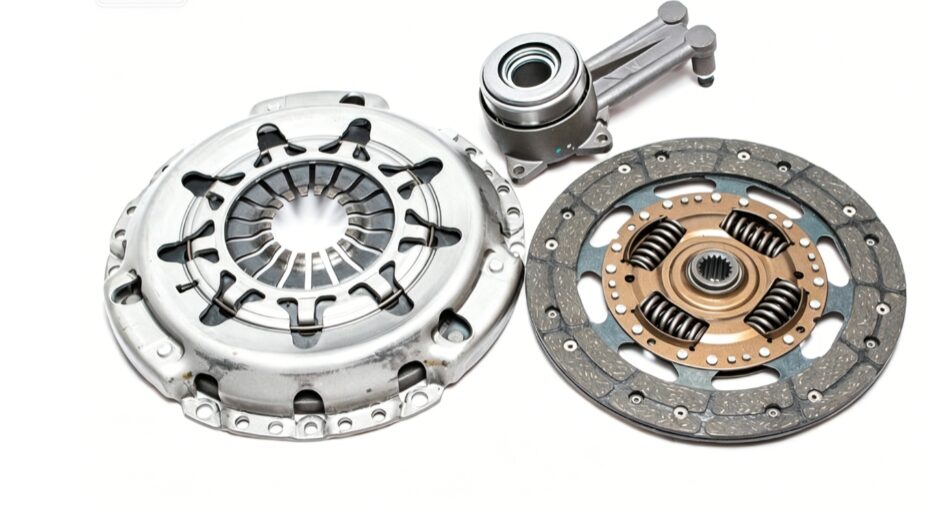
A manual transmission clutch system comprises the pressure plate assembly, driven disc, release bearing, release fork, and numerous other components — lubrication points are scattered and operating conditions vary enormously. Yet conventional lubrication approaches often use a single grease to handle everything: release bearing guide sleeve, fork pivot, torsional damper, diaphragm spring contact surface — each location has different lubrication requirements, yet they are all crammed into the same lubrication solution.
It is like asking one person to simultaneously be a sprinter, a weightlifter, and a swimmer — one event will inevitably collapse first.
The collapse process unfolds as follows:
When the release bearing slides along the guide sleeve, if the grease base oil volatilizes or anti-stick-slip additives are absent, the guide sleeve’s static friction coefficient far exceeds the kinetic friction coefficient, generating stick-slip vibration that produces a ‘squeak’ high-frequency squeal, typically in the 1–3 kHz range.
At each disengagement/engagement cycle the fork pivot承受载荷, ordinary grease extruded after metal-to-metal contact generates micro-abrasive debris. Debris oxidizes into Fe₂O₃, which is extremely hard, fills the clearance, and causes fit loosening — a ‘creak’ metallic friction sound appears; after clearance increases, ‘click’ impact sounds also occur.
If the torsional damper’s spline缺乏油干涸, slip resistance increases, and engine torque at clutch engagement releases unevenly — not rising linearly but releasing in spikes, causing the vehicle body to shudder in start-up. Metering the throttle in half-engagement is useless, because the torque curve itself is out of control.
At the pressure plate diaphragm spring contact surface, under half-engagement low-slip, high-compression-stress conditions, if the grease’s static/kinetic friction coefficient ratio is unstable, the interface generates self-excited vibration — a low-frequency ‘gurgle’ tremor sound transmits into the cabin. In severe cases it couples with the body’s structural natural frequency, causing full-vehicle resonance.
Finally, there is high temperature. The clutch engagement zone peak temperature exceeds 200°C; ordinary grease under high temperature experiences base oil oxidation, thickener carbonization, and additive failure — oil film collapses abruptly. Once lubrication fails, all the above problems simultaneously accelerate and worsen — irreversible, independent of human will.
This explains why: brand new is fine, after one year it starts squeaking, after two years there are batch complaints. Replacing the assembly improves things for two or three months, then it squeaks again. It is not that the assembly is low quality — it is that the design ceiling of the lubrication solution falls below the actual operating condition intensity requirements.
Replacing the assembly is ‘repair.’ Finding the right lubrication solution is the true ‘cure.’
VNONO clutch system dedicated grease is systematically designed around these five failure mechanisms, completely resolving issues at the formulation level.
High-drop-point base oil (≥260°C) paired with complex lithium or polyurea thickener maintains effective oil film above 200°C — no carbonization, no loss, no dripping. High-temperature failure is fundamentally solved.
Anti-stick-slip additive system reduces static-kinetic friction coefficient difference (μs–μd), eliminates stick-slip vibration, eliminates pedal ‘squeak’ squealing, and provides stable smooth pedal feel that does not drift with temperature or time.
MoS₂ solid lubricant paired with anti-micro-motion-wear additives forms a friction-reducing protective film on bearing oscillation contact surfaces, suppresses micro-abrasive debris generation, eliminates fork pivot ‘creak’ metallic sound, and prevents fit clearance expansion.
Adjustable-damping formulation provides appropriate viscous damping for the torsional damper, smooths the torque fluctuation curve, significantly improves start-up ‘shudder’ and ‘lurch’ phenomena, and makes vehicle behavior predictable under half-engagement conditions.
Friction characteristic stabilizers control the static/kinetic friction coefficient ratio within a reasonable 0.7–1.0 range, eliminating self-excited vibration at the diaphragm spring contact surface, and eliminating half-engagement ‘gurgle’ low-frequency tremor.
Additionally validated for compatibility with transmission oil, rubber dust covers, polyoxymethylene/nylon guide sleeves, and other materials — no corrosion, no swelling, no hardening, and no damage to any non-metal components.
Third-party bench test data: release bearing static-kinetic friction difference reduced to 1/3 of ordinary grease; pedal actuation force fluctuation reduced by more than 50%; fork pivot 50,000-cycle micro-motion wear test, debris generation reduced by more than 70%; damper torque fluctuation reduced by more than 60%, start-up smoothness subjective score improved by 1–2 points (10-point scale); after 200°C/168h high-temperature aging, penetration change rate less than 15%, no carbonization discoloration, no coke deposits.
What is your clutch system NVH target? Where does start-up smoothness and driving quality currently stand? To learn about VNONO clutch dedicated grease specific fitment specifications and coating process parameters, welcome to message me — I will match you with the most suitable product solution.