
By VNOVO Technical Support Team
Inside every kitchen appliance – stand mixers, food processors, blenders, coffee grinders – gears and bearings transmit motor torque to the working element. When these components operate near the food zone, any lubricant that could migrate into food must meet food-grade standards. The wrong grease causes regulatory non-compliance or product contamination. Yet selecting food-grade grease that also delivers adequate performance remains a challenge.
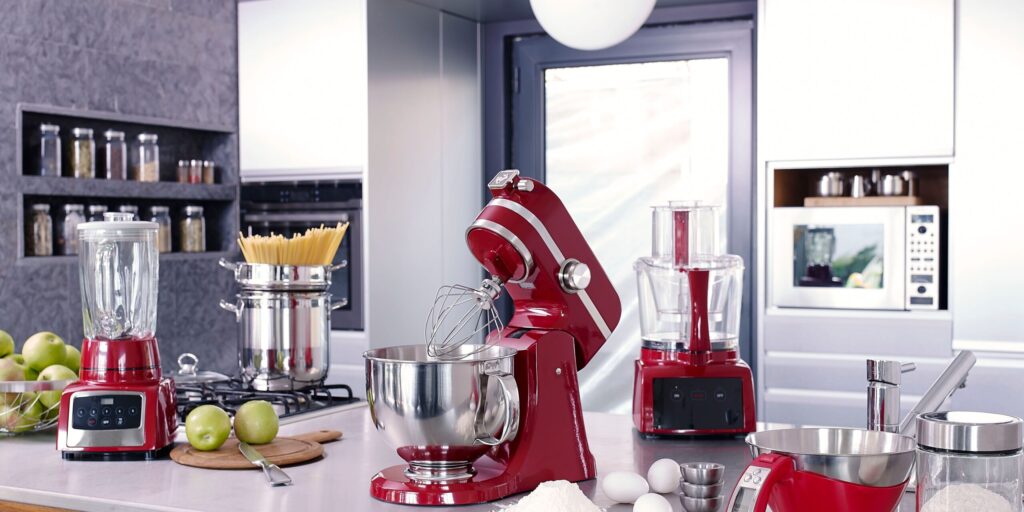
What Makes Kitchen Appliance Gear and Bearing Applications Demanding for Food-Grade Grease?
Kitchen appliances combine conditions that challenge any lubricant:
– Potential incidental food contact. Gears and bearings in food processors and mixers may be near the food zone. Any leakage could contact food. The grease must be NSF H1 registered and comply with FDA 21 CFR 178.3570.
– Frequent washdown. Components are washed with hot water, detergent, or steam. The grease must resist washout without emulsifying or dissolving.
– Wide temperature range. Coffee grinder bearings reach 80-100 °C during extended grinding; mixers warm during heavy kneading. Appliances may also be stored in cold environments.
– Mixed material interfaces. Gearboxes combine metal gears (steel, brass) with plastic gears (POM, PBT, nylon) and rubber seals. The grease must be compatible with all.
– Varying speed and load. Mixers run at multiple speeds; blenders handle ice and frozen ingredients; processors alternate between chopping and kneading.
– Noise sensitivity. Kitchen appliances operate in homes where noise is a quality factor. The grease must contribute to quiet operation.
– Sealed-for-life service. Most appliances are not re-lubricated. The grease must perform for years without hardening or separating.
– Multi-market regulatory compliance. NSF H1 (US), ISO 21469 (international), Kosher, Halal may all be required.
Why Do Kitchen Appliance Problems Persist Even When Food-Grade Grease Is Applied?
Six failure modes continue to cause issues:
1. Grease washout during cleaning. H1 greases with poor water resistance are displaced during washdown, leaving components under-lubricated.
2. Insufficient load-carrying capacity. Some H1 greases have limited additive packages (due to FDA ingredient restrictions), reducing protection under heavy loads like thick dough or frozen ingredients.
3. Incompatibility with plastic gears. Not all food-grade greases are compatible with POM, PBT, or nylon. Some cause swelling or cracking, leading to gear failure.
4. Grease migration into the food zone. Over-application or low-consistency grease migrates from the gearbox into the food chamber, contaminating food.
5. Grease hardening over time. Extended operation at elevated temperatures causes some food-grade greases to oxidize or separate, losing effectiveness.
6. Using H2 grease where H1 is required. H2 lubricants (no food contact) used where incidental contact is possible creates a compliance gap exposed by audits or contamination events.
What Properties Determine Whether a Food-Grade Grease Will Perform in Kitchen Appliances?
Key properties:
– NSF H1 registration. Minimum requirement for incidental food contact. Ingredients must comply with FDA 21 CFR 178.3570. Verify the specific product registration.
– Water resistance and washout resistance. Critical for washdown exposure (ASTM D1264).
– Load-carrying and anti-wear performance. Must protect gear teeth and bearing raceways. Some H1 greases achieve good AW performance through approved solid lubricants or synthetic base oils.
– Plastic and elastomer compatibility. Must be verified against POM, PBT, nylon, NBR, EPDM. Food-grade PAO greases generally offer broader compatibility than ester-based formulations.
– Temperature range. Must cover cold-start to elevated operating temperatures (up to 100-120 °C).
– Noise reduction. Softer grades (NLGI 1-2) often provide quieter plastic gear operation.
– Long-term stability. Must resist oxidation and separation over years of sealed service.
– Additional certifications. ISO 21469, Kosher, Halal as required by market.
How to Select the Right Food-Grade Grease for Your Kitchen Appliance
Step 1 – Identify the component and conditions:
| Component | Typical Conditions | Key Requirement |
| Plastic gear train (mixer/processor) | Moderate speed, variable load | Plastic compatibility, noise damping, H1 |
| Metal gear train (grinder/blender) | High speed, heavy load | AW/EP, high-temp stability, H1 |
| Motor bearing | High speed, sealed | Low drag, long life, H1 |
| Seal / O-ring | Food zone boundary | Elastomer compatibility, H1, water resistance |
| Output shaft bearing | Washdown exposure | Water resistance, H1, corrosion protection |
Step 2 – Match formulation: Plastic gears → food-grade PAO, NLGI 1-2, plastic-compatible. Metal gears → PAO with approved AW additives, NLGI 2. Bearings → lower viscosity, stable H1.
Step 3 – Verify certifications: NSF H1 baseline. ISO 21469, Kosher, Halal if required by market.
Quick Reference: Selection Guide
| Component / Condition | Key Properties | Direction |
| Plastic gear train | Plastic compatible, quiet, H1 | Food-grade PAO; NLGI 1-2; verify POM/PBT/nylon |
| Metal gear train | AW/EP, high-temp, H1 | PAO with approved AW; NLGI 2 |
| Motor bearing | Low drag, long life, H1 | Lower viscosity H1; sealed-for-life capable |
| Seal / O-ring | Elastomer compatible, H1, water resistant | H1 silicone or PAO; verify EPDM/NBR |
| Food-adjacent bearing | Water resistance, H1, corrosion protection | Tackifier-enhanced H1; ASTM D1264 verified |
| Multi-market compliance | NSF H1 + ISO 21469 + Kosher + Halal | Select products with all required certifications |
How VNOVO Provides Technical Support
VNOVO does not supply off-the-shelf “kitchen appliance food-grade grease” with universal claims:
Application-Oriented Selection Guidance – VNOVO reviews your appliance type, gear and bearing materials, speed and load profile, temperature range, cleaning regime, and certification requirements, mapping them against food-grade categories to recommend base oil type, viscosity, NLGI grade, and certifications.
Material Compatibility Verification – VNOVO helps assess candidates against gear polymers (POM, PBT, nylon), metals (steel, brass), seal elastomers (NBR, EPDM), and housing plastics – with emphasis on plastic gear compatibility and elastomer safety.
Scenario-Based Communication Support – VNOVO provides rationales explaining *why* a direction is suggested, what trade-offs exist (PAO = broad plastic compatibility and good low-temp vs. ester = better lubricity but potential polymer incompatibility; NLGI 1 = quieter and easier distribution vs. NLGI 2 = better stay-put and washout resistance), and what validation steps to prioritize.
Conclusion
When to use specialized food-grade grease in kitchen appliance gears and bearings
When the component has potential incidental food contact requiring NSF H1, operates in washdown conditions, uses plastic gears requiring verified compatibility, or must meet multiple market certifications (ISO 21469, Kosher, Halal).
When a general-purpose approach may suffice
When the component is fully isolated from the food zone (H2 acceptable), operates at narrow temperature range with light loads, and the target market does not require additional certifications beyond basic H1.
What VNOVO can support
1. Selection guidance – translating appliance type, materials, conditions, and certifications into food-grade formulation, base oil, viscosity, and NLGI grade
2. Material matching – assessing compatibility between candidates and all gear polymers, metals, seal elastomers, and housing plastics
3. Scenario communication – providing the technical rationale and decision framework to specify, validate, and apply the right food-grade grease for your kitchen appliance
*This article is provided for informational purposes based on publicly available industry references and established lubrication engineering principles. Specific product selection should always be verified against the appliance manufacturer’s guidelines, OEM recommendations, lubricant supplier technical data sheets, NSF registration, and material compatibility data.*