

When closing the glove box, a muffled “thud” sound is heard, the lid descends at a uniform speed and stops at the designed position. This is good tactile feel — the user is unconsciously judging the interior craftsmanship quality through this detail.
After a year or so, the same glove box opens and the lid slams down rapidly, producing a “clunk” sound from the bottom. Some users report “almost getting fingers pinched.” Upon disassembly, the damper’s internal silicone oil or damping grease has either leaked and diminished, or the viscosity has become too diluted to provide the designed damping force.
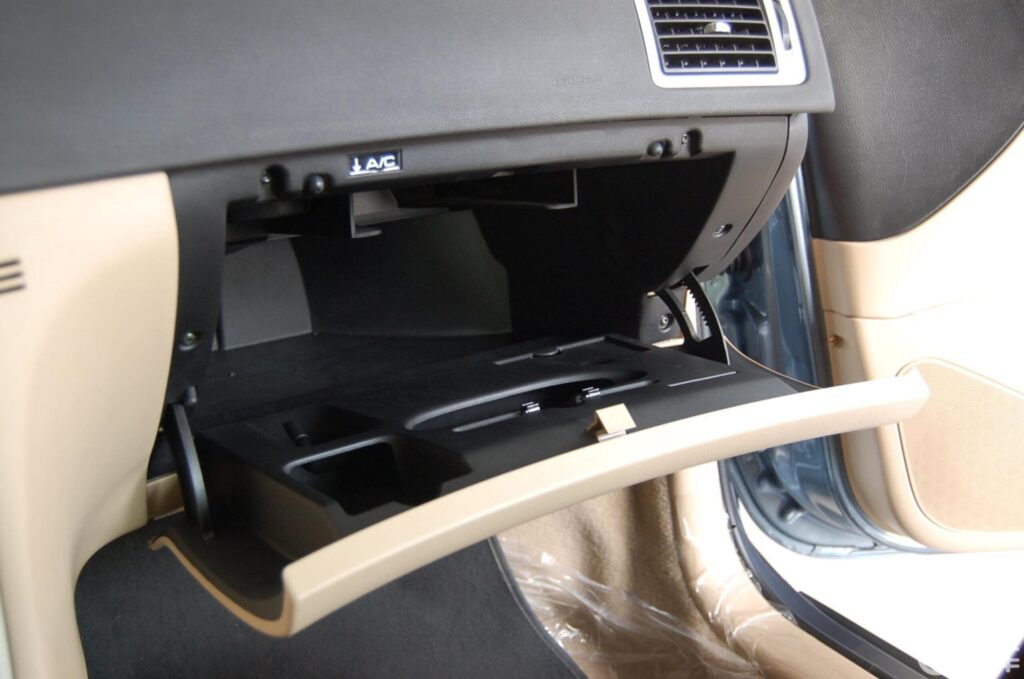
This failure process is not an accidental craftsmanship defect — it is a sign that the matching between the damping grease and the actual operating conditions has not been given sufficient attention.
The working principle of glove box dampers is straightforward: lid opening is gravity-driven, and the damper provides velocity-proportional resistance throughout the stroke, ensuring uniform lid descent. Rotary dampers use high-viscosity silicone oil or specialized damping grease inside, with fluid shear resistance generated as the rotor turns. Linear dampers use a piston moving in an oil cylinder, with fluid passing through small orifices to generate damping force. The common feature of both structures is that damping performance depends entirely on the grease’s viscosity and shear stability.
The core parameters of damping grease are threefold.
Viscosity and Viscosity Index (VI). Viscosity determines the damping torque — higher viscosity means greater resistance at the same speed. The viscosity index measures how viscosity changes with temperature. Higher VI means viscosity is less affected by temperature. The glove box operating environment spans a wide temperature range: below -20°C on winter nights, and above 85°C near the instrument panel on summer afternoons. If the grease VI is insufficient, excessive viscosity at low temperatures causes opening resistance and torque spikes; at high temperatures, viscosity drops too low and the “slam” occurs. High VI synthetic oils (PAO or modified silicone oil) combined with polyurea or complex lithium thickeners can achieve VI above 250, with viscosity variation significantly narrowed across the -40°C to 120°C range.
Shear Stability. This is the parameter most prone to problems. Ordinary silicone oils, after repeated shearing, have their molecular chains cut, causing permanent viscosity reduction. The ASTM D1831 shear stability test simulates this process: after 100,000 shear cycles, ordinary silicone oil viscosity can decrease by more than 50%, while formulations with anti-shear additives can be controlled within 15%. This means: a new car produces “thud,” and after 5,000 opens, the “thud” is still there — instead of becoming “clunk.”
Seal Compatibility. The sealing rings inside dampers are mostly NBR, HNBR, or EPDM materials; linear dampers commonly use TPE seals. After grease contacts rubber materials, incompatibility can cause seal swelling (grease absorbed by rubber, volume increases) or shrinkage (plasticizer in rubber extracted by grease) — both situations lead to leakage. The 100°C/500h immersion test is essential: hardness change <5%, volume change <10% — only then can long-term seal effectiveness be guaranteed.
One more parameter that is easily overlooked: Low Volatility. The damper cavity volume is limited and the grease quantity is small to begin with; if evaporation loss at 100°C/24h exceeds 1.5%, after one year of use the grease dries out and damping performance declines sharply.
At the structural design level, the filling process is equally critical. A filling rate of 90% to 100% ensures uniform damping throughout the full stroke; if the fill quantity is insufficient, damping at the end of the stroke is inadequate and the lid accelerates suddenly before reaching the stop — and the “slam” occurs. Customizing the damping level based on glove box weight and hinge resistance torque is key to achieving a 3 to 5 second descent time — not buying a “close enough” damping grease and pouring it in, but first calculating the mechanics, then selecting the formulation.
What is your target glove box opening/closing descent time? What is the endurance test cycle count requirement? What is the allowable damping torque decay range?
Send a private message with the damper type (rotary/linear) and structural parameters, and I can provide a damping grease selection table and filling process specifications.
[Contact] What is your target glove box opening/closing descent time? What is the endurance test cycle count requirement? What is the allowable damping torque decay range? Send a private message with the damper type (rotary/linear) and structural parameters, and I can provide a damping grease selection table and filling process specifications.