
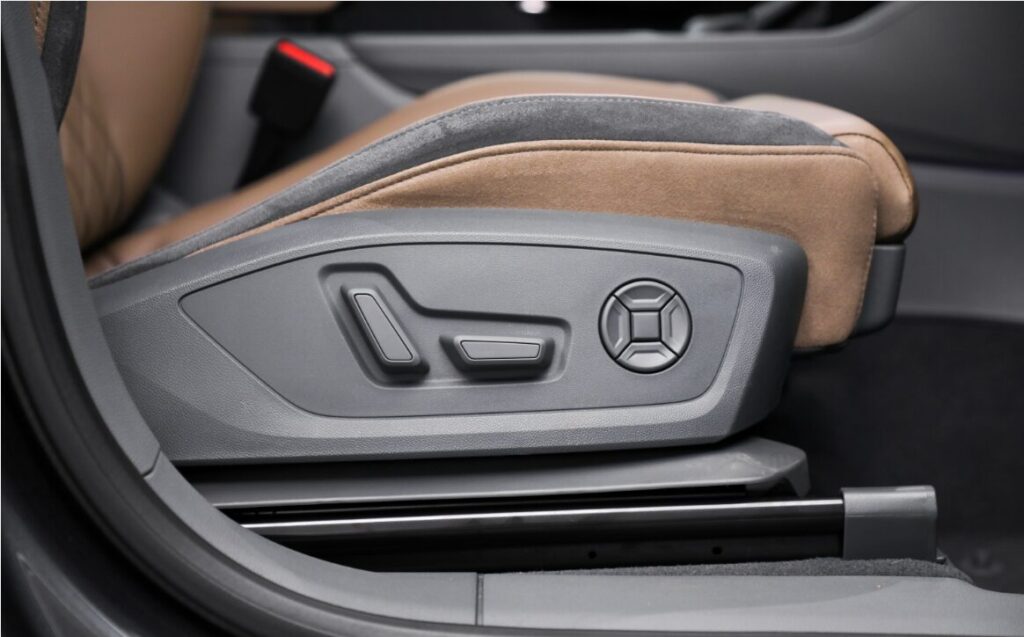
The seat recliner is the core adjustment mechanism of a vehicle seat, using a pair of bevel gears or planetary gear set to convert motor rotation into angular adjustment. It is relied upon every time you adjust the seat, every time you collide with it, and for more than a decade of use. However, there is a common misconception in the industry: lubricating grease is an “afterthought,” something to be checked only after structural design is complete, the mold is made, and the parts are assembled.
Too late. Far too late.
Lubricating grease is not an afterthought—it is a parameter that should be determined during the gear design stage. The planetary gear center distance, pressure angle, and face width; the bevel gear assembly method—all of these determine what viscosity base oil, what additive system, and what thickening agent the grease needs. Writing lubricating grease parameters into the BOM during the design stage is what enables the seat recliner to truly complete a 15,000-cycle alternating load durability test.
Backlash: Not Just Enough Clearance—It Must Accommodate Oil Film Thickness
Backlash is the most underestimated parameter in gear mesh. Designers typically leave clearance by empirical value: is 0.05 mm to 0.10 mm enough? But if the base oil viscosity of the lubricating grease is selected incorrectly, the actual oil film thickness may be only 1–3 μm, causing direct metal-to-metal contact in the high pressure zone.
Seat recliner working backlash has specific requirements: radial clearance not exceeding 1.2 mm, lateral clearance not exceeding 1.0 mm. Within this spatial constraint, the base oil viscosity of the lubricating grease must be capable of forming a valid oil film within this clearance gap. Under full-film lubrication, the oil film thickness must at least cover the tooth surface asperities; otherwise, boundary lubrication causes direct wear.
Tooth Surface Roughness and Oil Film Thickness
A commonly used evaluation metric in gear design is the specific film thickness λ (lambda): the ratio of oil film thickness to composite surface roughness.
λ < 1: boundary lubrication—asperities are in direct contact; high wear rate, essentially no lubrication.
λ = 1–3: mixed lubrication—asperities occasionally contact; this is the danger zone where wear debris is generated.
λ > 3: full-film lubrication—asperities completely separated by oil film; ideal state with minimal wear.
For seat recliner gears, the target should be λ > 3 at operating temperature. This means that in addition to the backlash calculation, the tooth surface roughness target must also be coordinated during design—the Ra value of the gear tooth surface and the oil film thickness must be matched.
Gear Material and Lubricating Grease Additive System
Seat recliner gears are predominantly made of either powder metallurgy steel or plastic (POM). For plastic gears, there is an additional critical requirement: the lubricating grease must not cause plastic swelling, embrittlement, or stress cracking.
For POM gears, the selected lubricating grease must pass the plastic-grease compatibility test—typically a 168-hour浸渍 test at rated operating temperature, with mass change, dimension change, and appearance change all within the standard range.
For steel gears, EP (extreme pressure) additives become critical. During gear meshing, the contact stress can reach 1–2 GPa, far exceeding the yield strength of the gear material. At such high contact stresses, the oil film can rupture even with high-viscosity base oil. EP additives form a chemical reaction film on the metal surface under high pressure, preventing metal-to-metal contact and adhesive wear.
Common EP additives include zinc dialkyldithiophosphate (ZDDP), sulfized fatty acids, and phosphorus-containing compounds. However, for plastic gear pairs, EP additives may have compatibility issues with the plastic—the selection must be verified through testing.
Seat Recliner Durability Target: 15,000 Cycles—Can Your Grease Make It?
The seat recliner durability target is typically 15,000 cycles or more, covering the entire vehicle service life. These 15,000 cycles are not just simple rotations—they include varying load conditions: no-load adjustment, occupied adjustment, and impact loads from collisions.
Under varying load conditions, the lubricating grease faces more complex challenges:
At high load, the oil film thins and boundary lubrication increases, requiring EP additives to protect the tooth surface.
At no-load, the grease must still maintain sufficient film thickness to prevent wear from asperity contact.
At low temperature (e.g., -30°C in winter), the grease base oil viscosity increases sharply, and the grease may not flow to the meshing zone in time, risking dry friction at the moment of start.
At high temperature (e.g., +85°C near the instrument panel in summer), the grease base oil viscosity decreases and may be squeezed out of the contact zone under load, leading to grease starvation.
Only a lubricating grease that passes comprehensive testing across these conditions can reliably complete the 15,000-cycle durability target.
Share your thoughts in the comments. Have you encountered seat recliner failures? What were the symptoms? DM me to get the “Seat Recliner Gear Lubrication Selection Manual + POM Gear Compatibility Test Report + EP Additive Selection Guide”—I have compiled them; just say if you need it.