
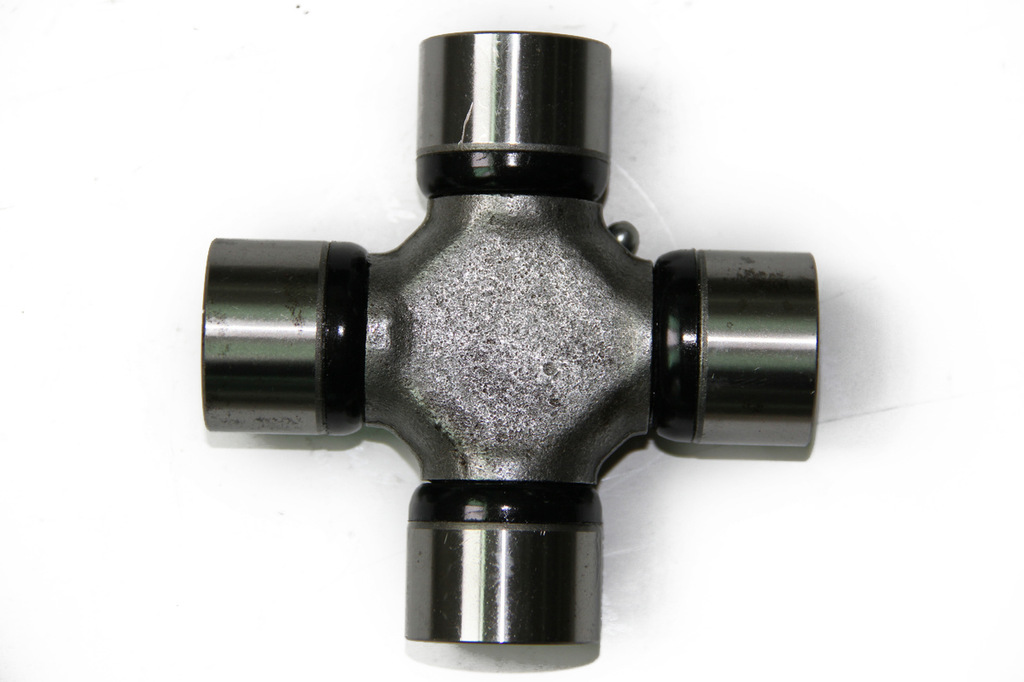
The failure mode of universal joint cross bearings in steering systems is relatively unique: unlike worm gears with their distinct gear meshing, or spline sliding joints that experience axial displacement, cross shaft operating conditions in universal joints involve small-angle high-frequency oscillation — a condition where oil film establishment is extremely difficult, and micro-motion wear is the primary failure mode. Once micro-motion wear occurs, Fe2O3 debris accumulation leads to bearing clearance increase, and NVH performance deteriorates — and this deterioration is irreversible; disassembled bearings cannot be restored through re-lubrication.
Conditions for Micro-Motion Wear to Occur
The nature of micro-motion wear is: two contacting surfaces experience small-amplitude relative motion (amplitude typically in the micron-to-millimeter range), but the amplitude is insufficient to cause adequate relative sliding across the entire contact interface to refresh the lubrication film. Under these conditions, the oil film cannot fully recover during each oscillation cycle, and oxidative wear occurs at contact surface areas with concentrated compressive stress, generating reddish-brown Fe2O3 debris.
Contact surface darkening is the first step — this signals the beginning of oxidation layer formation. If debris color is deep red and thickness is considerable, it indicates the oxidation reaction has been ongoing for some time, during which bearing clearance has expanded. If no intervention occurs at this stage, debris will continue to act as third-body abrasiles during subsequent oscillation cycles, further intensifying wear; the sound evolves from “clunk” to more pronounced metallic impact noise, and perceptible steering wheel vibration can develop.
How Bench Tests Replicate This Failure Process
5,000 cycles, -30 to 80 degC wide temperature range, load plus vibration — the significance of these test conditions is that they simulate the actual operating state of cross shafts during real steering operations: not large-angle oscillation, but repeated small-angle cross oscillation while subject to vibration loads transmitted from the chassis.
Under these conditions, the performance of ordinary grease control groups is typically: contact surface oxide layer thickness increases significantly; Fe2O3 debris quantity reaches several times the initial state; bearing clearance expands noticeably after testing.
VNOVO Steering System Specialty Grease (suitable for universal joint cross bearings) bench test data: oxide debris quantity reduced by 80%, corresponding to better bearing clearance retention capability. Wear depth 3-8 micrometers; conventional greases typically exceed 15 micrometers. This gap directly reflects in NVH indicators during the durability later stage.
Another key indicator: static-dynamic friction coefficient difference delta-u. The reason micro-motion wear generates abnormal noise is directly related to friction state changes at the contact surface during each oscillation cycle. When delta-u < 0.03, the friction state at the contact surface remains relatively stable, self-excited vibration is unlikely to occur, and abnormal noise risk is low.
Several Key Thresholds for Design Stage Selection
Micro-motion wear does not have a clear delta-u critical value like worm gear stick-slip, but several parameters should be incorporated into specifications at the design stage:
First, bench test results for debris quantity. Require suppliers to provide contact surface microscope photos and debris composition analysis reports after 5,000 cycles, as a basis for selection — not just relying on data sheets.
Second, low-temperature starting torque increase. -30 degC starting torque increase <40% (conventional grease >120%) — the significance of this data for cold-region markets is clear. At low temperatures, grease viscosity increases, micro-motion oscillation resistance rises, and the already-fragile oil film fails more easily.
Third, water washout resistance and non-emulsification performance. Steering systems are installed in the chassis area, and water wading conditions are inevitable. Grease not emulsifying or washing out under water spray is a basic guarantee for durability later stage.
Fourth, material compatibility. Universal joint cross bearings involve combinations of metal and rubber seal components; the grease base oil and additive system must be compatible with rubber materials such as EPDM, otherwise seal swelling will introduce additional oil leakage risk.
Fifth, evaporation loss. Under high-temperature conditions (after prolonged steering wheel stationary position under direct sunlight, with local temperatures in the steering gear area not being low), base oil volatilization causes grease thickening and cone penetration decrease, reducing micro-motion interface oil film thickness and accelerating wear. <2%/100 degC/24h is a reasonable upper limit.
Which supplier’s solution is your universal joint from? What are the cross shaft working angle range, oscillation frequency, and durability cycle target? Is there angular misalignment or axial displacement? Send specific parameters via private message, and we can provide a cross bearing lubrication solution selection report and coating process parameters.