
Glove box open-close cycling durability is a routine item in complete vehicle durability testing. Requirements vary greatly among OEMs: high-end models typically demand 30,000 to 50,000 failure-free cycles, while economy models require 15,000 to 20,000 cycles.
The glove box is a non-maintainable component. The grease in the damper and hinge is applied once at the factory for lifetime use — there is no window for adding grease later. If the design target is 20,000 cycles, ordinary grease can only hold up for 12,000 cycles, leaving the remaining 8,000 cycles to “hard grinding.” The demands placed on grease by glove box durability are the result of three superimposed constraints.
The target number of open/close cycles determines the mechanical lifespan of the grease. The accelerated evaporation of base oil at 80°C determines its thermal aging lifespan. And the non-maintainability of the damper means the degradation of the grease is irreversible. Each condition places its own demands on the grease, and all three take effect simultaneously within the same glove box assembly.
50,000 Open/Close Target: Grease Failure Curves Are Non-Linear, and the Failure Point Must Lie Beyond the Target
Every time the glove box is opened and closed, the grease inside the damper is sheared once, and the hinge contact area is squeezed once. The lifespan degradation of grease is not linear — the feel is normal and damping is clear for the first 5,000 cycles. After 8,000 cycles, the feel becomes “loose”. After 10,000 cycles, damping significantly degrades. And after 12,000 cycles, dry friction noises emerge from the hinge.
The steep drop-off point on this curve is the moment the grease thickener network begins to collapse. Under repeated shearing, the thickener fibers of ordinary lithium grease break, the oil separation rate rises, the grease turns from semi-solid to liquid, and damping force is lost. If the design target is 15,000 cycles, the failure point must occur after 20,000 cycles. If the target is 50,000 cycles, the failure point must be pushed beyond 60,000 cycles.
After 100,000 shears, the change in cone penetration must be controlled within 10% to ensure the thickener network does not collapse before the end of the open/close lifespan.
Accelerated Base Oil Evaporation at 80°C: Grease Lifespan Is Consumed Even When “Not Opening or Closing”
After a car sits under the summer sun, the interior temperature can reach over 80°C. The driving forces behind base oil evaporation are time and temperature, not the number of open/close cycles. When ordinary grease sits at 80°C for an extended period, the base oil continuously evaporates, and the thickener gradually dries into clumps — meaning the grease ages even if the car is rarely driven.
Open/close lifespan tests are usually run on rigs at room temperature, measuring the consumption of grease by mechanical cycles. But real-world vehicle conditions are a dual superposition of mechanical cycles and thermal aging. Ordinary grease might last 12,000 cycles on a room-temperature test rig, but after adding the high-temperature thermal aging of a single summer, its actual lifespan is further compressed.
The base oil evaporation rate must be controlled so that the evaporation loss at 100°C for 24 hours is less than 2%, effectively locking down the thermal aging timeline.
Damping Torque Degradation Is Irreversible: Grease Has No Chance to “Recover”
The glove box damper handles both lubrication and damping functions simultaneously. Once the grease degrades, the damping torque degrades unilaterally and irreversibly. The set value for damping torque is a range: if it’s too large, the box won’t open; if it’s too small, the lid drops abruptly. After grease degradation, the damping torque slips below the lower limit, the lid opening speed accelerates, and terminal impact becomes pronounced. The grease on the hinge is equally non-maintainable.
It is squeezed with every open/close, pushed aside, and after the base oil evaporates, leaving dry residue, the hinge enters dry friction, causing squeaks and expanding clearances to occur simultaneously.
The three constraints stack together: 50,000 open/close cycles require a shear-resistant thickener, 80°C high temperatures require low-volatility base oil, and non-maintainability requires the grease’s degradation curve to avoid hitting the failure threshold within its design life. A 15,000-cycle target can be covered by high-performance lithium grease, but a 50,000-cycle target strictly requires an upgrade to polyurea or complex thickener systems.
The Same Durability Cycle Differed by a Summer Between the Test Rig and the Real Car
On a room-temperature test rig, glove box durability testing runs open/close cycles at a fixed frequency. The grease operates under constant temperature and humidity, making its degradation curve predictable. In a real car, the glove box experiences alternating aging from open/close cycles, high-temperature sun exposure, and winter freezing. The high temperatures of a single summer can multiply the base oil evaporation rate by several times, while a single winter can push the grease’s low-temperature starting torque sky-high.
A 12,000-cycle failure point on a test rig might advance to 8,000 cycles when superimposed with real-world seasonal aging. It’s not that the test rig measured incorrectly; it’s that the test rig didn’t account for the compounding effects of thermal and mechanical aging.
From “15,000 Cycles” to “50,000 Cycles”: The Selection Logic Changes
Moving from economy to high-end models, the durability target moves up a tier, and the grease selection logic must follow suit.
Shear Resistance — The fiber structure of polyurea or complex thickeners is stable. Cone penetration changes are controlled within 10% after 100,000 shears, ensuring damping torque does not slip below the lower limit before the end of its life. Under the same conditions, the cone penetration change of ordinary lithium grease can exceed 30%, resulting in obvious damping loss.
Low Volatility — The evaporation rate of synthetic hydrocarbon/ester base oils is far lower than that of mineral oils. 100°C/24h evaporation loss is kept below 2%, meaning the base oil remains in the thickener after high-temperature sun exposure, preventing the grease from drying out.
High Adhesion — The hinge contact area is squeezed with every open/close cycle, so the grease must stay in place long-term. Tackifiers allow the grease to form a stable oil film at the metal-plastic interface, remaining in the contact zone even after thousands of squeezes, postponing dry friction noises and expanding clearances well beyond the design life.
The 50,000-cycle target for high-end models and the 15,000-cycle target for economy models do not place the same level of demand on grease. There is no one-grease-fits-all solution; you must match different grades of formulations to different durability targets.
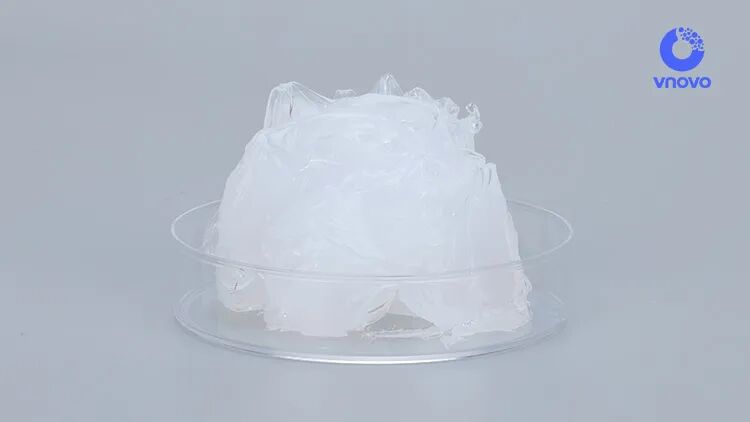
Products are already being made according to this logic, such as the VNOVO series of damping greases, which feature graded formulations for different durability targets.
Failure in glove box durability tests rarely appears early on; it usually erupts centrally in the middle-to-late stages. A normal feel in the early stages does not mean the grease’s lifespan covers the design target — it just means the failure curve hasn’t reached the steep drop-off yet. For a 15,000-cycle target, grease must maintain damping torque after 20,000 cycles. For a 50,000-cycle target, it must remain effective after 60,000 cycles.
With three constraints stacked into the same glove box assembly, the grease must simultaneously handle the thickener’s shear resistance, the base oil’s evaporation resistance, and long-term retention on the hinge.
Moving from 15,000 to 50,000 cycles raises not just the cycle count, but also the difficulty of grease selection.