
By VNOVO Technical Support Team
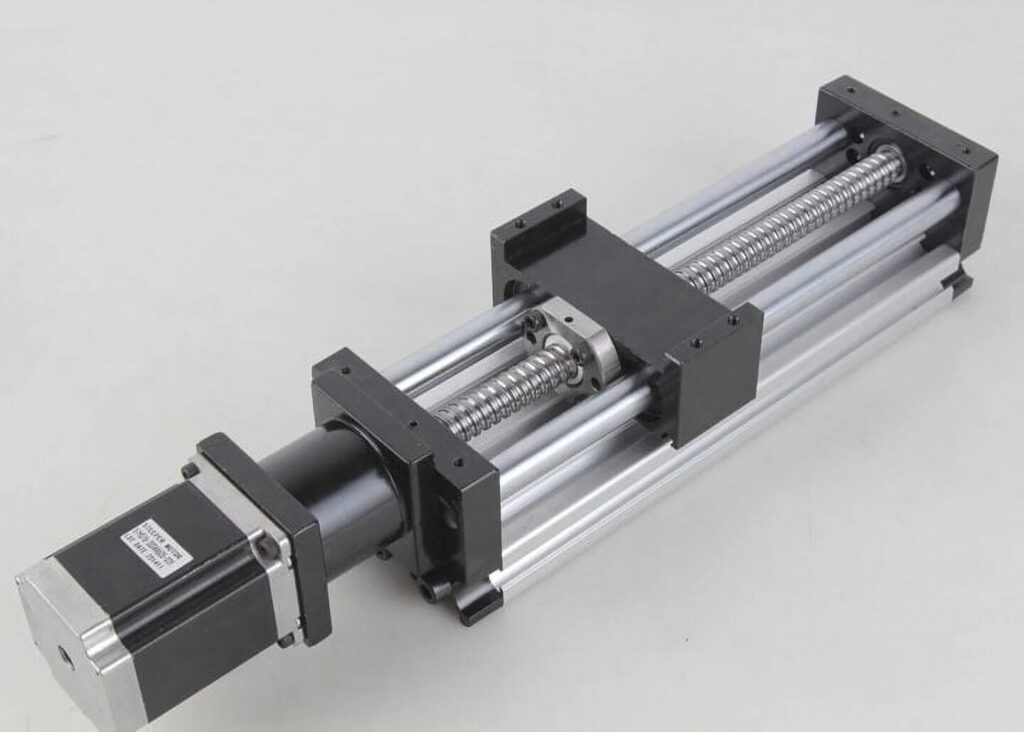
Guide rails and linear sliding systems are fundamental to the precision and reliability of CNC machine tools, injection molding machines, printing presses, and automated assembly stations. Whether the system uses rolling elements (linear ball guides) or plain sliding surfaces (box-way guides), the lubricant at the rail-to-carriage interface directly affects positioning accuracy, service life, and maintenance cost.
What Makes Industrial Guide Rail Applications Demanding for Grease?
Guide rail systems combine several challenges:
– Mixed motion regimes. Linear guides experience both rolling contact (balls/rollers) and sliding contact (end seals, scraper lips). Each regime has different lubrication needs.
– Stick-slip sensitivity. Plain sliding guides (box ways, dovetail slides) are prone to stick-slip – the carriage sticks at rest then jumps forward, causing positioning errors and surface damage. The grease must minimize static-to-dynamic friction difference.
– Fretting corrosion risk. Guide rails that experience micro-oscillation or vibration without full travel – machines in standby or axes making small corrective movements – are vulnerable to fretting corrosion (false brinelling) at rolling element contact points.
– Contamination exposure. Many guide rails operate with metal chips, coolant splash, dust, and humidity. The grease must resist coolant washout and help prevent contaminant ingress.
– Wide speed range. Some axes traverse rapidly (30+ m/min), others creep slowly for fine positioning. The grease must perform at both extremes.
– Long re-lubrication intervals. Many machines are greased on weekly or monthly schedules. The grease must maintain properties between services without hardening or migrating.
– Precision positioning requirements. Too-soft grease allows elastic deflection under load; too-stiff increases drive force requirements.
Why Do Guide Rail Lubrication Problems Persist Even When Grease Is Applied?
Six failure modes continue to cause issues:
1. Stick-slip on plain sliding guides. Greases with high static-to-dynamic friction ratio cause carriage stick-and-jump, producing positioning errors and surface scoring.
2. Fretting corrosion during standby. Machines idle under ambient vibration develop fretting marks at ball-raceway contacts if grease lacks anti-fretting properties (ASTM D4170 / D7594).
3. Coolant washout. Low-tack greases displaced by coolant spray leave rails unprotected. Washout resistance (ASTM D1264) is critical in wet environments.
4. Grease migration on vertical rails. Gravity pulls grease downward, leaving upper sections under-lubricated. Low-tack greases are especially susceptible.
5. Excessive drag at high traverse speed. Heavy-consistency greases increase carriage resistance during rapid traverse, generating heat and wasting drive energy.
6. Seal incompatibility. Some greases cause swelling or shrinkage of carriage end seals, allowing contaminant entry or grease leakage.
What Properties Determine Whether a Guide Rail Grease Will Perform?
Key properties:
– Base oil viscosity. Higher viscosity provides thicker film for heavy-load plain guides; lower viscosity reduces drag for high-speed rolling guides.
– NLGI consistency. NLGI 2 is common. Softer (NLGI 0-1) distributes into tight clearances but may leak; stiffer (NLGI 3) stays on vertical rails but resists redistribution.
– Anti-fretting performance (ASTM D4170 / D7594). Directly relevant for guides subject to micro-oscillation or standby vibration.
– Water resistance / washout (ASTM D1264). Critical for machining centers with coolant exposure.
– Tack and adhesion. Keeps grease on vertical rails and resists displacement during rapid traverse.
– Friction characteristics. Low static-to-dynamic friction ratio reduces stick-slip on plain sliding guides.
– Seal compatibility. Must be verified against end seal elastomers (typically NBR or fluoro-rubber).
How to Select the Right Grease for Your Guide Rail Application
Step 1 – Identify the guide type:
| Guide Type | Typical Application | Key Challenge |
| Linear ball guide | CNC, measuring equipment | Fretting prevention, low drag, precision |
| Linear roller guide | Heavy-load CNC, presses | Load support under heavy preload |
| Plain box-way / dovetail | Large machine tools | Stick-slip prevention, heavy-load film |
| Polymer-pad sliding guide | Packaging, automation | Polymer compatibility, low friction |
| Miniature linear guide | Semiconductor, medical | Cleanliness, low torque, small quantity |
Step 2 – Match grease to guide type:
– Rolling linear guides (ball/roller): Lower viscosity (32-100 cSt @ 40 °C), NLGI 2, fretting-tested, moderate tack. Priority: anti-fretting + low drag.
– Plain sliding guides (box ways): Higher viscosity (100-460 cSt), NLGI 2, low friction, strong AW/EP additives. Priority: stick-slip prevention + load support.
– Polymer-pad guides: Verify plastic compatibility; avoid ester-based greases if polymer sensitivity exists. Priority: material compatibility + smooth motion.
Step 3 – Account for environment: Coolant exposure requires washout resistance. Vertical installations require high tack. Cleanroom applications require low-outgassing formulations.
Quick Reference: Guide Rail Grease Selection Guide
| Guide / Application | Key Properties | Direction |
| Linear ball guide – CNC | Anti-fretting, low drag, precision | PAO-based, NLGI 2, fretting-tested (ASTM D4170) |
| Linear roller guide – heavy load | Film under preload, load retention | Higher viscosity PAO/ester; NLGI 2; EP/AW additives |
| Plain box-way / dovetail | Stick-slip prevention, heavy-load film | High viscosity (220-460 cSt); NLGI 2; low friction; AW/EP |
| Polymer-pad sliding guide | Polymer compatibility, low friction | Plastic-compatible PAO; verify pad material; NLGI 2 |
| Vertical linear guide | Tack, migration resistance | High-tack formulation; NLGI 2-3 |
| Coolant-exposed machining | Washout resistance, corrosion protection | Water-resistant (ASTM D1264); Li-complex or Ca-sulfonate; NLGI 2 |
| Miniature / cleanroom guide | Low torque, low outgassing, cleanliness | Low-viscosity PAO; NLGI 1-2; low oil separation |
How VNOVO Provides Technical Support
VNOVO does not supply off-the-shelf “guide rail grease” with universal claims:
Application-Oriented Selection Guidance – VNOVO reviews your guide type, load/speed profile, orientation, coolant exposure, and precision needs, mapping them against formulation categories to recommend base oil family, viscosity range, NLGI grade, anti-fretting level, and validation approach.
Material Compatibility Verification – VNOVO helps assess candidates against all materials: guide rail steel, rolling elements, carriage body, polymer pads, and end seal elastomers – with emphasis on seal compatibility and polymer safety.
Scenario-Based Communication Support – VNOVO provides rationales explaining *why* a direction is suggested, what trade-offs exist (higher viscosity = better load support but more drag vs. lower viscosity = less drag but thinner film; NLGI 2 = balanced retention vs. NLGI 1 = easier distribution but more leakage), and what validation steps to prioritize.
Conclusion
When to use specialized guide rail grease
When the guide requires anti-fretting protection, operates in coolant-exposed environments, needs stick-slip prevention on plain sliding surfaces, carries heavy loads requiring high-viscosity film, or has vertical/inclined orientation needing high tack.
When a general-purpose approach may suffice
When the guide operates in a clean, dry environment at moderate load and speed, uses standard horizontal orientation with regular re-lubrication, or is a non-critical axis where occasional re-greasing is acceptable.
What VNOVO can support
1. Selection guidance – translating guide type, load/speed profile, and environment into formulation direction, viscosity range, NLGI grade, and property priorities
2. Material matching – assessing compatibility between candidates and all metals, polymers, and seal elastomers in your guide assembly
3. Scenario communication – providing the technical rationale and decision framework to specify, validate, and apply the right grease for your guide rail application
*This article is provided for informational purposes based on publicly available industry references and established lubrication engineering principles. Specific product selection should always be verified against the guide manufacturer’s guidelines, OEM recommendations, lubricant supplier technical data sheets, and material compatibility data.*