

There has been significant activity in the industry recently: from May 21-23, the New Energy Vehicle Specialty Lubricants Conference was held at the Shijiazhuang International Convention and Exhibition Center. The Lanzhou Institute of Chemical Physics, Chinese Academy of Sciences, simultaneously released research progress on electrically erosion-resistant conductive greases for motor bearings. The core topic of industry discussion has shifted from “getting by” to “precision engineering” — high-speed boundary lubrication, low-viscosity traps, and electric bearing corrosion have emerged as the three major focus areas.
This aligns with our assessment of electric drive bearing greases. These three directions represent the primary root causes of electric drive bearing failure today.
There is a question I am asked frequently: Can your grease handle 30,000 rpm?
The tone when asked is skeptical. They had used greases from other suppliers before — after a few thousand hours, bearing temperatures would climb, eventually forcing a replacement. After repeating this cycle a few times, the team had developed something of a PTSD around “high-speed lubrication.”
I understand the concern. The operating conditions for new energy electric drives are genuinely demanding — 20,000 to 30,000 rpm, with centrifugal forces strong enough to tear apart the thickener structure of ordinary greases. The base oil gets thrown off first, and the remaining thickener grinds dry on the raceway. Bearing temperatures jump from 80 degC to 130 degC — hot enough to feel scalding.
This is not a grease quality issue. It is a formulation logic problem.
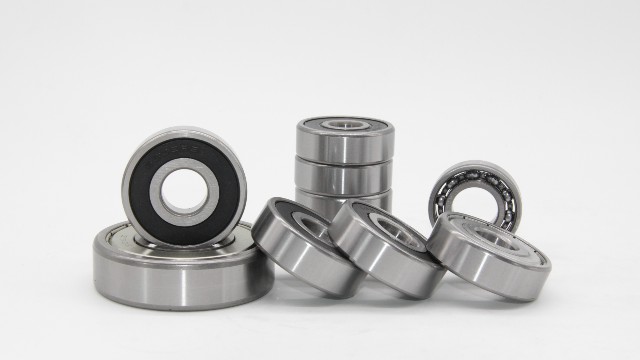
How to Achieve >95% Grease Retention at 30,000 rpm
The core of high-speed bearing lubrication is thickener structural strength. Higher viscosity is not inherently better — what matters is whether the thickener fibers can maintain their skeleton under high-shear conditions.
Conventional greases use 12-hydroxystearic acid lithium base, where thickener fibers have a layered structure prone to collapse under high shear. VNOVO uses a composite calcium sulfonate base, with much thicker and shorter thickener fibers forming a three-dimensional network structure — its shear resistance is in a completely different league.
Bench test results: running at 30,000 rpm for 1,000 hours, grease retention rate >95%, bearing temperature rise 15 degC lower than conventional greases. That 15 degC is not a marketing talking point — it is the gap between meeting and missing bearing life and durability targets.
Low-Speed High Torque: Gear Seizure Is the Real Pitfall
Climbing hills, starting off, rapid acceleration — under these conditions bearing loads spike instantly. If the oil film thickness cannot hold up, the rolling elements and raceway make direct contact, and adhesive wear, once initiated, quickly escalates into seizure.
Interestingly, there is a misconception in the industry: chasing low viscosity to reduce power loss. But low viscosity does not equal thick oil film. Under low-speed high-load conditions, the oil film is actually more prone to rupture.
VNOVO’s approach is to reduce the friction coefficient while ensuring boundary lubrication capability. Four-ball test data: friction coefficient 0.06-0.08, seizure load >1,000 N. This load margin is sufficient to handle peak loads in most electric drive operating conditions — no risk of triggering seizure every time you floor the accelerator.
Electric Corrosion: Time to Take 800V Platforms Seriously
The term “washboard ridges” should be familiar to electric drive engineers. At this Shijiazhuang conference, electrically erosion-resistant greases became one of the core topics, indicating the industry is beginning to face this issue head-on. However, many projects have only seen this in bench test reports; the actual proportion encountering it in vehicle durability testing is not low. It sometimes gets overlooked until 800V platforms are deployed, when bearing raceways gradually develop electric erosion pits and NVH complaint rates start climbing — and only then do people start tracing the cause.
The root cause: high-frequency common-mode voltage from the motor controller discharges to ground through the bearing. Current breaks down the oil film, creating microscopic fusion pits on the raceway surface; accumulated pits develop into washboard ridges. Conventional greases have a breakdown voltage around 1,000 V, and 800V platform common-mode voltage peaks easily exceed this.
VNOVO breakdown voltage exceeds 2,000 V — ample margin. Under the same electric current conditions, raceway erosion pit depth is only 1/5 that of conventional greases. This gap widens progressively over a 150,000-km durability cycle.
Wide Temperature Range: No Shortcuts
-40 degC starting torque is a hard requirement. During winter testing at dozens of degrees below zero, grease viscosity increases, motor start response degrades, and power is wasted overcoming friction. This is very apparent at the vehicle level.
Above 150 degC is the other extreme. Base oil volatilizes, grease dries out, and durability targets cannot be met. Conventional greases begin showing noticeable evaporation at 120 degC; at 150 degC/100h, evaporation loss typically exceeds 5%.
VNOVO’s wide-temperature-range solution is not achieved through a single additive — it is the result of base oil selection and formulation system working together. -40 degC starting torque <0.5 N-m; 150 degC/100h evaporation loss <3%. These numbers individually seem unremarkable, but achieving both simultaneously is not easy.
After bench testing equivalent to 150,000 km, grease consistency change <1 grade, no drying or cracking, seal ring compatibility (NBR/FKM) and motor winding material compatibility all verified.
For the project you are currently developing, which problem is the main concern for your bearings — high-speed grease throw-off, electric current, or low-temperature starting?
Industry enthusiasm was high during the Shijiazhuang exhibition. If you have technical questions, feel free to send a private message. Provide bearing type, rotational speed, voltage platform, and durability targets, and we will give you a specific lubrication solution and coating process parameters.