
One Transmission, Three Load Types
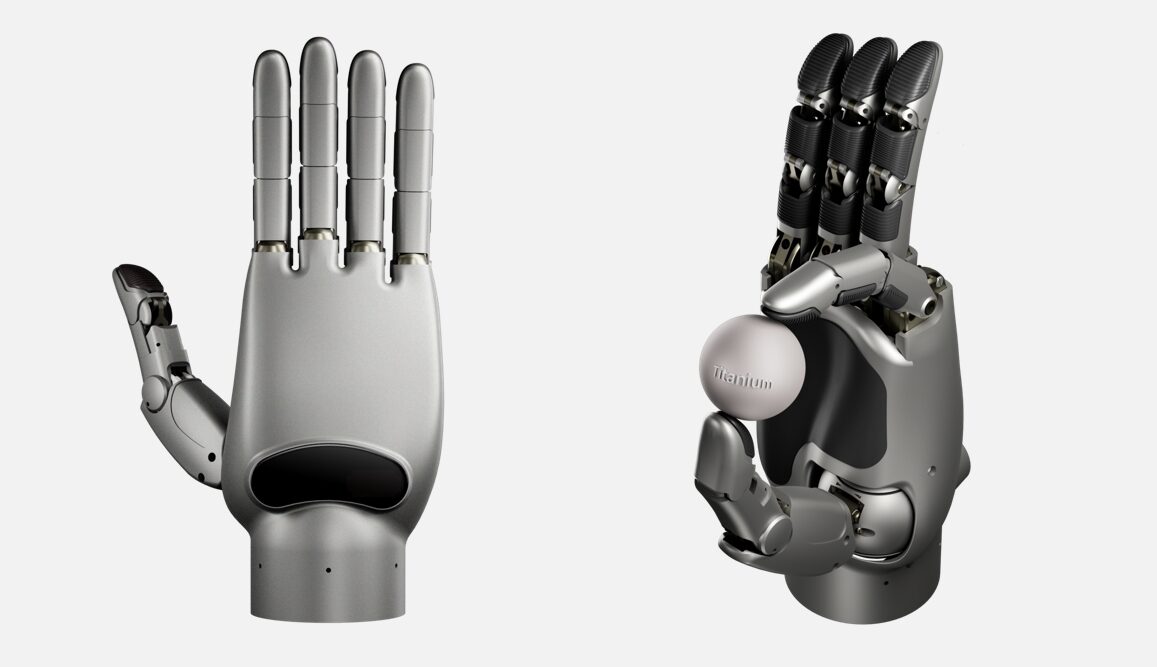
Many dexterous-hand designs use a three-stage hybrid transmission: motor, planetary gearbox, micro ball screw, tendon rope, and then the finger joint. The source points out that the screw changes direction at high frequency, which creates reverse axial impact; the tendon rope introduces elastic fluctuation, so the load on the gearbox is never steady; and the gearbox, sitting at the front of the chain, absorbs all three load types simultaneously. A grease selected for any single condition is likely to fail one of the others, which is why this transmission topology is a genuine lubrication dilemma rather than a routine selection task.
Viscosity Index as a First Differentiator
The source compares base oils: PAO (polyalphaolefin) offers a viscosity index of roughly 120-200, versus 90-100 for typical mineral oils. A higher viscosity index means the oil thins less as temperature rises and thickens less as it falls, which keeps film thickness more stable across the rapid load and temperature swings of a finger actuator. This is the first screening criterion for the combined-load case, and it explains why high-performance joint greases move away from mineral base oils.
What the Four-Ball Test Does and Does Not Show
The source warns that the four-ball EP test (per the ASTM D2596 method) measures static extreme-pressure capacity, not dynamic film response. A grease with an excellent weld-load number can still fail in a real joint because the film is sheared before it forms or because the thickener degrades under continuous motion. Laboratory EP numbers must therefore be confirmed with dynamic tests that reproduce the actual reversal rate and amplitude.
Single-Condition Greases and Their Trade-offs
The source reviews the trade-offs of single-condition formulations: a high-EP grease with a thick, adhesive structure tends to have poor shear stability and high drag; a low-viscosity grease handles high speed well but lacks impact capacity; polyurea and calcium-sulfonate greases hold high temperatures but are weak in boundary-film formation. PTFE thickeners push the upper temperature limit toward 275°C and pair well with PFPE base oils, but PTFE-thickened greases often show higher oil separation, which conflicts with cleanliness requirements.
Cross-Condition Synergy
The conclusion is a synergy profile: extreme-pressure additives for the axial impact, shear stability for the high-speed phase, low oil separation for the micro-motion phase, and a wide temperature range for the whole chain. The source reports an example formulation, labeled as a source-reported reference: a PFPE base with PTFE thickener, a four-ball weld load of 800 kg, oil separation below 10% at 100°C for 24 hours, and penetration remaining stable after 60 strokes of working. This profile should be treated as an engineering reference, not a universal solution.
Validation / Selection Conclusion
Build a test matrix that applies high-speed shear, axial impact, and micro-motion to the same sample, then measure film retention, penetration drift, and oil separation. Use viscosity index and four-ball EP numbers as screens only, and validate dynamically. The engineering reference profile of PFPE plus PTFE, with stable penetration and low oil separation, is a useful benchmark, but each transmission chain should be validated against its own duty cycle before adoption.