
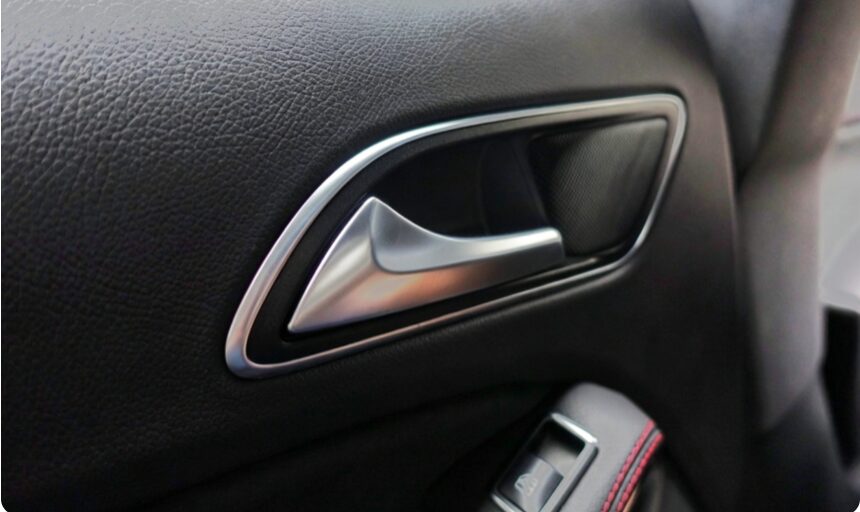
The interior door release handle, though small, has a relatively high probability of problems within the door trim panel. When the vehicle is new, pulling it feels smooth, the return is crisp, and there is little to no noise. But once the durability test—such as 50,000 cycles—or one to two years of vehicle use passes, problems emerge:
During pulling, “creak” or “squeak” noise, at approximately 200–800 Hz, sounds very cheap;
The handle return slows, sometimes fails to return fully, leaving it misaligned with the door panel;
The spindle has play, and when pulled it feels loose and wobbly.
Behind these phenomena, lubricating grease selection and application is often the biggest variable.
Upon disassembly, failing handles typically share several common characteristics: spindle wear, with increased fitting clearance; the return spring is dry and even rusty; there are scratches on the plastic sliding surface, and the lubricating grease mixed with dust has become black sludge. Conventional lubricating grease flows and migrates at high temperatures, becomes as hard as glue at low temperatures, and is essentially destroyed after a few thermal cycles.
Failure Mechanisms
Spindle area: the majority of interior release handles use metal spindles (steel or zinc alloy) with metal brackets or plastic bushings. During the durability test, the spindle oscillates repeatedly, and conventional lubricating grease is easily squeezed out of the contact zone under pressure, leading to direct metal-to-metal contact and adhesive wear. The fine wear particles (5–15 μm) mix with residual grease, becoming abrasive particles that progressively loosen the spindle. With increased clearance, the handle naturally develops play.
When the static and dynamic friction coefficients of the lubricating grease differ too much—typically Δμ > 0.08—stick-slip vibration occurs during low-speed pulling, producing that characteristic “creak” or “squeak” noise.
Spring area: the return spring works in a confined space, and if the lubricating grease selection is inappropriate, the spring coils adhere to each other due to grease viscosity changes or contamination, slowing the return or preventing it entirely.
Plastic sliding surface: scratches are generated because the plastic sliding surface lacks sufficient lubrication, and dust entering the friction zone accelerates wear.
Lubrication Solution Recommendations
For the spindle: use a gear grease with EP additives, with base oil viscosity of 150–320 cSt at 40°C. The EP additives form a reaction film on the metal surface under high pressure, preventing adhesive wear. The thickener should be urea-based for superior high-temperature stability.
For the return spring: apply a small amount of light machine oil or low-viscosity lubricating grease on the spring coils, ensuring each coil is isolated. Do not use high-viscosity grease, as it will cause coil adhesion.
For the plastic sliding surface: use a dedicated plastic-compatible lubricating grease, with base oil viscosity of 32–68 cSt at 40°C, and confirm plastic-grease compatibility through testing.
Anti-Corrosion Design for Spring
The return spring is typically made of music wire or stainless steel, but in high-humidity environments (such as coastal areas), spring corrosion can still occur. It is recommended to apply a thin layer of rust-preventive lubricating grease on the spring surface during assembly, which simultaneously provides lubrication and corrosion protection.
Also, control the lubricant application amount—the coating should be thin and uniform, avoiding pooling that could attract dust.
Have you encountered interior door release handle failures? Share your experience in the comments. DM me to get the “Interior Door Release Handle Lubrication Solution + Spring Corrosion Protection Design + Δμ Testing Method”—I have compiled them; just say if you need it.