
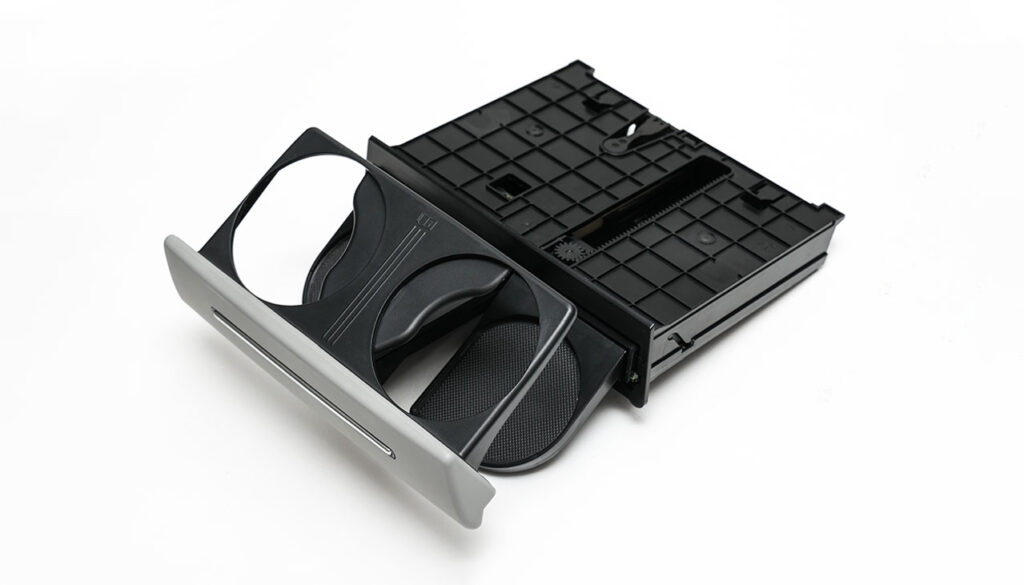
The cup holder clamping mechanism is one of the most frequently operated mechanisms in the interior system. After the durability test runs 3,000 cycles (approximately equivalent to 1–2 years of normal user use), the tactile feel degrades from ‘smooth’ to ‘rough,’ and the sound changes from ‘low thud’ to ‘squeak-creak’ — this degradation is not random; there is a complete failure chain that can be traced.
Design Baseline: Reference Condition
At the start of bench testing — 0 cycles — the cup holder clamping mechanism should meet three basic requirements: the clamping arm extends and retracts smoothly without binding or step-off; cup insertion/removal force is moderate and return is crisp; operation is silent or produces only a low spring sound with no abnormal noise.
These three criteria form the comparison baseline for durability testing. After 3,000 cycles, the baseline is essentially gone.
Typical Failures After 3,000 Cycles
At this stage of durability testing, the cup holder clamping mechanism typically exhibits the following:
Clamping arm extension/retraction binds; cup insertion resistance varies erratically and tactile feel is unstable. On the bench, the actuation force curve shows obvious peak skipping, with fluctuation amplitude exceeding 20% of the initial state.
Slow or incomplete return. After removing the cup, the clamping arm should spring back to its initial position, but after spring lubrication fails, return force decays, and stroke loss can reach 1–2 mm, causing the cup to sit higher or lower than intended.
Operational noise, frequency concentrated in 200–800 Hz, manifesting as ‘squeak’ or ‘creak’ sounds. Semi-anechoic chamber bench measurements typically show noise increase exceeding 3 dB(A) over the original baseline.
More seriously, the cup may shake during driving. After clamping force decays, the cup cannot be reliably secured; under road excitation it impacts the cup holder wall producing a ‘tapping’ sound that transmits into the cabin and triggers customer complaints.
Disassembly Analysis: Failure Mechanism Chain
Disassembly of failed cup holders reveals damage concentrated at three levels.
Sliding pair stick-slip and wear. The clamping arm is typically made of POM or ABS; the guide rail is metal or plastic. Interior cup holders operate in an open environment — dust enters with air flow and deposits on sliding surfaces. Ordinary grease (e.g., silicone oil) mixed with dust forms abrasive paste, causing the static-kinetic friction coefficient difference to expand from an initial 0.06–0.09 to above 0.40. Stick-slip vibration produces ‘squeak-creak’ noise (200–800 Hz); abrasive wear on sliding surfaces generates axial scratches; resistance further increases — a positive feedback loop forms.
Spring mechanism failure. The return spring is under long-term compressive/tensile alternating loads; contact stress concentrates at spring coil interfaces. Ordinary grease is squeezed out between coils, creating dry friction that generates high-frequency frictional noise; spring surface rusting further reduces return force. On bench testing, return stroke loss can be observed developing from 0 mm to 1–2 mm, corresponding to visible rust spots on the spring surface or dried grease residue.
Gear/rack wear (applicable to cup holders with gear drive). Small-module plastic gears (POM) mesh with metal or plastic racks. After dust intrusion, three-body abrasive wear occurs. Within 3,000 cycles, backlash can expand from an initial 0.03–0.05 mm to 0.15–0.20 mm, causing asynchronous clamping action, loose tactile feel, and increased noise.
Environmental Acceleration Factors
The above failure chain has several accelerating factors.
High temperature. In-vehicle summer temperatures can exceed 80°C; low-drop-point greases soften and flow, leaving sliding surfaces, and lubrication effectiveness decays rapidly.
Low temperature. At –20°C in winter, grease viscosity increases, starting torque rises, and tactile feel changes from ‘smooth’ to ‘stiff.’
Liquid spills. Beverage spills cause grease emulsification or direct washout of sliding surfaces, corroding metal components and accelerating spring rusting.
Bench Comparison: Impact of Lubrication Solutions on Failure Rate
We compared several lubrication solutions on the bench — differences are mainly reflected in sliding surface wear rate and tactile feel retention time.
Under simulated dust environment, ordinary silicone grease after 3,000 cycles: static-kinetic friction coefficient difference expands to above 0.40; sliding surfaces show obvious scratches; actuation force curve exhibits peak skipping; noise increase generally exceeds 5 dB(A).
VNOVO cup holder mechanism dedicated grease measured data (3,000 cycles, simulated dust environment): sliding surface friction coefficient maintained at 0.06–0.09; dust-resistant, dry-surface adhesion, powder does not adhere, no sludge formation; 100°C/24h evaporation loss <2%, long-term no drying; compatible with POM, ABS, PA66, TPE, metal springs, etc., no swelling or corrosion.
Friction coefficient data comparison: dedicated grease 0.06–0.09 vs. ordinary silicone grease 0.15–0.25 (rising to 0.40+ after dust contamination). This gap is not significant within the first 1,000 cycles; it expands dramatically between 2,000 and 3,000 cycles.
Conclusion
The root cause of interior quality degradation is often not in styling but in details. The cup holder clamping mechanism’s tactile feel is a touchpoint the user experiences daily. Lubrication-driven binding, noise, and poor return cause a major perceived quality drop across the entire vehicle.
The three lubrication failure nodes — sliding pair, spring, and gear — impose three core requirements on the grease: dust resistance (prevents abrasive paste formation), compatibility with POM/ABS/TPE materials (prevents swelling), and low static-kinetic friction coefficient difference (prevents stick-slip).
Discussion: Durability Test Index Settings
I would like to exchange practical insights with peers: when setting up cup holder clamping mechanism durability tests, what levels are typically set for the following indicators?
Clamping force decay upper limit: ≤20%?
Return stroke loss: ≤1 mm?
Operational noise increase upper limit: <3 dB(A)?
If you can provide the clamping mechanism structure type (sliding type/gear-rack type) and specific durability targets, I can deliver a matching lubrication solution selection table and coating process parameters. Message me for details.