
Fretting wear is the most easily overlooked failure mode in micro planetary reducers — and the most insidious.
It occurs at contact interfaces with very small slip amplitudes (typically 1–100 μm), where two surfaces undergo repeated micro-slip under load. Unlike ordinary wear, fretting damage nucleates and grows even when overall relative motion seems negligible.
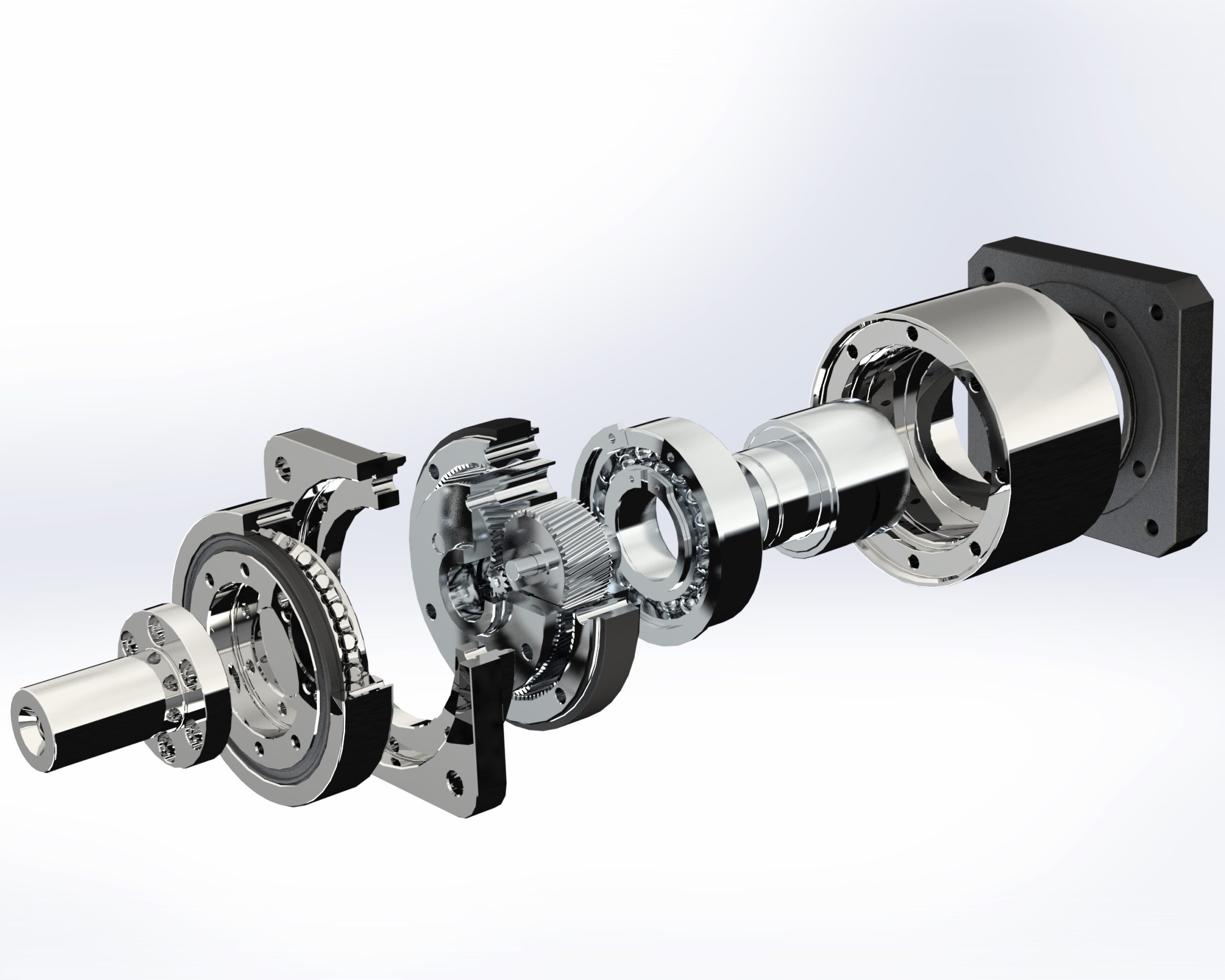
In micro planetary reducers, fretting typically appears at gear tooth roots, bearing raceway interfaces, and spline connections.
Why Micro Reducers Are Particularly Vulnerable
Extremely small contact dimensions amplify everything. In macro machinery, fretting might require years to cause failure. In micro planetary reducers with contact dimensions measured in millimeters, the same fretting mechanisms can cause failure in hundreds of hours.
Minimal lubrication film thickness. Oil film in micro reducers may be only 0.5–2 μm — comparable to the slip amplitude during fretting. When oil film thickness approaches surface roughness, boundary lubrication regime dominates, and fretting accelerates dramatically.
Limited heat dissipation. Compact structures cannot dissipate heat effectively. Fretting generates localized heat that accelerates oxidation and adhesive wear locally — a self-amplifying cycle.
Fretting Wear Stages
Stage 1: Initiation. Surface oxide films (typically 1–3 nm on steel) break under repeated micro-slip. Fresh metal exposed, immediately oxidizes. This is the initiation of adhesive wear.
Stage 2: Material transfer. Adhesive junctions form and tear repeatedly. Material from one surface transfers to the other, creating wear particles. Particles are typically 1–10 μm — in micro reducer scale, these are significant abrasives.
Stage 3: Third-body abrasion. Particles become trapped between contact surfaces. Hard particles (oxides, work-hardened metal) act as abrasives, accelerating wear rate 5–10× compared to Stage 2. This is the transition from mild to severe fretting.
Stage 4: Fatigue cracking. Under combined thermal and mechanical loading from Stage 3, subsurface fatigue cracks nucleate. These cracks propagate parallel to the surface initially (horizontal cracking), then turn perpendicular under bulk stress, causing macroscopic spalling.
How Grease Addresses Fretting
High-viscosity index base oil ensures oil film remains sufficient even at elevated temperature from fretting heating.
PTFE or MoS₂ solid lubricants form transfer films that reduce friction coefficient during micro-slip, reducing adhesion and material transfer.
EP additives form protective films that resist oxidation and provide corrosion protection for fresh metal surfaces exposed during fretting.
For micro planetary reducers in dexterous hands, grease with dedicated fretting-wear protection should be considered — particularly for joints that experience vibration loading alongside motion.
Have you observed fretting wear patterns in disassembled micro planetary reducers? What did the damage look like? Share in the comments.