
Veteran technicians in injection molding or rubber vulcanization know the despair well: the mold is polished bright and clean, the process parameters haven’t changed, but the manufactured products — especially transparent PC parts or white exterior pieces — always look as if covered in a layer of dust, or simply seep unidentified oil spots. Quality control holds a magnifying glass to assign blame, the workshop director slams the table demanding reasons, and the scapegoat is always “the mold wasn’t washed clean.”
But the truth is often much harsher than imagined — the real “culprit” has been hiding inside the barrel of the injection molding machine all along: that layer of ordinary grease you paid good money for, thinking it was “high-temperature resistant.”
I. The Invisible “Slow Poison”: High-Temperature Coking and Oil Migration
The working environment of a mold is extremely harsh, with the temperature around the mold cavity long maintained at 150°C-220°C. At this temperature, the internal structure of ordinary grease collapses rapidly. The base oil evaporates violently, the thickener oxidizes at an accelerated pace, and finally, a stubborn, hard, coked residue resembling burnt syrup is left around the gaps of the mold’s ejector pins, guide pillars, sliders, and even the parting lines.
This coked residue is the “root of all evil”:
For the End User (Product Factory): Flaking coked residue mixes into the raw material, directly causing black spots and oil streaks on the product. The yield rate drops off a cliff. Even more terrifyingly, it can block the mold’s cooling water channels, leading to localized overheating, which further exacerbates sink marks and deformation on the products.
For the Manufacturer (Mold Factory): The coked residue is extremely hard and acts as a “lapping paste” when the mold closes, accelerating the wear of guide bushes and cores. The originally precise mold clearances are forced open, flash (burrs) gets thicker and thicker, the repair frequency jumps from once every three months to once every half month, and the mold’s lifespan is cut in half.
For the Distributor: Customers complain about dirty products and return them. You run yourself ragged delivering cleaning agents and swapping to high-priced imported oils, but it only ever treats the symptoms, never the root cause. Oil consumption is high, customer stickiness is low, and you are forever trapped in the quagmire of price wars. Even more insidious is “oil migration.” At high temperatures, the viscosity of ordinary grease plummets.
It seeps into the mold cavity along the mold gaps like water, vaporizes at high temperatures, and forms an extremely thin “oil mist film” on the mold surface. This contamination is invisible to the naked eye, but the moment a release agent is sprayed or high-pressure air is blown, the oil stain instantly manifests, directly causing shrinkage cavities or poor adhesion in subsequent painting and electroplating processes.
II. The Fatal Misconception: Cleaning ≠ Solving the Problem
The response strategy for many factories is: stop the machine → spray cleaner → polish → restart the machine. This routine is repeated 2-3 times a week. Every stop loses production capacity; the cleaner corrodes the mold surface plating; and polishing damages precision. The money you spend on cleaning has long surpassed the cost of buying a single can of good grease. The root problem lies here: the high-temperature anti-coking and anti-oxidation properties of ordinary grease are sub-standard at the formulation level.
III. The Way Out: How VNOVO Uses “Hard Chemical Power” to End the Oil Stain Nightmare
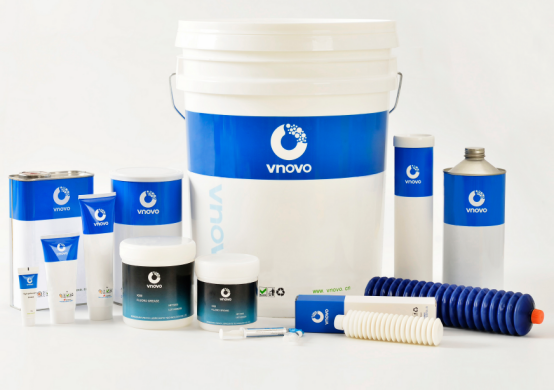
To cure the problem fundamentally, the scalpel must be taken to the base oil and thickener of the grease. VNOVO’s dedicated high-temperature Perfluoropolyether (PFPE) grease for molds is precisely a “dimension reduction strike” solution designed for this extreme operating condition.
1. Absolutely No Coking: Cutting the “Oil Sludge” Generation Chain from the Root. VNOVO uses a PFPE base oil. The molecular structure of this oil contains no carbon-hydrogen bonds. It remains chemically inert even at a high temperature of 300°C, and will absolutely not oxidize to generate hard gums or asphaltic substances.
Paired with ultra-fine PTFE (Polytetrafluoroethylene) powder as the thickener, even if the base oil slowly volatilizes under extreme high temperatures, all that remains is loose, soft, dry PTFE powder that falls off with a gentle wipe, never forming hard coke that scratches the mold.
2. Zero Dripping, Zero Migration: Safeguarding the Cleanliness of Every Shot. VNOVO’s “shear-thickening” technology ensures the grease possesses extremely high structural strength at high temperatures. When the temperature rises to 200°C, it will not thin out into oil drops like ordinary lithium grease, but instead maintains a paste-like adherence to the friction points.
It effectively eliminates the risk of lubricating oil seeping into the mold cavity along the guide pillars, keeping the mold surface “dry and clean” at all times. For optical lenses and medical consumable molds with stringent requirements, this is the final line of defense to guarantee cleanliness.
3. Extreme Pressure Anti-Wear and Long-Lasting Protection: Extending the Mold’s “Life Expectancy.” While solving contamination, VNOVO adds special anti-wear additives to form a tough physical adsorption film on the metal surface. Measured data shows that under the same load, the wear amount on guide bushes using VNOVO is only 1/5 that of ordinary high-temperature grease. This means the mold won’t need a major overhaul for three years, saving maintenance costs and downtime losses.
Summary:
Mold oil stains have never been a surface issue that can be solved with a “quick wipe”. They are a systemic failure triggered by the grease’s “betrayal” at high temperatures — coking wears down the mold, oil stains scrap the products, and downtime devours profits. Every link is eating away at your competitiveness.
The value of VNOVO PFPE grease lies not in “lubricating,” but in “not causing trouble” — no coking, no dripping, no migration. It allows the mold to always maintain a clean state at high temperatures, returning the yield rate and equipment efficiency to the levels they were meant to be.
For the end user, it’s a worry-free, effort-saving profit guarantee. For the mold factory, it’s a quality endorsement for delivery confidence. For the distributor, it’s a long-term business that breaks free from price wars to build a technical moat.
Choosing the right grease means choosing the right partner. VNOVO, running alongside you to win this battle for “cleanliness.”