
In new vehicle condition, the in-vehicle screen swivel mechanism feels like this: the tilt damping is uniform, the screen stays wherever you position it, and it does not drift on its own when the vehicle bumps; there is no “creak” or “clack” noise during operation; if it is electric, the speed is smooth and the motor does not vibrate. The durability target is generally 5,000 to 10,000 cycles.
After 3,000 to 5,000 cycles, problems begin to emerge. The tilt becomes rough and stuttering, with significantly degraded damping feel—the screen drifts downward on its own while driving, or shakes at every bump. Noise also appears, at a frequency of approximately 200–600 Hz, sounding like “creak” or “clack.” The electric version also exhibits inconsistent speed and increased motor noise.
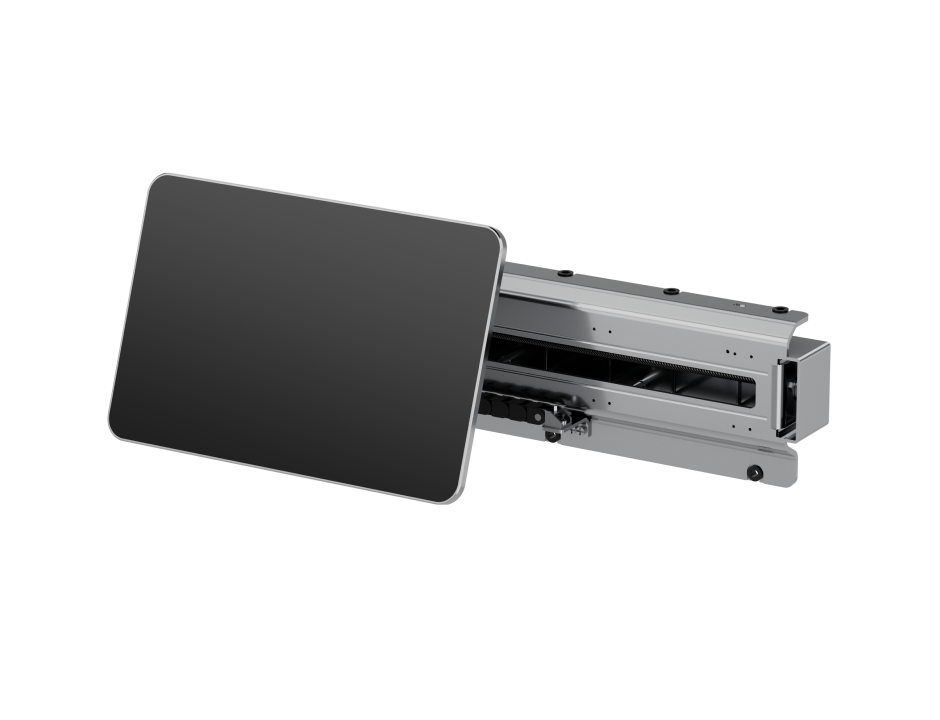
Upon disassembly, the typical failure finding is: plastic gear (POM or PA66) tooth surface wear, with backlash expanding from 0.05 mm on new parts to 0.15–0.25 mm; scratches on the spindle; the lubricating grease is either dried out and turned black or has already been lost. After gear mesh precision degrades, an obvious backlash (lost motion) can be felt during rotation, the feel worsens, and NVH deteriorates.
Why Do These Situations Occur?
Plastic gears have no self-lubricating capability and rely entirely on the lubricating grease to withstand wear. Conventional lubricating grease is easily squeezed out of the contact zone under the high temperature and high pressure of gear meshing, and the tooth surface begins adhesive wear. The wear debris (5–15 μm) generated mixes into the lubricating grease, turning the lubricant into abrasive particles. This initiates three-body abrasive wear, gradually deforming the tooth profile and increasing backlash. Once backlash exceeds 0.2 mm, the screen swivel has obvious lost motion, the feel deteriorates, and NVH worsens.
Damping degradation has two main mechanisms:
Grease loss: under thermal cycling, the lubricating grease gradually migrates and is squeezed out of the damping chamber, reducing the damping medium quantity.
Grease thinning: under high temperature, the base oil viscosity of the lubricating grease decreases, and under long-term shear, the thickener structure is damaged, leading to permanent viscosity loss.
Lubrication Solution Recommendations
For plastic gear pairs, it is recommended to use a specialized gear grease with the following characteristics:
Base oil viscosity: PAO or ester-based synthetic oil with a viscosity of 100–220 cSt at 40°C; the viscosity at 100°C should maintain above 15 cSt to ensure adequate film thickness at operating temperature.
Thickener: urea-based thickener is preferred, with superior high-temperature stability and shear stability compared to lithium-based thickeners.
Additive: must include anti-oxidants, anti-wear additives, and EP additives suitable for plastic gears. For POM gears, verify compatibility with the plastic-grease compatibility test.
For the damping mechanism: use high-viscosity silicone oil or specialized damping grease, and confirm the viscosity retention after thermal aging.
NVH Control Points for Screen Swivel Mechanisms
Since this mechanism is located inside the cabin and close to the driver’s ear, its NVH performance has a significant impact on the user experience. Key control points include:
Gear mesh noise: the primary noise source, which must be controlled through proper grease selection and sufficient backlash.
Motor NVH: select low-noise motors and use vibration-damping motor mounts.
Resonance frequency: avoid the natural frequency coinciding with vehicle vibration frequencies through structural design.
Have you encountered screen swivel mechanism failures? Share your experience in the comments. DM me to get the “Screen Swivel Mechanism Lubrication Solution + POM Gear Compatibility Report + NVH Test Standard Comparison Table”—I have compiled them; just say if you need it.